
Every Singapore-incorporated company must file its financial statements with ACRA unless an exemption applies, and most of those that file must do so in XBRL rather than as a PDF. The two exemptions that matter to private companies are the dormant relevant company and the solvent exempt private company.
Raffles Corporate Services works with a panel of experienced Singapore law firms who offer cost-effective and efficient legal service and advice. This article is general information only and is not legal advice.
Almost every director we speak to assumes the question is technical. It is not. The technical part, the tagging, is a job you can hand to software or to your corporate secretary. The part that actually decides your year end workload is a set of eligibility questions answered long before anybody opens a tool: is the company dormant, is it an exempt private company, is it solvent, is it small, and is it publicly accountable.
Get those five answers right and the filing follows automatically. Get them wrong and you either do far more work than the law asks of you, or you file the wrong thing and get sent back.
What XBRL actually is, in one paragraph
XBRL stands for eXtensible Business Reporting Language. It is not a different set of accounts. It is the same financial statements your directors have already approved, expressed as structured, machine readable data so that each figure carries a label from a common dictionary. ACRA publishes that dictionary as its taxonomy, and the current one is the ACRA Taxonomy 2026, which applies to filings made from 25 February 2026 onwards.
The practical consequence is that your revenue figure is not just a number on page three of a PDF. It is a tagged data point that can be read, compared and analysed without a human opening the document. That is why the regulator wants it, and it is also why filing is fussier than uploading a PDF: a machine is checking your file before a person ever sees it.
Who does not have to file financial statements at all
Two exemptions do the heavy lifting. If you fall into either, the XBRL question never arises.
The dormant relevant company
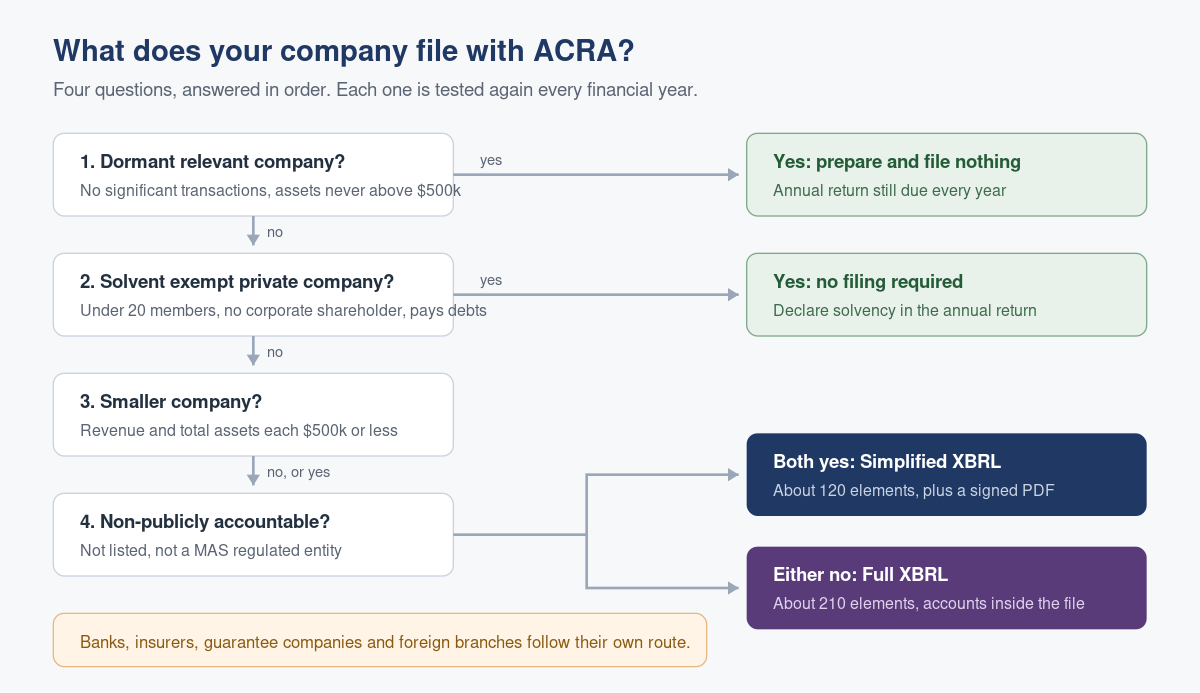
A company that satisfies the conditions in section 201A of the Companies Act 1967 is relieved from preparing financial statements at all, which necessarily relieves it from filing them. The conditions run together, so all of them must be met:
- The company has been dormant from the time of its formation, or from the end of the previous financial year. Dormant here means no significant accounting transaction during the financial year, and an accounting transaction is one that affects the financial statements.
- The company passes the substantial assets test. Its total assets must not have exceeded $500,000 at any point during the financial year. For a parent company, the test is applied to the consolidated total assets of the group.
- The company is neither a listed company nor a subsidiary of one.
Note the phrase “at any time during the financial year”. This is not a year end snapshot. A company that held $700,000 in a bank account in March and distributed it in November has failed the test for that year, even though its balance sheet at the year end is small.
The solvent exempt private company
An exempt private company, or EPC, is a private company with fewer than 20 members in which no corporation holds a beneficial interest in the shares, directly or indirectly. A government owned private company declared an EPC by Gazette also qualifies. That covers a very large share of ordinary Singapore SMEs, and it stops covering you the moment a holding company or a corporate investor appears on your register of members.
An EPC that is solvent, meaning it can meet its debts as and when they fall due, does not have to file its financial statements. What it must do instead is make an online declaration of solvency when it files its annual return. That declaration is a statement by the company, and it is not a formality.
An EPC may still choose to file voluntarily, and some do because a bank, a fund or a prospective buyer wants the accounts on public record.
The trap is the insolvent EPC. Solvency is not a permanent status. An EPC that cannot pay its debts as they fall due loses the filing exemption for that year and must file, in XBRL, like everybody else.
If you do have to file, what exactly do you file?
The deliverable depends on what kind of company you are and how big your operations are.
| Your company | What you file with the annual return |
|---|---|
| Smaller and non-publicly accountable company, including an insolvent EPC of that size | Simplified XBRL financial statements, plus a PDF of the financial statements authorised by the directors |
| Any other Singapore-incorporated company required to file, including insolvent EPCs that are not small or not non-publicly accountable | Full XBRL financial statements |
| Bank, finance or insurance company regulated by MAS | XBRL FSH (Banks) or XBRL FSH (Insurance), plus a PDF of the authorised financial statements |
| Company limited by guarantee | PDF of the authorised financial statements only |
| Company with ACRA approval to use accounting standards other than the prescribed ones | PDF of the authorised financial statements only |
| Solvent EPC filing voluntarily | Optional, either XBRL in the template matching its size, or a PDF of the authorised financial statements |
| Foreign company with a Singapore branch | PDF of the authorised financial statements only |
Two points that are easy to miss. First, “companies using other accounting standards” does not mean companies applying International Financial Reporting Standards while also stating compliance with SFRS(I). Those companies are in the ordinary XBRL population. Second, a company limited by guarantee is out of XBRL entirely, which is a genuine relief for the charities and trade associations that use that form.
The two size tests that decide Full versus Simplified XBRL
This is where most of the confusion lives, because the test has two limbs and you have to pass both to use the shorter template.
Limb one: are you a smaller company?
A smaller company is one where both of the following are true for the current financial year:
- Revenue does not exceed $500,000
- Total assets do not exceed $500,000
Assess both against the financial statements you are required to prepare under the Companies Act 1967, not against management figures. If your company has a subsidiary, an associate or a joint venture, use consolidated figures, unless the company is exempt from preparing consolidated financial statements under the accounting standards or by ACRA. The $500,000 threshold applies whatever the length of your financial year, so a short first period does not get a pro rated allowance. If you report in a foreign currency, translate revenue at average rates across the year and total assets at the closing rate.
Note the difference between this test and the small company audit exemption test, which uses far larger thresholds. They are separate regimes and a company can easily be exempt from audit while still being required to file Full XBRL.
Limb two: are you non-publicly accountable?
You are non-publicly accountable if you are none of the following: a listed company, or a company in the process of issuing debt or equity for trading on a securities exchange in Singapore, or a company whose securities are listed outside Singapore; a bank, merchant bank, licensed finance company, an approved financial institution or a payment services licensee or designated payment system operator; a licensed insurer, a Lloyd’s Asia Scheme foreign insurer or a registered insurance broker; a capital markets infrastructure provider such as an approved exchange or clearing house; a capital markets intermediary such as a capital markets services licence holder, licensed financial adviser, registered fund management company or licensed trust company; or another regulated entity such as a licensed trade repository, benchmark administrator, trustee-manager of a listed registered business trust, designated financial holding company or licensed credit bureau.
For an ordinary trading or holding company with no MAS licence and no listing, the answer is yes, you are non-publicly accountable, and the only real question is the size test.
The four templates, and how much they ask of you
| Template | Roughly how many data elements | What it captures |
|---|---|---|
| Full XBRL | About 210 | Primary statements and selected notes |
| Simplified XBRL | About 120 | Complete financial performance and position statements, and selected notes |
| XBRL FSH (Banks) | About 80 | Banking company disclosures |
| XBRL FSH (Insurance) | About 80 | Insurance company disclosures |
The gap between 210 and 120 elements is not trivial when you are doing this by hand for the first time, which is the practical argument for confirming your size test before anyone starts tagging.
One further point on Full XBRL. The complete set of financial statements goes in as a single text block element, and what you put there must be legible, complete and identical to the statements tabled at the AGM or sent to members. That text block is converted to PDF and attached to the company’s annual return extracts, which members of the public can buy. If you were hoping the full accounts would stay private, they will not.
What goes wrong in practice
Assuming last year’s answer still holds. Size is tested each financial year. A company that crossed $500,000 of revenue this year moves from Simplified to Full XBRL, and nobody sends a warning letter. The year a company grows is the year the filing gets longer, and that usually collides with the year everyone is busiest.
Losing EPC status without noticing. One share issued to a corporate investor, or a founder transferring shares into his own holding company for tax reasons, ends EPC status. The filing exemption goes with it, and the accounts become public. This is worth raising before a restructuring, not after. Our note on accounting considerations when restructuring or selling your business covers the wider version of this problem.
Treating “dormant” as a feeling. Directors often describe a company as dormant when it has a bank charge, a corporate secretarial fee and one small invoice a year. Those are accounting transactions. Section 201A relief is narrow, and claiming it wrongly means the company has failed to prepare financial statements at all, which is a materially worse position than filing late.
Filing the accounts and forgetting the return. XBRL data uploaded to ACRA’s server is not a filing. The filing is the annual return under section 197 of the Companies Act 1967, and if that does not go in on time the company and its officers are exposed to late lodgement penalties regardless of how good the XBRL file was.
Frequently asked questions
Does my dormant company still need to file an annual return if it does not file accounts?
Yes. The exemption in section 201A of the Companies Act 1967 relieves a qualifying dormant relevant company from preparing and filing financial statements. It does not relieve the company from filing its annual return, holding or dispensing with its AGM, or keeping its ACRA records current. Those obligations continue every year for as long as the company exists.
We are an exempt private company but we made a loss. Do we have to file?
A loss does not by itself end the exemption. The test is solvency, meaning whether the company can pay its debts as and when they fall due. A loss making company with adequate cash or shareholder support can still be solvent. A company that cannot meet its liabilities as they fall due is insolvent for this purpose and must file its financial statements in XBRL.
Is Simplified XBRL available just because we are a small company?
No. You need both limbs. You must be a smaller company, meaning revenue and total assets each not exceeding $500,000 for the financial year, and you must be non-publicly accountable, meaning not listed and not a regulated financial entity. Fail either limb and you file Full XBRL.
Do we file a PDF as well as the XBRL file?
It depends on the template. Simplified XBRL filers also lodge a PDF of the financial statements authorised by the directors. Full XBRL filers do not file a separate PDF, because the complete set of statements is carried inside the XBRL file as a text block and is converted to PDF by ACRA.
Will our financial statements be publicly available?
Yes, if you file them. Financial statements filed as part of an annual return can be purchased by any member of the public. That is one reason solvent exempt private companies think carefully before filing voluntarily.
Our company is a Singapore branch of a foreign parent. What do we file?
A foreign company with a Singapore branch files a PDF copy of its financial statements authorised by its directors rather than an XBRL set. The branch filing regime has its own deadlines and its own content requirements, which differ from those for a Singapore-incorporated subsidiary.
Where this sits in the year end sequence
The XBRL question comes late. Before it, you need financial statements that comply with the Accounting Standards, a directors’ statement, and either an audit or a properly established audit exemption. Our guide to what a Singapore company actually has to produce at year end covers that upstream work, and the choice of reporting framework sits even further upstream than that. Once you know what you are filing, the mechanics of producing the file are covered in our piece on preparing and filing XBRL financial statements, and the wider picture is in our overview of filing financial statements in XBRL format.
Most of the value here is in the classification, not the keystrokes. Raffles Corporate Services runs the size and eligibility tests for client companies before the year end closes, so the filing route is settled while there is still time to do something about it. If you are not certain whether your company is filing Full XBRL, Simplified XBRL or nothing at all this year, that is a short conversation.
You can reach us through Raffles Corporate Services, or read more on Singapore corporate secretarial practice at Singapore Secretary Services.
— The Editorial Team, Raffles Corporate Services
Need help with this?
Raffles Corporate Services can handle the ACRA filings, compliance documentation and records for you, and where court proceedings or legal advice are needed, we work with a panel of experienced Singapore law firms who offer cost-effective and efficient legal service and advice.
Email: [email protected]
Call, SMS or WhatsApp: +65 8501 7133