
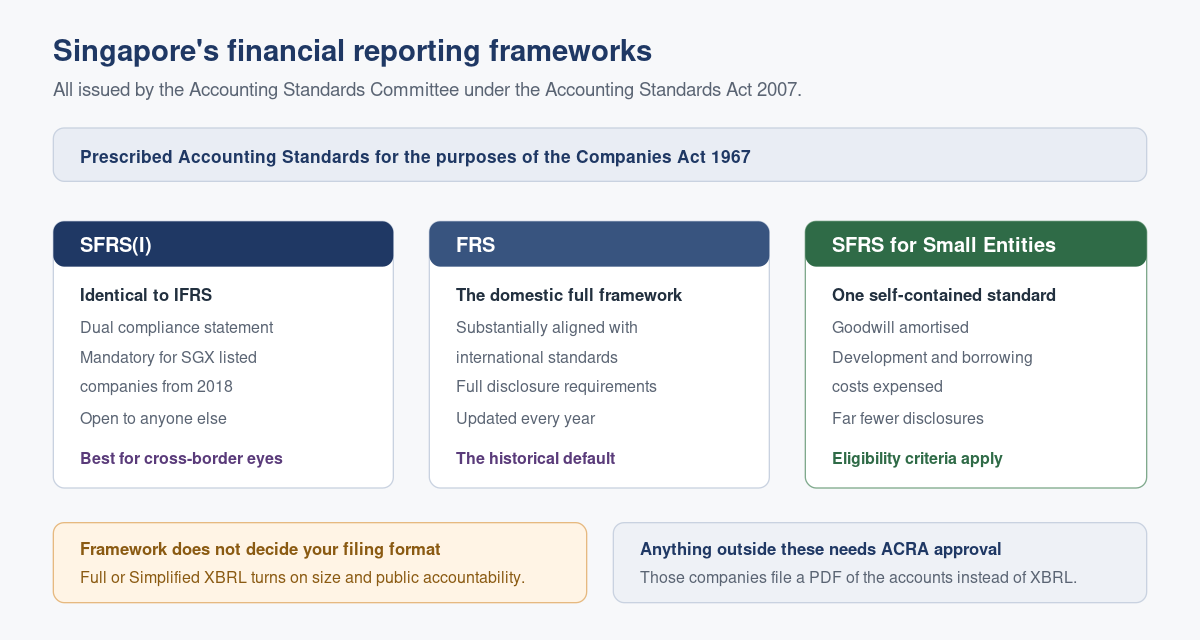
Singapore has three general purpose financial reporting frameworks for companies: Financial Reporting Standards, Singapore Financial Reporting Standards (International), and the SFRS for Small Entities. The first two are full, detailed frameworks. The third is a single simplified standard for smaller private companies.
Raffles Corporate Services works with a panel of experienced Singapore law firms who offer cost-effective and efficient legal service and advice. This article is general information only and is not legal advice.
All three are issued by the Accounting Standards Committee under the Accounting Standards Act 2007, and all three are “Accounting Standards” for the purposes of the Companies Act 1967. That matters, because a company applying any of them is applying prescribed standards. It is only when a company wants to report under something else entirely that it needs ACRA’s approval.
This article explains what each framework is and where they genuinely differ. Which one your company should be using is a separate question, and it has its own answer in our companion piece on which accounting framework applies to your company.
The three frameworks, defined
Financial Reporting Standards (FRS)
FRS is the domestic full framework: the Financial Reporting Standards and their Interpretations issued by the Accounting Standards Committee. It is substantially aligned with international standards, and most of the technical content a Singapore accountant deals with day to day, revenue recognition, leases, financial instruments, deferred tax, sits here in a form that will look familiar to anyone who has worked under IFRS.
This is the framework the majority of Singapore private companies have historically applied, and many still do.
Singapore Financial Reporting Standards (International), or SFRS(I)
SFRS(I) is the framework designed to be identical in content to IFRS Accounting Standards. A company applying SFRS(I) can state compliance with both SFRS(I) and IFRS Accounting Standards in the same set of financial statements, which is the entire point of its existence: one set of accounts that a foreign parent, an overseas lender or an international auditor will accept without a reconciliation.
Singapore-incorporated companies listed on the Singapore Exchange were required to move onto SFRS(I) for annual reporting periods beginning on or after 1 January 2018. Unlisted companies are not forced onto it, but any company may choose to apply it, and companies with international shareholders frequently do.
SFRS for Small Entities
The SFRS for Small Entities is a single, self-contained standard rather than a library of separate standards. It covers recognition, measurement, presentation and disclosure for a small entity in one document, written in plainer language and running a small fraction of the length of the full frameworks.
It is a genuine simplification, not a shortcut. A company applying it is applying a prescribed accounting standard and producing general purpose financial statements that give a true and fair view. It is simply asked for less detail, and permitted simpler measurement, on the basis that the users of a small private company’s accounts are a bank, a tax authority, a handful of shareholders and possibly a buyer, rather than an anonymous public market.
Eligibility turns on size thresholds and on not being publicly accountable. Those criteria are set out in full in the companion article.
Where the frameworks actually differ
Most of the differences are in measurement choices and in the sheer volume of disclosure. These are the ones that change the numbers or the workload.
| Area | Full frameworks (FRS and SFRS(I)) | SFRS for Small Entities |
|---|---|---|
| Form | Many separate standards plus interpretations | One self-contained standard |
| Goodwill after acquisition | Not amortised, tested for impairment | Amortised over its useful life |
| Development costs | Capitalised when the recognition criteria are met | Expensed as incurred |
| Borrowing costs on qualifying assets | Capitalised | Expensed as incurred |
| Investment property | Accounting policy choice of fair value or cost | Fair value where it can be measured reliably without undue cost or effort, otherwise cost |
| Disclosure volume | Extensive, and growing each year | Substantially reduced |
| Earnings per share, segment and interim reporting | Required where applicable | Not required |
| Pace of change | Updated each year through annual volumes | Revised far less frequently |
| International recognition | SFRS(I) equals IFRS Accounting Standards | Singapore specific |
The difference that matters most is stability
For a small company, the headline saving is not the goodwill treatment. It is that the full frameworks move every single year. New standards, amendments and interpretations arrive on a rolling cycle, each one published as an annual volume applying to reporting periods beginning on a given 1 January. Somebody has to read them and decide whether they touch your accounts, and for a company with a $3 million turnover that is a recurring cost with very little benefit attached.
The SFRS for Small Entities changes rarely. A company on it can produce a comparable set of accounts year after year without re-learning the rules, which is exactly what a small owner-managed business wants from financial reporting.
The difference that matters most to everyone else is comparability
Run the argument the other way and SFRS(I) wins. If your company has a foreign parent that consolidates under IFRS, an investor who benchmarks you against international peers, or a plan to raise money outside Singapore, then a set of accounts that says “compliant with IFRS Accounting Standards” on its face removes work and doubt from every one of those conversations. That is worth real money, and it is worth more than the disclosure effort it costs.
What the choice does not change
Three things are the same regardless of framework, and they catch people out.
The directors’ duty. Whichever framework you use, the directors must lay financial statements that comply with the Accounting Standards and give a true and fair view. A simplified framework is not a lower standard of care. Our note on what the accounts can cost a director personally covers where that duty bites.
Audit. The reporting framework and the audit requirement are separate questions. A company can apply the SFRS for Small Entities and still need an audit, and a company can be exempt from audit and still be on a full framework.
XBRL. Filing format is decided by size and public accountability, not by framework. A company on the SFRS for Small Entities that fails the smaller company test still files Full XBRL. See our guide to XBRL requirements and exemptions for how those tests work.
What goes wrong in practice
Drifting between frameworks without deciding. Accounts get prepared from last year’s template. A company that grew past the eligibility thresholds two years ago, or that acquired a corporate shareholder, may still be producing small entity accounts because nobody re-tested. The problem only surfaces when an auditor, a lender or a buyer asks which framework the accounts were prepared under.
Underestimating what a switch costs. Changing framework is not a formatting change. Comparatives are restated, opening balances are reworked, and accounting policies that were never previously articulated have to be written down and applied consistently. A move onto SFRS(I) in the year of an investment round is a poor piece of timing.
Assuming simplified means optional. Simplified disclosure does not mean you can leave out a disclosure you would prefer not to make. Related party transactions, director remuneration arrangements and going concern uncertainty all still have to be dealt with. Our note on key management personnel compensation disclosure covers the area small companies most often try to skip.
Confusing “other accounting standards” with the small entity framework. A company using accounting standards other than the prescribed ones needs ACRA’s approval and files a PDF rather than XBRL. The SFRS for Small Entities is a prescribed standard, so a company applying it is in the ordinary filing population.
Frequently asked questions
Is SFRS for Small Entities the same as IFRS for SMEs?
It is Singapore’s simplified reporting framework for smaller entities, issued by the Accounting Standards Committee and modelled on the international standard for small and medium sized entities. It is the Singapore version that has legal effect here, and it is a prescribed accounting standard for the purposes of the Companies Act 1967. Refer to the Singapore standard, not the international text, when preparing Singapore accounts.
Can a company applying SFRS(I) say its accounts comply with IFRS?
Yes, and that is the purpose of the framework. SFRS(I) is designed so that a company complying with it complies with IFRS Accounting Standards, and financial statements can state both. That dual statement is why companies with foreign parents, overseas lenders or international investors choose SFRS(I) even when nothing requires them to.
Does using a simplified framework mean we need less bookkeeping?
No. The underlying records are the same. Section 199 of the Companies Act 1967 requires every company to keep accounting records that sufficiently explain its transactions and enable true and fair financial statements to be prepared. The simplification is in how those records are measured, presented and disclosed, not in whether they are kept.
Can we move from SFRS for Small Entities to a full framework voluntarily?
Yes. Companies do it ahead of fundraising, an acquisition or a listing, or because a new shareholder expects it. Plan it a year ahead if you can. Changing framework means restating comparatives and reworking opening balances, so doing it during a live transaction adds pressure at the worst possible time.
Who decides which framework we use?
The directors, on advice. The Accounting Standards Committee issues the standards and sets the eligibility criteria, but nobody assigns a framework to your company. The directors approve the financial statements and are responsible for the framework those statements state compliance with, which is why the decision deserves a minuted moment rather than a default.
Choosing well, once
The framework decision is one of the few accounting choices that is genuinely strategic. It shapes how much reporting work you do each year, how readable your accounts are to outsiders, and how much friction you meet the day somebody wants to lend to you or buy you.
Raffles Corporate Services prepares financial statements for Singapore companies under both the full frameworks and the SFRS for Small Entities, and we are usually the ones who notice that a client has grown past the criteria before an auditor does. If nobody has re-tested your eligibility since the accounts were first set up, that is worth half an hour of somebody’s attention. Our note on working effectively with an outsourced accounting firm explains how we like to run that conversation.
You can reach us through Raffles Corporate Services, or read more on Singapore corporate secretarial practice at Singapore Secretary Services.
— The Editorial Team, Raffles Corporate Services
Need help with this?
Raffles Corporate Services can handle the ACRA filings, compliance documentation and records for you, and where court proceedings or legal advice are needed, we work with a panel of experienced Singapore law firms who offer cost-effective and efficient legal service and advice.
Email: [email protected]
Call, SMS or WhatsApp: +65 8501 7133