

A receiver is a person a secured lender appoints to seize and realise the assets you charged to it. In most cases the lender does not need a court order, does not need your consent, and does not need to warn you. The appointment takes effect the moment the appointee accepts the instrument.
Raffles Corporate Services works with a panel of experienced Singapore law firms who offer cost-effective and efficient legal service and advice. This article is general information only and is not legal advice.
That is the most important thing to understand about receivership. Judicial management and winding up run through the courts and give you time to be heard. Receivership usually does not. It is a private contractual remedy, exercised under the security document your company signed when it took the money.
This is part two of three on managing company debt. Part one deals with the security itself: what a charge is and why registration decides priority, with the filing mechanics in our guide to registering a charge. Part three deals with judicial management, the moratorium and rescue.
What a receiver actually is
A receiver is an individual appointed to take possession of specified property of a company and turn it into cash for the creditor who appointed them. A receiver and manager goes further: they also run the business, or the relevant part of it, while the realisation happens. Part 6 of the Insolvency, Restructuring and Dissolution Act 2018 governs both, and every reference to a receiver in that Part includes a receiver and manager.
Two features define the role. The receiver owes their primary duty to the appointing chargee, not to the company and not to creditors generally, unlike a judicial manager, who must act in the interests of creditors as a whole and is an officer of the court. And receivership is not a class remedy: unsecured creditors get nothing from it directly, and once the secured debt, the receiver’s remuneration and the statutory preferential claims are paid, anything left goes back to the company.
Who can and cannot be appointed
The Act disqualifies a long list of people, because the job requires independence from both sides. A company or corporation cannot be a receiver unless another written law authorises it. Neither can an undischarged bankrupt, a chargee or other security holder over the company’s property, the company’s auditor, or a director, secretary or employee of the company or of the chargee.
There is also a licensing gate. Other than the Official Receiver, an individual who is not a licensed insolvency practitioner cannot act as a receiver. If a lender’s relationship manager offers to “put someone in” informally, that is not receivership and it carries none of the protections.
How the appointment happens
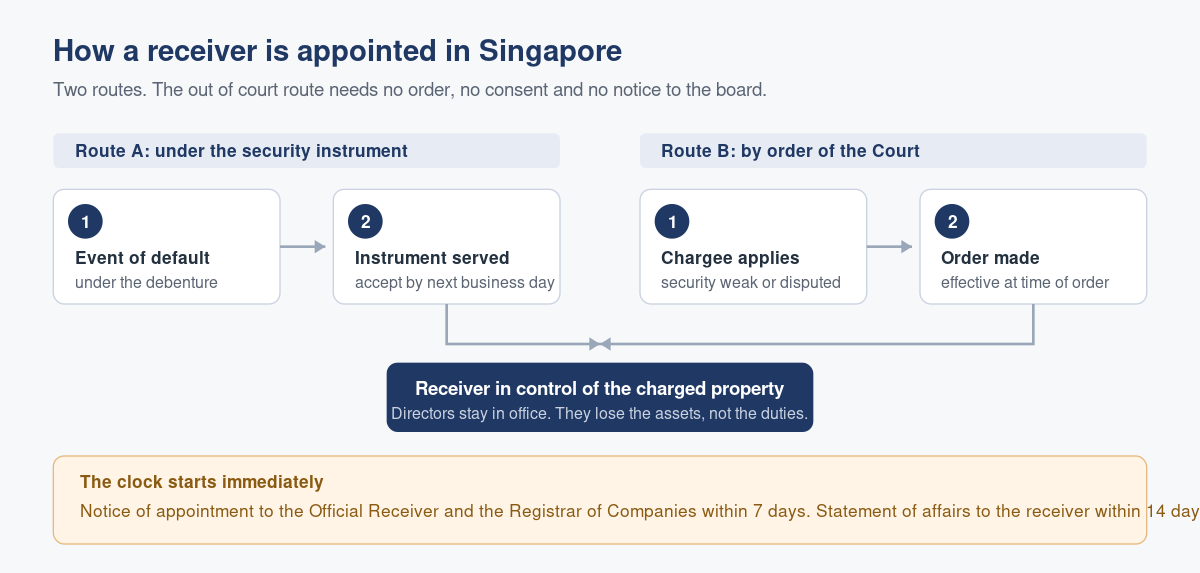
There are two routes, and the out of court route is far more common.
- The lender relies on the security document. A debenture or mortgage will contain an express power to appoint a receiver on an event of default. Default is usually defined broadly: missed payment, breach of covenant, cross-default on another facility, or a material adverse change.
- The lender serves the instrument of appointment. The appointee must accept it before the end of the business day following the day the instrument is received, failing which the appointment is of no effect. If they do accept, the appointment is treated as made at the moment the instrument was received, not at acceptance.
- Alternatively, a creditor applies to court. Where the security is defective, contested, or silent on appointment, the chargee can ask the court to appoint. That appointment is deemed made when the order is made. Where the company is already being wound up by the court, the court may appoint the liquidator as receiver.
The consequence of step two is stark. A company can be solvent on Monday morning by its own reckoning and in receivership by Monday afternoon, with the board still unaware that the instrument has been signed.
If you believe the appointment was bad, the challenge is after the fact and it is to the court: see challenging the appointment of a Singapore receiver. Where an appointment is later found invalid, the court can order the person who made it to indemnify the appointee against liability arising solely from the invalidity, which is why receivers insist on a clean security review before accepting.
What the receiver can do, and what the directors lose
Directors are not automatically removed. The board remains in office. What it loses is control of the charged property, which in a typical all assets debenture means control of everything that matters.
| Function | Before receivership | During receivership |
|---|---|---|
| Dealing with the charged assets | Board | Receiver |
| Running the trading business (receiver and manager) | Board | Receiver |
| Company bank accounts within the charge | Board | Receiver |
| Statutory filings with ACRA and IRAS | Board | Board, still |
| Holding the AGM and filing the annual return | Board | Board, still |
| Directors’ duties under the Companies Act | Apply | Still apply |
| Employment contracts | Company | Receiver may adopt them, with personal liability |
That last row is the one receivers are most careful about. A receiver who takes possession to enforce a charge is personally liable on contracts they enter into in performing their functions, and, to the extent of a qualifying liability, on any contract of employment they adopt. Qualifying liabilities include wages, accrued vacation leave, retrenchment benefits, ex gratia payments or payments in lieu of notice, and employer provident fund contributions, and only to the extent payable after the appointment.
Directors who assume receivership suspends their obligations are wrong, and the mistake is expensive. The annual return still has to be filed, and directors’ duties to creditors sharpen rather than disappear once a company is in financial difficulty: see directors’ duties when a company is financially parlous.
Preferential debts come first out of floating charge assets
Where a receiver is appointed on behalf of debenture holders secured by a floating charge, and the company is not then in winding up, certain debts must be paid out of the floating charge property ahead of any claim for principal or interest under the debentures. These are the debts that would be preferential in a winding up and are due by way of wages, salary, retrenchment benefit or ex gratia payment, vacation leave, or superannuation or provident fund payments, in the same order of priority as applies in a liquidation.
This catches lenders out regularly. A floating charge over book debts and inventory looks like full recovery on paper, then the payroll arrears come off the top. See priority disputes between a receiver and preferential creditors and fixed and floating charge receivers in Singapore.
The ACRA and Official Receiver filings
Receivership generates a defined sequence of lodgements, and the deadlines are short.
| Event | Who files | Deadline | Filed with |
|---|---|---|---|
| Appointment of receiver, by order or under an instrument | The person who obtained the order or made the appointment | Within 7 days | Official Receiver and Registrar of Companies |
| Receiver ceasing to act (instrument appointments) | The receiver | Within 7 days after cessation | Official Receiver and Registrar of Companies |
| Appointment made outside Singapore over Singapore property of a corporation | The appointee, before acting | Before acting as receiver | Registrar of Companies |
| Statement of affairs prepared by the company | Directors and secretary, verified by affidavit | Within 14 days of the company receiving notice of appointment, or longer if allowed | Submitted to the receiver |
| Statement of affairs plus receiver’s comments | The receiver | Within 30 days after receiving the statement | Official Receiver and Registrar of Companies |
| Receiver’s detailed account of receipts and payments | The receiver | Within 30 days after each 6 month period, and within 30 days of ceasing to act | Official Receiver and Registrar of Companies |
Default on the appointment notice obligations is an offence carrying a fine not exceeding $5,000 and a default penalty. Default on the receiver’s accounts, or on submitting the statement of affairs itself, carries a fine not exceeding $1,000 and a default penalty.
One more obligation is quietly the most visible of the lot. Once a receiver has been appointed, every invoice, order for goods, business letter, order form and other correspondence issued by or on behalf of the company, in any form, on which the company’s name appears must state immediately after the first appearance of that name that a receiver or manager has been appointed. So must every company website on which the name appears. Default carries a fine not exceeding $10,000 and a default penalty, and it bites the company, any officer, the liquidator and the receiver who knowingly and wilfully authorised or permitted it.
What goes wrong in practice
The website is never updated. The invoices get changed because the receiver’s team redrafts the template. Nobody touches the website. That is the breach an enforcement officer can verify from a desk in thirty seconds, and it is the most common one we see.
The statement of affairs is late. Directors are shell-shocked, the finance manager has resigned, and the 14 day clock runs from the company’s receipt of the receiver’s notice. Ask the receiver for an extension in writing early. They can allow a longer period, and usually will if asked before the deadline rather than after it.
The floating charge holder does not react to a judicial management application. Notice of such an application must go to any person entitled to appoint a receiver and manager over the whole or substantially the whole of the company’s property under a floating charge, and must also be published and sent to the Registrar of Companies. A chargee who opposes can have the application dismissed where the court is satisfied the prejudice to them would be disproportionately greater than the prejudice to unsecured creditors. That is a powerful veto, and missing the notice is how it gets lost. See receivership versus judicial management in Singapore.
Nobody checks whether the security was properly registered. An unregistered registrable charge is void against the liquidator and any creditor. A receiver appointed under void security is a receiver appointed under nothing. See challenging the validity of a Singapore fixed or floating charge.
Frequently asked questions
Does a receiver take over the whole company?
Not necessarily. A receiver’s authority extends only to the property covered by the charge they were appointed under. With an all assets debenture that is effectively the whole business. With a charge over a single property, the receiver controls that property and nothing else.
Are directors removed when a receiver is appointed?
No. Directors remain in office and remain subject to their statutory duties. They lose control of the charged assets and, where a receiver and manager is appointed, of the trading business. They stay responsible for the company’s ACRA filings, financial statements and annual return.
Can the company stop a receiver being appointed?
Rarely, and not by objecting. The power is contractual and exercisable without a court order. The realistic routes are to cure the default before the instrument is signed, negotiate a standstill with the lender, or challenge the validity of the appointment or the underlying security in court after the event.
Who pays the receiver?
The company does, out of its own property. On vacating office, the receiver’s remuneration, expenses and indemnity are paid out of the company property under their control, ranking ahead of the charge held by the appointor. The court can fix or reduce the amount on the application of the company, its liquidator or the appointor.
Is receivership the end of the company?
Not automatically. Receivership is asset enforcement, not dissolution, and it has no fixed term. If the receiver recovers enough, is discharged and the business survives, the company continues. In practice many receiverships are followed by winding up, because the assets that were charged were the assets that mattered.
Getting ahead of it
By the time a receiver is appointed, your options have narrowed to managing the consequences. The useful work happens earlier: knowing exactly what is charged and to whom, watching the covenants rather than only the repayment dates, and keeping the registers and ACRA filings in a state where a lender’s due diligence produces no surprises.
Raffles Corporate Services maintains registers of charges, files the Part 6 lodgements that receivership triggers, and keeps directors compliant while an enforcement process runs. If your company has secured borrowing and you are not certain what the register shows, that is a short conversation.
You can reach us through Raffles Corporate Services, or read more at Singapore Secretary Services. The governing provisions sit in Part 6 of the Insolvency, Restructuring and Dissolution Act 2018 and Division 8 of Part 4 of the Companies Act 1967.
— The Editorial Team, Raffles Corporate Services
Need help with this?
Raffles Corporate Services can handle the ACRA filings, compliance documentation and records for you, and where court proceedings or legal advice are needed, we work with a panel of experienced Singapore law firms who offer cost-effective and efficient legal service and advice.
Email: [email protected]
Call, SMS or WhatsApp: +65 8501 7133