
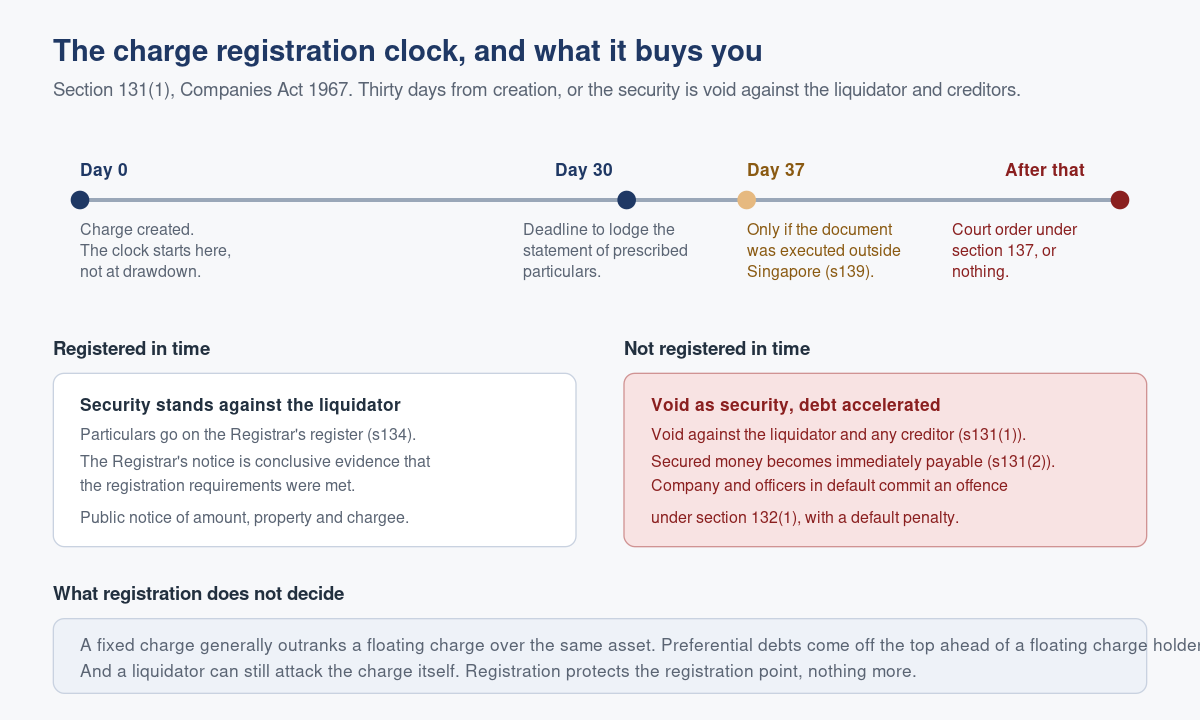
A charge is security over a company’s assets, given to a lender so that if the company does not pay, the lender can take the asset rather than queue with everyone else. Register it with ACRA within 30 days of creation, or under section 131(1) of the Companies Act 1967 it is void against the liquidator and any creditor of the company.
Raffles Corporate Services works with a panel of experienced Singapore law firms who offer cost-effective and efficient legal service and advice. This article is general information only and is not legal advice.
That single sentence is the reason this topic matters to people who are not bankers. A charge that is not registered in time does not become slightly weaker. As security, it disappears, at exactly the moment it was supposed to work.
This is part one of three on managing company debt. Part two covers receivership, what happens when a secured lender enforces, and in the meantime our note on fixed and floating charge receivers sets out the legal framework. Part three covers judicial management, the court supervised rescue.
What a charge actually is
A charge does not transfer ownership. It attaches a claim to an asset, so that the asset answers for the debt ahead of the company’s general creditors. Two forms do most of the work in practice.
A fixed charge attaches to an identified asset from the moment it is created, and the company cannot dispose of that asset free of the charge without the lender’s consent. Land, a ship, a specific piece of plant, shares in a subsidiary: these take fixed charges.
A floating charge hovers over a class of assets that changes day to day, typically stock and receivables. The company keeps dealing with those assets in the ordinary course until something causes the charge to crystallise and fasten onto whatever is in the pot at that moment. The trade-off is obvious: a floating charge lets the business operate, and it is worth less on the day it is needed.
A debenture is the document that usually contains both.
Which charges have to be registered
Section 131(3) of the Companies Act 1967 lists the charges the registration obligation applies to. In practical terms:
- a charge securing an issue of debentures;
- a charge on uncalled share capital, or on calls made but not paid;
- a charge on shares the company owns in a subsidiary;
- a charge created by an instrument that, if executed by an individual, would need registering as a bill of sale;
- a charge on land wherever situated, or an interest in land, but not one for rent or another periodical sum issuing out of land;
- a charge on the company’s book debts;
- a floating charge on the undertaking or property of the company;
- a charge on a ship or aircraft, or a share in one;
- a charge on goodwill, or on a patent, trade mark, copyright or registered design, or a licence under any of them.
Two carve-outs are worth knowing. A charge on book debts does not include a charge on a negotiable instrument or on Government-issued debentures, and a shipowner’s lien created on or after 1 October 2018 is outside the regime. Section 141 extends Division 8 to a foreign company only if it is registered in Singapore, and never to that company’s charge over property outside Singapore.
Why registration matters more than the loan document
The instrument governs your relationship with your lender. Registration governs your relationship with everybody else, and that second problem only becomes visible when the company runs out of money.
| What you registered | What it gives you | What it does not give you |
|---|---|---|
| A statement of particulars, lodged within 30 days | Security that stands up against the liquidator and other creditors | A copy of the loan agreement on the public record |
| Particulars entered on the Registrar’s register under section 134 | Public notice of the amount secured, the property charged and who holds the charge | Any guarantee that your description of the property was adequate |
| Registration confirmed by the Registrar’s notice | Conclusive evidence that the registration requirements were met, under section 134(2) | Protection against a claim that the charge itself is invalid or vulnerable |
Note what you are lodging. Section 131(1) requires a statement containing prescribed particulars, not the instrument. Section 131(1A) only obliges the company to produce the instrument, or a certified true copy, if the Registrar asks to inspect it. The public register is a summary you wrote, which is why a vague description of the charged property is a real exposure rather than a typing slip.
The detailed mechanics of that lodgement are in our companion guide to filing the particulars of a charge with ACRA.
The 30-day clock, and its two exceptions
The base rule in section 131(1) is 30 days after the creation of the charge.
Documents executed outside Singapore. Section 139 extends any time limit in Division 8 by seven days where the instrument, deed, statement or other document was executed or made outside Singapore, or by such further periods as the Registrar may allow. That is where the familiar 37 days comes from. It turns on where the document was signed, not where the lender is.
Property acquired subject to an existing charge. Section 133(1) gives a company 30 days from completing the acquisition to lodge particulars where it buys property already carrying a charge of a registrable kind. The same 30-day rule applies from the date of registration in Singapore where a foreign company registers here with an existing charge, or with property acquired subject to one.
If you miss the window for a Singapore-executed charge, there is no administrative extension. The only route is a court order under section 137, where the Court may extend time or rectify the register if satisfied that the omission or misstatement was accidental, due to inadvertence or some other sufficient cause, is not of a nature to prejudice creditors or shareholders, or that relief is otherwise just and equitable. An application costs a great deal more than filing on day five, which is the practical argument for treating the deadline as immovable.
How priority actually works
Priority is the question of who gets paid first out of the same asset, and it is decided by a combination of the statute, the type of charge, and notice.
Registration is the gateway, not the ranking rule. An unregistered registrable charge is void against the liquidator and creditors under section 131(1), and section 131(2) makes the secured money immediately payable. The lender becomes an unsecured creditor holding an accelerated debt. Registering late, once a court has allowed it, does not restore a position lost to charges registered in the meantime.
A fixed charge generally beats a floating charge over the same asset, even an earlier floating charge, because the floating charge leaves the company free to deal with the assets until crystallisation. Lenders manage this with a negative pledge, and the practical effect of that clause depends on notice. See negative pledge clauses and how the courts enforce them.
Section 131(10) blocks the obvious workaround. Where a registrable charge is created within 30 days of a prior unregistered charge, over all or part of the same property, and secures the same debt, the later charge is not operative unless the Court is satisfied it was given in good faith to correct a material error, or in other proper circumstances, and not to evade Division 8.
Preferential claims come off the top, and the charge itself can be attacked. On an insolvency, certain preferential debts rank ahead of a floating charge holder, so a bank with only a floating charge can find employee claims have consumed the realisations. Registration also protects only the registration point: it does not stop a liquidator arguing unfair preference or an invalid floating charge. See priority disputes between a receiver and preferential creditors, priority disputes between registered charges and challenging the validity of a fixed or floating charge.
What the company must keep, and what it must file when the debt is paid
Registration is not the end of the obligation.
Keep the instrument. Section 138(1) requires the company to keep the instrument creating a registrable charge, or a copy, at its registered office while the charge remains in force. For a series of debentures, one debenture of the series is enough. Section 138(1A) deems that document part of the company’s records and requires it to be kept for five years after the debt is satisfied in full or the property released, whichever is later.
Keep your own register of charges. Section 138(2) requires a register at the registered office recording all charges specifically affecting the company’s property and all floating charges, with a short description of the property, the amount and the names of the persons entitled. Any creditor or member may inspect it without fee. Default under section 138 is an offence carrying a fine not exceeding $2,000 and a default penalty.
File the satisfaction. When the debt is paid or the property released, section 136 lets the company lodge a statement of satisfaction of charge, endorsed by the chargee, and the Registrar enters it on the register. This is the step companies forget, and a discharged loan still showing as a live charge will hold up your next financing, audit or sale. If your company has debenture holders, the register of debenture holders obligations sit alongside all of this.
What goes wrong in practice
Everyone assumes the lawyer filed it. The borrower thinks the lender’s solicitors handled registration; the solicitors think they were instructed on the facility only. Section 132(1) allows the company or any person interested in the documents to lodge, and section 132(2) lets that person recover the fees from the company. The lender has everything to lose here and should file rather than wait and hope.
The description of the charged property is too loose. It registers, and then a searcher two years later cannot tell whether a particular asset is caught. Correcting it means a section 137 application.
Satisfactions are never filed. Years of repaid facilities sit on the register because nobody closed them out, and every one becomes a question in due diligence.
The charge is registered and then forgotten. The company grants a second facility over the same assets without checking the first. Pull your own register of charges from ACRA before signing anything secured. It is free to officers and members, and our guide to downloading your company registers from Bizfile explains how. Note also that default in complying with section 131 makes the company and every officer in default guilty of an offence under section 132(1), liable on conviction to a fine not exceeding $1,000 and a default penalty, with section 133(2) applying the same exposure to the acquired-property case. The fine is not the real cost; the void security is.
Frequently asked questions
What happens if a charge is not registered within 30 days?
Under section 131(1) of the Companies Act 1967 the charge is void against the liquidator and any creditor, so far as it confers security over the company’s property. Section 131(2) then makes the secured money immediately payable. The lender keeps a contractual debt but loses the security, and the only route back is a court order under section 137.
Does registering a charge with ACRA put my loan agreement on the public record?
No. You lodge a statement of prescribed particulars: the date of creation, the amount secured, a description sufficient to identify the property charged, and the name of the person entitled to the charge. The instrument itself stays with the company, and the Registrar may ask to inspect it or a certified true copy.
Do I get more time if the security document was signed overseas?
Yes, seven days. Section 139 of the Companies Act 1967 extends any Division 8 time limit by seven days where the document was executed or made outside Singapore, and allows the Registrar to grant further periods. It depends on where the document was signed, not on where the lender or the borrower is based.
Who is responsible for registering the charge, the borrower or the lender?
Legally the company must comply, and the company and its defaulting officers commit an offence if it does not. But section 132(1) lets any interested person lodge, and section 132(2) lets that person recover the fees from the company. Since the lender loses the security if nobody files, the lender should file.
Our loan was repaid years ago but ACRA still shows the charge. Does that matter?
Yes, commercially. Until a statement of satisfaction is lodged under section 136 and entered on the register, the charge appears live to every bank, auditor and buyer who searches. It will not sink a transaction, but it will delay one, and the chargee’s endorsement can be slow to obtain years after the relationship ended.
Thirty days is not a long time
Most charge problems are calendar problems. The facility is agreed weeks before signing, signed on a Friday, and then the file sits with whoever is back from leave first while the 30 days go by and everyone assumes somebody else is handling it.
Raffles Corporate Services files charge registrations, variations and satisfactions for Singapore companies, keeps the section 138 register of charges current, and reconciles it against ACRA’s record before a financing or a sale rather than during one. If you are about to grant security, or you suspect your ACRA record still shows facilities you repaid, that is a short conversation worth having early.
You can reach us through Raffles Corporate Services, or read more on Singapore corporate secretarial practice at Singapore Secretary Services.
— The Editorial Team, Raffles Corporate Services
Need help with this?
Raffles Corporate Services can handle the ACRA filings, compliance documentation and records for you, and where court proceedings or legal advice are needed, we work with a panel of experienced Singapore law firms who offer cost-effective and efficient legal service and advice.
Email: [email protected]
Call, SMS or WhatsApp: +65 8501 7133