
A creditors’ voluntary winding up is the route you take when the directors accept that the company cannot continue because of its debts, and they start the liquidation themselves rather than waiting for a creditor to drag them to court. The creditors, not the shareholders, choose the liquidator.
Raffles Corporate Services works with a panel of experienced Singapore law firms who offer cost-effective and efficient legal service and advice. This article is general information only and is not legal advice.
That last sentence is the whole difference between this route and a members’ voluntary winding up, where the directors swear the company can pay everyone in full within twelve months and the shareholders keep control. Here they cannot swear that, so control passes to the people who are owed money. Starting one is not a failure of nerve. It is usually the cheapest and least damaging way out.
This is the second of three parts. Part one covers the solvent route, members’ voluntary winding up, and part three covers court-ordered winding up, which is what happens when somebody else makes the decision for you.
When this is the right route
Three things need to be true. The company cannot pay its debts as they fall due, or cannot pay them in full within twelve months. The directors are unwilling to sign a declaration of solvency, or would be signing one they do not believe. And there is no realistic rescue, whether by refinancing, a scheme of arrangement or judicial management.
If the business is small, look at the Simplified Winding Up Programme first. It is designed for micro companies with annual revenue under $1 million and small companies with annual revenue under $10 million: a creditors’ winding up, but cheaper and shorter. Our note on the Simplified Insolvency Programme sets out the eligibility conditions.
One statutory trap sits at the front. Under section 184 of the Insolvency, Restructuring and Dissolution Act 2018, once a creditor has applied to court to wind the company up for inability to pay its debts, the company cannot resolve to wind itself up voluntarily without the court’s permission. Start early or lose the option.
The sequence, in order
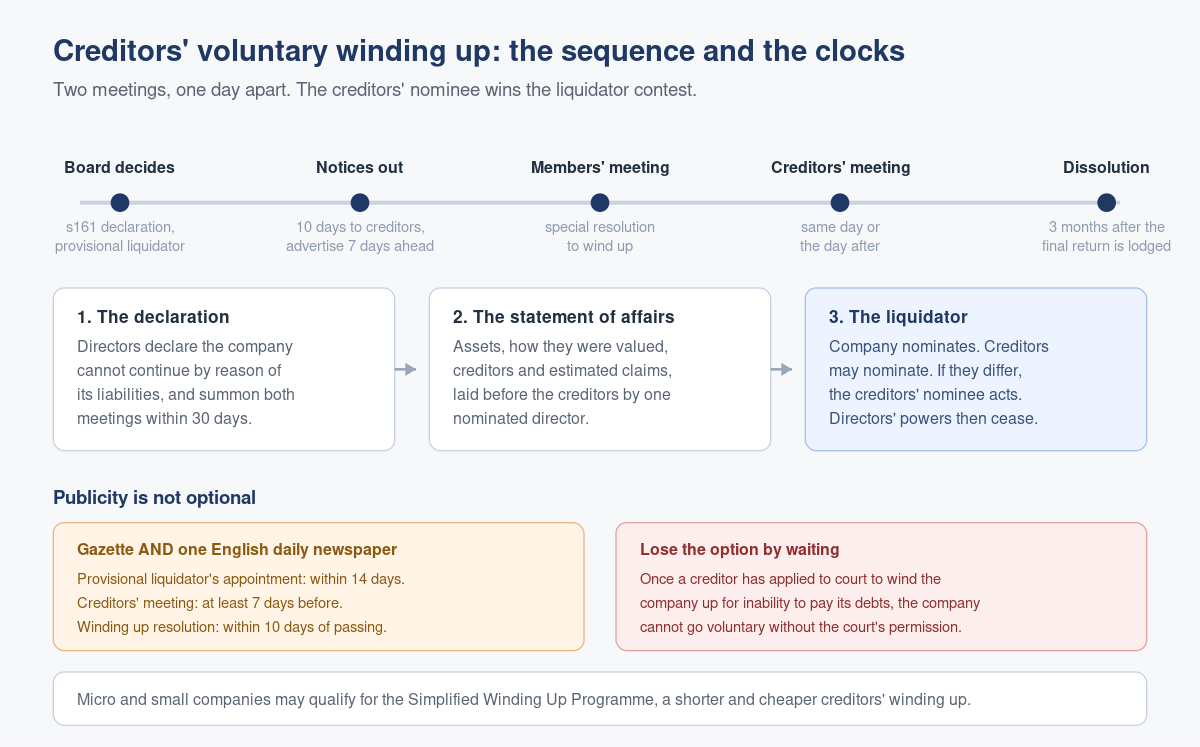
- The section 161 declaration, if the board wants protection immediately. The directors lodge a statutory declaration with the Official Receiver and a declaration with the Registrar of Companies stating that the company cannot, by reason of its liabilities, continue its business, and that meetings of the company and of its creditors have been summoned for a date within 30 days. They must then immediately appoint a licensed insolvency practitioner as provisional liquidator, and advertise that appointment.
- Notices go out for two meetings. The members’ meeting at which the winding up resolution will be proposed, and the creditors’ meeting, held on the same day or the day after. Notice to creditors goes out simultaneously with the notices to members, accompanied by a statement showing the names of all creditors and the amounts of their claims.
- The members pass the special resolution to wind up, and the resolution is lodged and advertised.
- The creditors’ meeting is held. The directors lay a full statement of the company’s affairs before it, showing how the assets were valued, with a list of creditors and the estimated amount of their claims. One director is appointed to attend, and that director and the company secretary must attend and explain the company’s affairs and the circumstances that led to the winding up.
- The liquidator is appointed. The company nominates, the creditors may nominate, and where the two differ the creditors’ nominee takes the job. From that moment the directors’ powers cease, except so far as the committee of inspection or the creditors approve their continuance.
- The liquidator realises, distributes and reports. If the liquidation runs past a year, meetings of the company and the creditors are held annually.
- Final meeting and dissolution. The liquidator draws up an account, advertises the final meeting, lodges the return, and the company is dissolved three months after that lodgement.
The deadlines that actually bite
| Step | Deadline | Source |
|---|---|---|
| Appoint provisional liquidator after the section 161 declaration | Immediately | IRDA 2018, section 161(1) |
| Meetings of company and creditors after the declaration | Within 30 days | IRDA 2018, section 161(1)(b) |
| Advertise the provisional liquidator’s appointment | Within 14 days of appointment | IRDA 2018, section 161(4) |
| Notice of creditors’ meeting to creditors | At least 10 days before | IRDA 2018, section 166(2)(a) |
| Advertise the creditors’ meeting | At least 7 days before | IRDA 2018, section 166(3) |
| Lodge the winding up resolution with the Registrar | Within 7 days of passing | IRDA 2018, section 160(2)(a) |
| Gazette and newspaper notice of the resolution | Within 10 days of passing | IRDA 2018, section 160(2)(b) |
| Advertise the final meeting | At least 30 days before | IRDA 2018, section 180(2)(c) |
| Lodge the return of the final meeting | Within 7 days after the meeting | IRDA 2018, section 180(3) |
| Dissolution takes effect | 3 months after that lodgement | IRDA 2018, section 180(6) |
Failure to lodge or advertise the resolution is an offence for the company and every officer in default, carrying a fine not exceeding $5,000 and a default penalty. Default on the creditors’ meeting requirements carries a fine not exceeding $2,000.
What changes the moment the winding up commences
A creditors’ voluntary winding up commences when the section 161 declaration is lodged with the Registrar, if a provisional liquidator was appointed before the resolution was passed. Otherwise it commences when the resolution is passed.
From that date the company must stop carrying on business, except so far as the liquidator considers it necessary for a beneficial winding up. The corporate entity survives until dissolution, but the people running it change. Share transfers and alterations in the status of members after commencement are void unless the liquidator sanctions them. Attachments, distress and enforcement orders put in force after commencement are void unless the court orders otherwise, and no action or proceeding may be commenced or continued against the company without the court’s permission.
Who gets paid, and in what order
Assets are applied pari passu against liabilities, subject to the statutory order of priority: the costs and expenses of the winding up including the liquidator’s remuneration, then employee claims for wages and salary, retrenchment benefits, work injury compensation, employer CPF contributions and accrued leave, then tax and goods and services tax assessed before commencement. Everything else ranks equally as unsecured.
Secured creditors sit outside all of this to the extent of their security, though preferential debts have priority over the claims of floating charge holders where general assets fall short.
What the directors are signing up for
Directors often treat the process as a formality once the liquidator is appointed. It is not.
The statement of affairs is a sworn document, the attending director must disclose the circumstances leading to the winding up, and the liquidator may require any other director to submit a statement of concurrence within 14 days agreeing with the statement of affairs or qualifying it. That design stops one director carrying the story alone.
The liquidator then investigates. Transactions at an undervalue, unfair preferences given to particular creditors in the run-up, and trading on while insolvent are all within scope, and officers can be examined in court about them: see public examination of company officers under the IRDA. Directors of a company in difficulty also owe a duty to have regard to creditors’ interests before formal insolvency, explained in our note on financially parlous companies, and anyone directing without an appointment is not outside it: see shadow directors.
What goes wrong in practice
Paying the friendly creditor first. The supplier who is also a friend, the director’s loan account, the landlord who has been patient. Payments made in the months before a winding up can be unwound as unfair preferences, and the recipient has to give the money back. The director who arranged them can end up personally on the wrong end of the application.
Letting a creditor get to court first. Once an application has been made on the ground of inability to pay debts, the company needs the court’s permission to go voluntary. Directors who spend three months negotiating with one aggressive creditor often lose the cheaper route while doing it.
Skipping the newspaper advertisement. The Gazette notice and the newspaper notice are separate requirements and both are compulsory. Missing one is an offence, and it hands a disgruntled creditor a procedural complaint at the worst possible moment.
Appointing nobody. Where it is proposed to wind up voluntarily and no liquidator or provisional liquidator has been appointed or nominated, the directors’ powers are suspended except as needed to comply with the creditors’ meeting requirements and to protect perishable or wasting assets. A board that passes the resolution and then goes quiet for a fortnight is acting without authority.
What gets filed with ACRA
Through ACRA’s winding up service the liquidator files the notice of appointment of a liquidator or provisional liquidator, the notice of cessation, the account of receipts and payments with the statement of position, the return relating to the final meeting, and notice of any change in the situation of the liquidator’s office. Through general lodgement go the statement of affairs, notice of the holding of the creditors’ meeting, dissolution of the company, and notice of early dissolution under sections 209 and 210 of the Insolvency, Restructuring and Dissolution Act 2018. If a liquidator has to be changed mid-liquidation, our note on removing or replacing a liquidator covers the court’s power to do it.
Frequently asked questions
What is the difference between a creditors’ voluntary winding up and a members’ voluntary winding up?
Solvency and control. A members’ voluntary winding up requires the directors to declare that the company can pay its debts in full within twelve months of commencement, and the shareholders appoint the liquidator. In a creditors’ voluntary winding up no such declaration is made, and where the members and the creditors nominate different liquidators, the creditors’ nominee is appointed.
Can the directors choose the liquidator in a creditors’ voluntary winding up?
They can nominate one, but they cannot impose one. The company nominates at its meeting and the creditors may nominate at theirs. If the two nominations differ, the creditors’ nominee becomes liquidator. Any director, member or creditor may apply to court within 7 days of the creditors’ nomination for an order that the company’s nominee act instead of, or jointly with, the creditors’ nominee.
How long does it take before the company is dissolved?
There is no fixed period, because it depends on how long it takes to realise assets and adjudicate claims. The final stage is fixed, though. Once the affairs are fully wound up, the liquidator advertises the final meeting at least 30 days ahead, lodges the return within 7 days after the meeting, and the company is dissolved three months after that lodgement.
Are the directors personally liable for the company’s debts in a creditors’ voluntary winding up?
Not by reason of the liquidation itself. Limited liability survives. Personal exposure comes from specific conduct: personal guarantees, unfair preferences, transactions at an undervalue, breach of duty, and any statutory liability arising from how the company was run before it stopped. The liquidator’s job includes looking for exactly those things.
Does a creditors’ voluntary winding up stop creditors suing the company?
Largely, yes. After commencement, no action or proceeding may be commenced or continued against the company except with the court’s permission and on such terms as the court imposes, and attachments or enforcement orders put in force after commencement are void unless the court orders otherwise. Secured creditors can still enforce their security.
Doing this properly, and early
The best predictor of how a creditors’ voluntary winding up goes is how early it was started. Boards that act while there is still cash to pay for the process and records to explain it come out cleanly. Boards that wait for a statutory demand spend more, disclose more and carry more personal risk.
Raffles Corporate Services works alongside licensed insolvency practitioners on the corporate secretarial side of these liquidations: the resolutions, the meeting notices, the Gazette and newspaper advertisements, the ACRA lodgements and the record set the liquidator will want on day one.
You can reach us through Raffles Corporate Services, or read more on Singapore corporate secretarial practice at Singapore Secretary Services.
— The Editorial Team, Raffles Corporate Services
Need help with this?
Raffles Corporate Services can handle the ACRA filings, compliance documentation and records for you, and where court proceedings or legal advice are needed, we work with a panel of experienced Singapore law firms who offer cost-effective and efficient legal service and advice.
Email: [email protected]
Call, SMS or WhatsApp: +65 8501 7133