

Court-ordered winding up, also called compulsory winding up, is a liquidation started by an application to the General Division of the High Court. Most of the time the applicant is an unpaid creditor, the ground is that the company cannot pay its debts, and the company had no say in any of it.
Raffles Corporate Services works with a panel of experienced Singapore law firms who offer cost-effective and efficient legal service and advice. This article is general information only and is not legal advice.
The other two routes are decisions the company makes. This one is made about the company, usually after a period of ignored correspondence. Once the order is made, a liquidator takes possession of the assets and the directors lose control.
This is the third of three parts. Part one covers members’ voluntary winding up for a solvent company, and part two covers creditors’ voluntary winding up, the route directors take themselves when the company cannot pay.
Who can apply, and on what grounds
Section 124 of the Insolvency, Restructuring and Dissolution Act 2018 lists who may apply: the company itself, any director, any creditor including a contingent or prospective creditor, a contributory or a deceased contributory’s personal representative, the liquidator, the Minister in the circumstances specified, a judicial manager, and the Monetary Authority of Singapore where the company carries on or has carried on banking business.
A director must first satisfy the court that there is a prima facie case and obtain permission to bring the application. That gate exists because a winding up application is a blunt instrument and it was being used to fight internal disputes.
Section 125(1) sets out the grounds. These are the ones that arise in practice.
| Ground | Typical fact pattern |
|---|---|
| The company is unable to pay its debts | An unpaid supplier, lender or landlord. By far the most common ground. |
| It is just and equitable to wind the company up | Deadlock between shareholders, loss of substratum, or a quasi-partnership that has broken down. |
| Directors have acted in their own interests | Minority shareholder alleging the board is running the company for itself. |
| The company has no member, or has suspended business for a whole year | Dormant shells and abandoned companies. |
| The company is being used for an unlawful purpose or against the public interest | A Ministerial application. The Official Receiver must be the liquidator in a national security case. |
On the just and equitable ground, and where directors have acted unfairly, the court has an alternative to closing the company down: it may instead order that one or more members’ shares be bought out on terms it approves. An application does not have to end in liquidation.
The statutory demand, and what actually makes a company “unable to pay its debts”
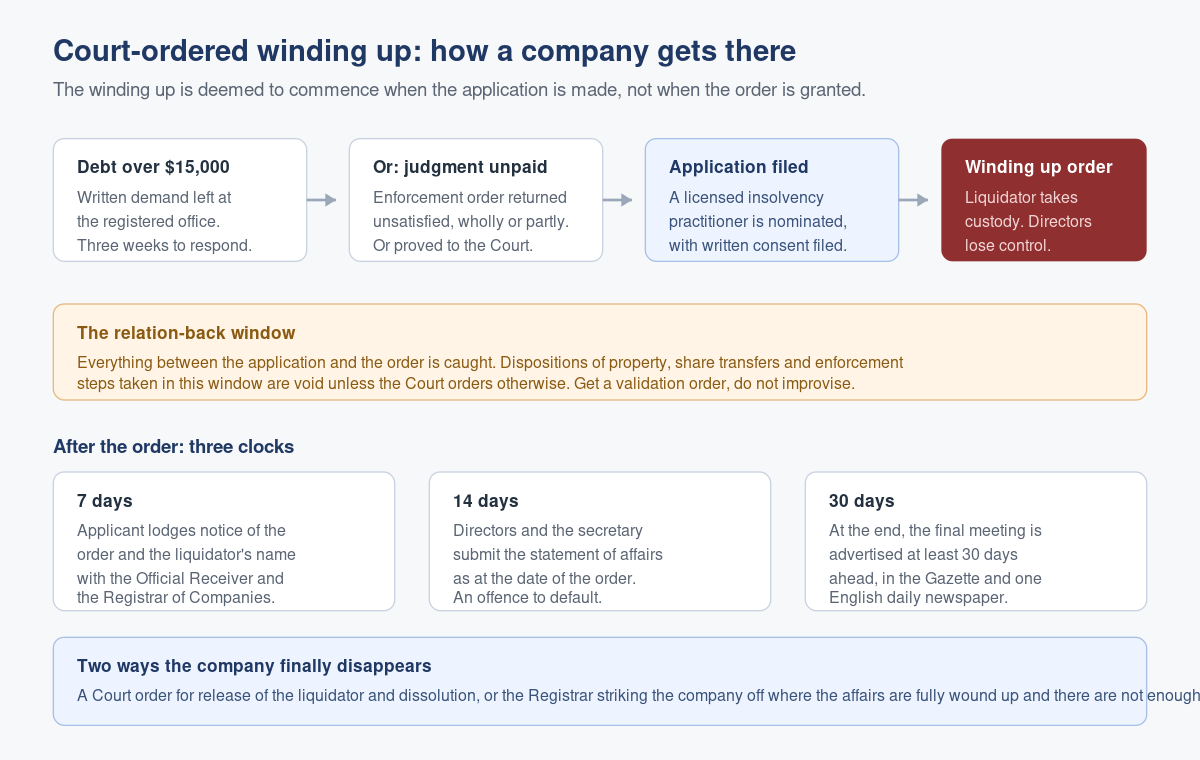
Section 125(2) gives three ways to establish inability to pay debts. The first is the statutory demand: a creditor owed a sum then due exceeding $15,000 serves a written demand by leaving it at the company’s registered office, and the company neglects for three weeks afterwards to pay, secure or compound for it to the creditor’s reasonable satisfaction. The second is an enforcement order or other process issued to enforce a judgment coming back unsatisfied, wholly or partly. The third is simply proving inability to the court, which must take contingent and prospective liabilities into account.
Two practical points follow. The demand goes to the registered office, which is why a company that lets its registered office arrangement lapse can be wound up without anybody ever reading it. And the debt must be genuinely undisputed. Where a company raises a bona fide dispute on substantial grounds, the winding up court is not the forum and the application can be dismissed with costs against the creditor. Our note on disputed debts and the AnAn standard sets out how the Singapore courts approach that question.
What happens, in order
- The applicant nominates a liquidator. The applicant must nominate a licensed insolvency practitioner in writing and file that person’s written consent before the hearing. The Official Receiver may be nominated where the applicant has taken reasonable steps but cannot obtain a practitioner’s consent, and the Official Receiver agrees.
- The application is filed. From that moment it is a lis pendens, which is to say the world is on notice. In practice banks freeze accounts and counterparties stop dealing long before any order is made. Before an order is made the company, a creditor or a contributory may ask the court to stay proceedings against the company, and the court may appoint a provisional liquidator to take control of assets that might otherwise disappear.
- The hearing. The court may dismiss, adjourn conditionally or unconditionally, or make any interim or other order. It cannot refuse to wind up merely because the company has no assets or because its assets are already fully mortgaged.
- The order is made and the liquidator appointed. The court may appoint a licensed insolvency practitioner or, with his consent, the Official Receiver. A liquidator other than the Official Receiver cannot act until the appointment has been notified to the Registrar of Companies and security given in the prescribed manner.
- Notice within 7 days. The applicant lodges notice of the order, its date and the liquidator’s name and address with the Official Receiver and the Registrar of Companies, and within 7 days after the order is passed and entered lodges a copy of it, serves a copy on the company secretary or as the court directs, and delivers a copy to the liquidator. Default carries a fine not exceeding $5,000 and a default penalty.
- Statement of affairs within 14 days. One or more directors and the company secretary must submit a statement of the company’s affairs as at the date of the order, unless the time is extended. Former officers, and anyone involved in the company’s formation in the year before the order, may be required to submit one too.
- Realisation, adjudication and distribution. The liquidator takes the property into custody, may apply for a vesting order, investigates, admits or rejects claims, and distributes in the statutory order of priority.
- Final account and dissolution. The liquidator calls a meeting of the company and the creditors, advertised at least 30 days ahead in the Gazette and at least one English local daily newspaper, lodges the return within 7 days after it, and applies to court for release and for an order that the company be dissolved. The company is dissolved from the date of that order.
The date that catches people out
In a compulsory winding up the clock runs backwards. Where no voluntary winding up resolution was passed beforehand, the winding up is deemed to have commenced at the time the application was made, not at the date of the order. Any disposition of the company’s property, any transfer of shares and any alteration in the status of members after commencement is void unless the court orders otherwise, and so is any attachment, distress or enforcement order put in force after it.
That is why paying a supplier out of the company account between service of the application and the hearing is dangerous. The money can be clawed back from the recipient, and the director who authorised it has some explaining to do. In that window the right move is a validation order from the court, not a judgement call over lunch.
What the order does to everyone else
Once an order is made or a provisional liquidator appointed, no action or proceeding may be commenced or continued against the company except with the court’s permission and on the terms it imposes. The order operates in favour of all the creditors and contributories as though made on their joint application, so a creditor who did nothing gets the same benefit as the one who paid for the application.
Secured creditors remain outside the liquidation to the extent of their security. The rest rank in the statutory order: the costs and expenses of the winding up including the liquidator’s remuneration, then the applicant’s costs, then employee claims for wages and salary, retrenchment benefits, work injury compensation, employer CPF contributions and accrued leave, then tax and goods and services tax assessed before commencement, and then everyone else equally.
What goes wrong in practice
Nobody read the statutory demand. The registered office is a service address the directors stopped checking, or a provider whose fees went unpaid. Three weeks later the company is deemed unable to pay its debts on a debt the directors would have settled immediately. This is the single most avoidable route into compulsory liquidation.
Ignoring it because the debt is disputed. A genuine dispute is a defence, but it has to be raised promptly and with evidence. Silence is read as an admission, and by the hearing date it is too late to build the file.
Leaving it too late to go voluntary. Once an application has been made on the ground of inability to pay debts, the company cannot resolve to wind itself up voluntarily without the court’s permission.
Assuming personal exposure ends with the order. It does not. The liquidator investigates unfair preferences, transactions at an undervalue and the conduct of the officers, and can apply to have officers examined on oath: see public examination of company officers. Directors of a company already in difficulty should also read the Singapore position on duties to creditors when a company is financially parlous, and anyone directing without an appointment should read when a shadow director is liable.
Company gone, but the register not yet clear
A compulsory liquidation does not always end with a court dissolution order. Where the affairs have been fully wound up and there are no assets, or not enough to pay the costs of obtaining a dissolution order, section 344(3) of the Companies Act 1967 lets the Registrar gazette a notice and strike the company off instead. Early dissolution under sections 209 and 210 of the Insolvency, Restructuring and Dissolution Act 2018 is filed with ACRA as its own notice. Either way the company disappears and the obligation to retain its books and papers does not. If the liquidator has to be changed mid-liquidation, see our note on removing or replacing a liquidator.
Frequently asked questions
Who can apply to wind up a Singapore company in court?
The company itself, any director, any creditor including a contingent or prospective creditor, a contributory, the liquidator, a judicial manager, the Minister on the grounds specified, and the Monetary Authority of Singapore where the company carries on or has carried on banking business. A director needs the court’s permission and must show a prima facie case first.
How much must a debt be before a creditor can serve a statutory demand?
The debt must be a sum then due exceeding $15,000. The written demand is served by leaving it at the company’s registered office, and if the company neglects for three weeks to pay, secure or compound for it to the creditor’s reasonable satisfaction, the company is deemed unable to pay its debts for winding up purposes.
Can we stop a winding up application once it has been filed?
Sometimes. If the debt is genuinely disputed on substantial grounds, the application can be resisted and dismissed. If it is not disputed, the practical answer is to pay or secure it, or to agree terms with the applicant, before the hearing. The court can also dismiss or adjourn on terms, and on the just and equitable ground it may order a share buy-out instead.
What must the directors do once a winding up order is made?
Submit a statement of the company’s affairs as at the date of the order to the Official Receiver or the liquidator, within 14 days of the order unless extended. It must show the assets, debts and liabilities, the creditors, and the securities they hold. Failure without reasonable excuse is an offence carrying a fine of up to $10,000, imprisonment of up to 12 months, or both.
Is the company dissolved as soon as the winding up order is made?
No. The order starts the liquidation. Dissolution comes at the end, either by a court order following the liquidator’s final account and meeting, or by the Registrar striking the company off where the affairs have been fully wound up and there are not enough assets to pay for a dissolution order.
Getting ahead of it
Almost every compulsory liquidation we see could have been a cheaper, quieter creditors’ voluntary winding up if the board had moved three months earlier. The trigger is rarely a surprise. It is a demand letter that was not answered, or a registered office that stopped forwarding post.
Raffles Corporate Services keeps registered office correspondence in front of the people who need to see it, maintains the statutory records a liquidator or a court will ask for, and works with licensed insolvency practitioners where a company must respond to an application quickly. If a statutory demand has landed, that is a same-week conversation.
You can reach us through Raffles Corporate Services, or read more on Singapore corporate secretarial practice at Singapore Secretary Services.
— The Editorial Team, Raffles Corporate Services
Need help with corporate secretarial or compliance matters?
If you would like help with your company's corporate secretarial, governance or compliance requirements, email [email protected] or WhatsApp +65 8501 7133.
Our team can assist with corporate secretarial, accounting and tax matters. Where legal advice is needed, advisers from our associated law firms can assist.