

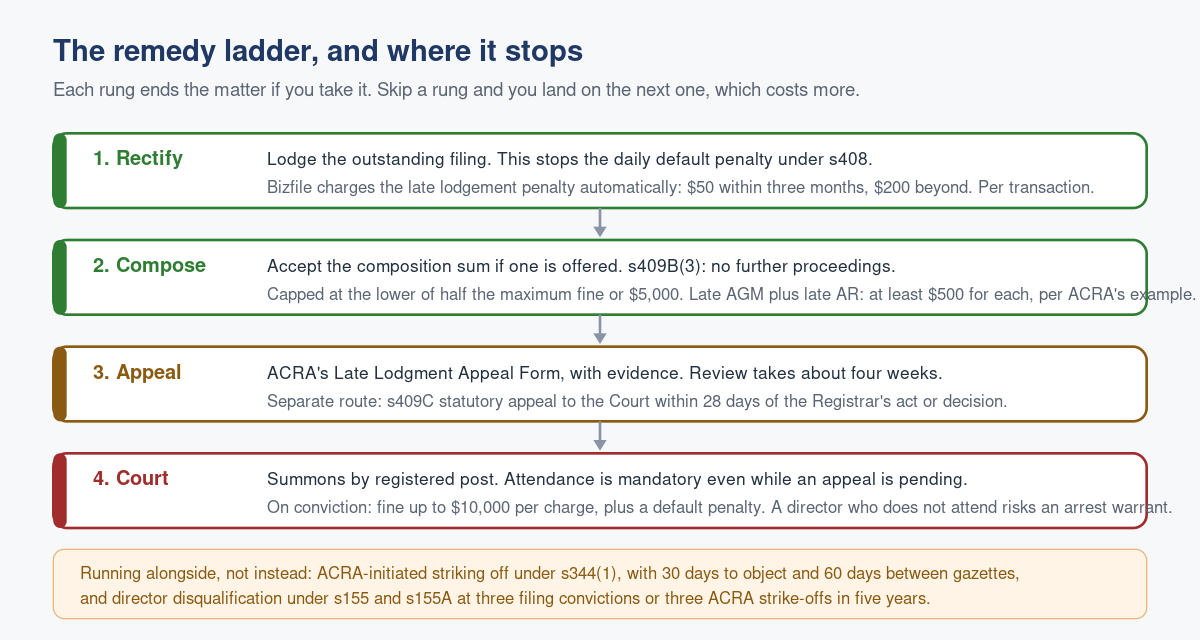
Fix the breach first, then deal with the money. For almost every common ACRA offence the sequence is the same: lodge the outstanding filing, pay the late lodgement penalty that Bizfile calculates automatically, accept a composition sum if one is offered, and appeal only afterwards and only on facts.
Raffles Corporate Services works with a panel of experienced Singapore law firms who offer cost-effective and efficient legal service and advice. This article is general information only and is not legal advice.
Doing it in that order matters. A company that argues about the penalty before it has filed the return is a company whose offence is still continuing, which under section 408 of the Companies Act 1967 means a default penalty can keep accruing daily. Rectification is what stops the clock. Everything else is negotiation.
Part 1 of this guide sets out which offences SMEs actually commit and what each one costs. This part sets out the remedy.
The remedy for each breach
| The breach | What you file to fix it | What you pay |
|---|---|---|
| Registered office not accessible (section 142) | Move the registered office to an address that is genuinely open and accessible, then lodge the change | Late lodgement penalty on the change filing, if any |
| Registered office change not notified (section 143) | Lodge the notice of change of registered office in Bizfile | $50 within three months of the due date, $200 beyond |
| Company name or registration number missing (section 144) | No filing. Correct your templates, invoices, receipts and publications | Nothing to ACRA, but section 144(2) personal liability on unnamed instruments does not disappear retrospectively |
| Officer change not notified (section 173A) | Lodge the appointment or cessation, one transaction per officer | $50 or $200 per late transaction |
| Undischarged bankrupt or disqualified person on the board (sections 148, 154, 155) | Cease the appointment and lodge it; obtain Court or Official Assignee permission if the person must continue | Nothing to lodge on the disqualification itself; the offence remains prosecutable |
| AGM not held (section 175) | Hold the meeting, then file | Composition, typically together with the annual return |
| Annual return not filed (section 197) | Lay the financial statements, then file the annual return | $300 within three months of the deadline, $600 beyond, plus composition where offered |
| False or misleading statement (section 401) | Lodge a correction; a Notice of Error may be the right instrument | This is not a filing problem. Take legal advice before doing anything |
Two remedies on that list are not really filings, and they are the two most often mishandled. Section 144 has no rectification transaction: you fix the documents, and the personal liability section 144(2) attaches to a negotiable instrument issued without the company’s name is a matter between the officer and the holder. Section 401 is a criminal exposure rather than an administrative one, and a company that quietly overwrites a false declaration usually makes its position worse.
Late lodgement penalties: how the amount is set
ACRA’s late lodgement penalty scale for companies is short. For filing due dates from 9 December 2024, the penalty is $50 where the default is within three months and $200 where it is more than three months.
Late annual returns sit on a separate and higher scale. For filing due dates on or after 14 January 2022, a late annual return attracts $300 if filed up to three months after the deadline and $600 beyond that.
Three mechanics are worth knowing before you file.
- The penalty is per transaction, not per session. Two director changes filed together, both more than three months late, produce $400, not $200. ACRA’s own worked examples confirm this.
- Bizfile calculates and charges it automatically. There is no negotiation at the point of filing and no option to file without paying. Whatever relief you get comes later, through an appeal.
- You can ask for more time before you are late. ACRA accepts applications for a 60-day extension of time to file the annual return, at a published fee of $200 per application. If you know in July that the accounts will be late, an extension is cheaper and cleaner than a penalty plus composition. Our step-by-step guide to filing the annual return covers where the extension sits in the process.
Composition: what it is and when to accept
Composition is the Registrar settling an offence for a sum of money instead of taking you to court. The power comes from section 409B of the Companies Act 1967, and the cap is written into the section: the Registrar may collect a sum not exceeding the lower of one half of the maximum fine prescribed for the offence, or $5,000. Section 409B(3) is the part that matters commercially: once the sum is paid, no further proceedings may be taken against that person in respect of that offence.
Only offences prescribed as compoundable can be composed, and the Minister prescribes which ones.
What a composition typically looks like
Because a late AGM usually causes a late annual return, ACRA often deals with both breaches in the same offer. ACRA’s published example of a company whose financial year ended 31 December, which held its AGM and filed its annual return roughly one month late in each case, shows a composition sum of at least $500 for each of the two breaches.
“At least” is doing real work in that sentence. The figure is a floor, not a tariff, and it rises with the length of the default and the company’s history.
Should you accept?
Almost always, yes, and quickly. Accepting composition ends the matter under section 409B(3). Declining does not get you a lower number: it gets you a summons. ACRA will prosecute where composition is not accepted, where there are multiple or repeated late filings, or where it decides not to offer composition at all.
The narrow case for not accepting is where you genuinely did not commit the offence, for example where the filing was made on time and the record is wrong, or where you were never an officer of the company. That is a factual dispute, and it belongs in an appeal or in court, not in ignoring the offer.
If it goes to court
The prosecution process has three stages, and the costly mistakes are procedural rather than legal.
- Summons. ACRA sends it by registered mail to the company’s registered office or to the director’s home address. It states the court, the date and the time. This is the point at which a stale registered office address becomes genuinely expensive, because a summons you never read is still a summons.
- Attendance. A director, or a representative carrying a letter of authority, must attend. If the company sends nobody, the court may hear the matter in the company’s absence. If a director fails to attend, a warrant for their arrest will be issued. Attendance is required even while an appeal is being processed. That is the single most commonly missed point in the whole process.
- Verdict. On conviction, the fine can be up to $10,000 per charge, and a default penalty may also apply.
In court the representative can accept composition if ACRA offers it after the summons has issued, plead guilty, or claim trial.
Appealing a penalty or a summons
A director may appeal to ask ACRA to reduce a penalty or review a summons. The route is ACRA’s Late Lodgment Appeal Form, with supporting documents attached. ACRA indicates a review takes about four weeks, longer during peak periods or where it needs clarifications, and says each case is assessed on its own merits.
Separately, and quite differently, section 409C of the Companies Act 1967 gives any party aggrieved by an act or decision of the Registrar the right to appeal to the Court within 28 days of the act or decision. That is a statutory appeal against a decision, not a request for leniency on a penalty, and it does not apply where the Act provides its own review mechanism or declares the decision final. For most SME penalty disputes the administrative appeal form is the right door. For a refusal or a register decision you say the Registrar got wrong, section 409C is the one to look at.
What ACRA is actually looking for
ACRA does not publish a scoring rubric, and we would not invent one. What we can say from filing these is which appeals read well and which do not.
Appeals that tend to work set out a specific, evidenced, external cause and show the breach has already been rectified: a hospitalisation with dates, a bereavement, a filing agent’s documented failure, a fire or flood with an incident report. They are short, they attach the proof, and they say what has been put in place so it does not recur.
Appeals that tend not to work assert that the company was busy, that the director did not know the deadline, that the accountant was slow, or that the company is dormant. None of those are defences, and a dormant company still has to file. Our Companies Act 1967 deep-dive FAQ is a useful reminder that low activity reduces the work, not the obligation.
What goes wrong at the remedy stage
Filing in the wrong order. Directors sometimes lodge an appeal and wait for the outcome before filing the overdue return. The default continues while they wait, the daily default penalty under section 408 keeps running, and any goodwill the appeal might have earned is gone because the breach is still live. File first. Appeal second.
Missing court because an appeal is pending. ACRA is explicit that scheduled court dates must still be attended while an appeal is processed. A director who stays away on the assumption the appeal has paused matters risks a warrant.
Fixing the filing and not the cause. A company that files three years of overdue returns in one week has solved a symptom. If the returns were late because the bookkeeping was never current, the same thing happens next year. The useful question is not “how do we file this” but “why were we not ready”.
Forgetting the striking-off and disqualification consequences. Enforcement does not stop at money. ACRA can strike a company off under section 344(1) of the Companies Act 1967 where it has reasonable cause to believe the company is not carrying on business or is not in operation, and consecutive unfiled annual returns are a common trigger. The sequence is a striking-off notice, 30 days to object, a first gazette notification, then a final gazette notification 60 days later, at which point the company no longer legally exists. Under sections 155 and 155A, three or more filing convictions in five years bring a five-year disqualification, and three or more ACRA strike-offs in five years bring three years for a first occurrence and five for a repeat. Debarment is a lighter separate sanction that can follow a failure to lodge for a continuous period of three months or more, and it blocks new appointments as a director or company secretary.
If your company has already been struck off, restoration is a court process rather than a filing, and the register rebuild afterwards is its own exercise: see our note on restoring statutory registers and records after court restoration.
Frequently asked questions
Does paying a composition sum mean I have a criminal record?
No. Composition settles the offence without a conviction, and section 409B(3) of the Companies Act 1967 bars further proceedings in respect of that offence once the sum is paid. A conviction only arises if the matter goes to court and you plead or are found guilty.
Can I appeal the late lodgement penalty after I have already paid it?
Yes. Bizfile charges the penalty automatically at the point of filing, so payment is normally unavoidable and does not prejudice an appeal. Submit ACRA’s Late Lodgment Appeal Form with your evidence. ACRA indicates about four weeks for review, and each case is assessed on its own facts.
How much is a composition sum for a late AGM and annual return?
ACRA’s published example for a company roughly one month late on both shows at least $500 for the late AGM and at least $500 for the late annual return. That is a floor rather than a fixed rate. The sum rises with the length of the default and with the company’s filing history.
If I file everything late in one go, do I pay one penalty or several?
Several. Late lodgement penalties are charged per late transaction. Two overdue director changes are two penalties, not one. ACRA’s own examples show two director changes filed more than three months late producing $400 in total.
My company is dormant. Do I still have to fix this?
Yes. Dormancy reduces the content of your filings, not the obligation to make them. A dormant company that stops filing annual returns is a standard candidate for ACRA-initiated striking off under section 344(1), and its directors are exposed to the same disqualification thresholds.
Do I have to attend court if my appeal has not been decided?
Yes. ACRA states that scheduled court dates must still be attended while an appeal is being processed. If a director does not attend, a warrant for arrest will be issued. Send a director or a representative with a letter of authority regardless of the appeal’s status.
Getting off the back foot
The remedies in this article all work. They are also all more expensive and more stressful than not needing them, and the gap between the two is mostly a calendar.
Raffles Corporate Services files officer and address changes inside the 14-day window, works the annual cycle backwards from the financial year end rather than forwards from ACRA’s reminder, and reconciles your registers against ACRA’s before every year end. If you are currently in the middle of one of these problems, we deal with the rectification and the appeal together, in that order. There is more on Singapore corporate secretarial practice at Singapore Secretary Services, and you can verify every provision cited here on Singapore Statutes Online or against ACRA’s enforcement and penalties guidance.
— The Editorial Team, Raffles Corporate Services
Need help with corporate secretarial or compliance matters?
If you would like help with your company's corporate secretarial, governance or compliance requirements, email [email protected] or WhatsApp +65 8501 7133.
Our team can assist with corporate secretarial, accounting and tax matters. Where legal advice is needed, advisers from our associated law firms can assist.