

Almost every ACRA offence a Singapore SME commits comes from one of six provisions of the Companies Act 1967: the registered office rules, the name and registration number rules, the director eligibility rules, the 14-day notification rules, the annual cycle, and false statements. None of them involve fraud. Nearly all of them involve forgetting.
Raffles Corporate Services works with a panel of experienced Singapore law firms who offer cost-effective and efficient legal service and advice. This article is general information only and is not legal advice.
Directors brace for the dramatic offences and get caught by the boring ones. The company that gets a summons is almost never the company that lied to the Registrar. It is the company whose registered office is a locked unit above a shop, or whose annual return slipped past the deadline because the accounts were not ready.
This article sets out which offences are actually committed, what each one costs, and the administrative habit behind each. Part 2 deals with the remedy: the rectification filing for each breach, how composition works, and what ACRA looks at when you appeal.
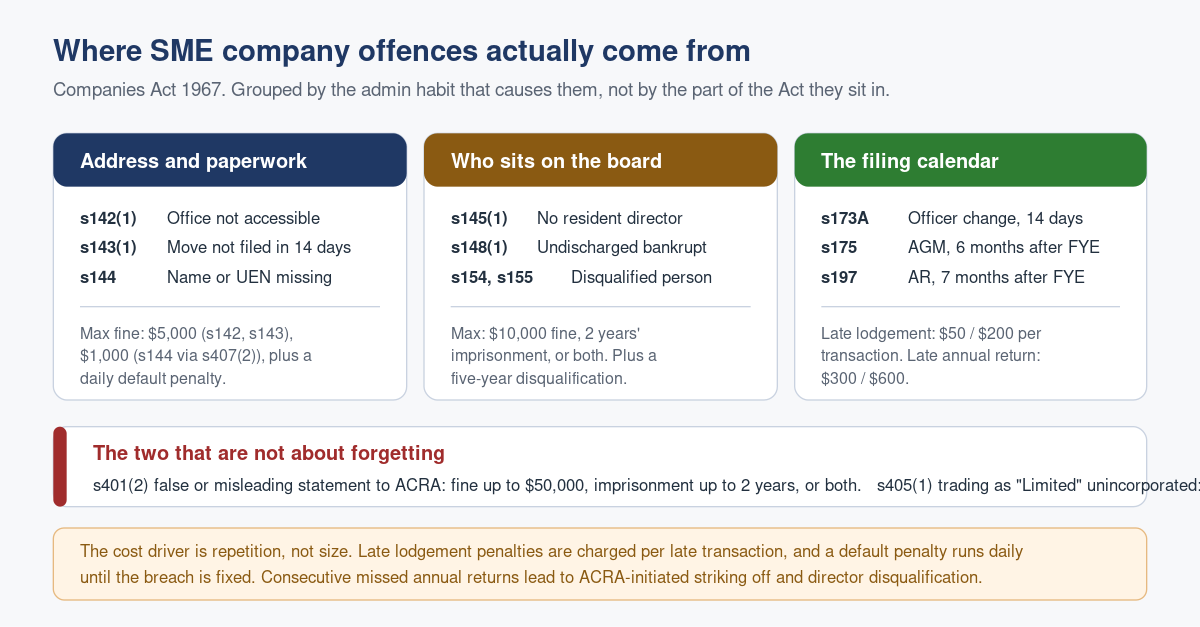
The offences at a glance
| The breach | Provision | Maximum on conviction | Why it happens |
|---|---|---|---|
| No properly maintained registered office | Section 142(1) | Fine up to $5,000, plus a default penalty, against the company and each officer in default | The office exists on paper but nobody is there, or the unit is locked |
| Registered office change not notified in 14 days | Section 143(1) | Fine up to $5,000, plus a default penalty | The move happened, the filing did not |
| Company name or registration number missing from documents | Section 144 | No figure in the section, so the general penalty in section 407(2) applies: fine up to $1,000 | New invoice template, new e-commerce platform, new letterhead |
| Undischarged bankrupt or disqualified person acting as a director | Sections 148(1), 154, 155 | Fine up to $10,000, imprisonment up to 2 years, or both | The bankruptcy or disqualification was never diarised against the directorship |
| Officer change not notified in 14 days | Section 173A | Late lodgement penalty of $50 within three months, $200 beyond | The resignation letter was signed and filed in a drawer |
| AGM not held in time | Section 175 | Composition, or prosecution | The accounts were late, so the meeting was late |
| Annual return not filed in time | Section 197 | $300 or $600 late lodgement penalty, escalating to a fine of up to $10,000 per charge on conviction | Same reason as the AGM |
| False or misleading statement to ACRA | Section 401(2) | Fine up to $50,000, imprisonment up to 2 years, or both | Signing a declaration nobody read |
| Unregistered business using “Limited” | Section 405(1) | Fine up to $10,000, imprisonment up to 2 years, or both | A trading name adopted without checking |
Two phrases in that table deserve more attention than they get. “And also to a default penalty”: under section 408 of the Companies Act 1967 a default penalty runs for each day the breach continues after conviction or composition, and where the section does not state an amount the cap is $200 per day. A one-off $5,000 fine is survivable; a daily penalty on a breach nobody has fixed is not. “Each officer in default”: section 408(3) defines that as an officer who knowingly and wilfully commits, authorises or permits the offence. Directors are named personally, and the fine is theirs personally.
The registered office rules, and why they are breached so often
Section 142(1) of the Companies Act 1967 requires a company to have a registered office in Singapore from the date of incorporation, to which communications and notices can be addressed, and which is open and accessible to the public for not less than three hours during ordinary business hours on each business day.
That last part is what people miss. The registered office is not just an address for letters. It is a place a member of the public is entitled to walk into for at least three hours a day.
Where it goes wrong
The common failure is not a company with no address. It is a company whose address is real but unattended: a founder’s flat while the founder is overseas, a co-working desk that lapsed, a shophouse unit open only when there is a delivery. If ACRA sends a notice and nothing comes back, the address has failed at the one job the Act gives it.
Section 143(1) requires notice of the situation of the registered office, and of the days and hours it is open, to be lodged, and where those particulars change later, within 14 days. A useful quirk: if the office is open for at least five hours during ordinary business hours on each business day, no notice of the days and hours is required at all.
The name and number on your documents
Section 144(1) requires the company’s name to appear in legible romanised letters on its seal, if it has one, and on all business letters, statements of account, invoices, official notices, publications, bills of exchange, promissory notes, indorsements, cheques, orders, receipts and letters of credit issued or signed on its behalf. Section 144(1A) requires the registration number on business letters, statements of account, invoices, official notices and publications.
The fine is small: the Act attaches no figure to section 144, so section 407(2) caps it at $1,000.
The real exposure is section 144(2). An officer who signs or authorises a bill of exchange, promissory note, other negotiable instrument, indorsement or order that omits the company’s name is personally liable to the holder for the amount due unless the company pays it. That is not a regulatory fine. That is a director’s own money on a commercial instrument.
This breach arrives through templates. A new invoicing system or payment-platform receipt gets built without the UEN on it, and nobody notices because the company has been trading happily for years. If you have changed billing software in the last twelve months, that is worth a five-minute check.
The director rules that catch competent people
At least one ordinarily resident director
Section 145(1) requires every company to have at least one director ordinarily resident in Singapore, and where the company has only one member that sole director may also be the sole member. Section 145(2) restricts directorship to a natural person aged at least 18 with full legal capacity.
The provision that surprises people is section 145(5). A director must not resign or vacate office unless at least one ordinarily resident director remains, and a purported resignation in breach of that is invalid. Not penalised. Invalid. The person is still a director and still carries the exposure. Founders who tender a resignation on the way out and assume the matter is closed are frequently still on the register two years later.
Bankruptcy and disqualification
Section 148(1) makes it an offence for an undischarged bankrupt to act as a director of, or take part in the management of, any corporation without the permission of the Court or the written permission of the Official Assignee. Section 154 disqualifies a person convicted of an offence involving fraud or dishonesty punishable with imprisonment of three months or more, and certain offences and civil penalties under the Securities and Futures Act 2001. That disqualification generally runs five years from conviction under section 154(4), or five years from release where a prison sentence was imposed, and acting as a director during it is itself an offence under section 154(5). Section 155 does the same for persistent filing default, and only the Court can lift it.
These happen because personal insolvency and a directorship sit in different mental files, and a disqualified director rarely gets a diary reminder five years later. Our note on shadow directors covers the related trap of stepping back from a board without actually stepping back.
The 14-day clock, and the annual cycle
Two rhythms generate most of ACRA’s enforcement volume.
The 14-day clock. Changes to your directors, chief executive officer, secretary or auditor must be notified within 14 days. Section 173A carries the duty, section 173E gives a disqualified director their own duty to tell the company, and section 173H lets an officer who has resigned, been removed or retired notify the Registrar themselves if they have reasonable cause to believe the company will not. Worth knowing if you are the one leaving: you do not have to rely on the company to file.
The annual cycle. For a private company, the AGM must be held within six months of the financial year end under section 175, and the annual return filed within seven months under section 197. The two are causally linked, which is why they are almost always breached together: the return cannot be filed without financial statements laid before members, so late accounts produce a late meeting, and a late meeting produces a late return.
Late annual returns carry their own scale: $300 within three months of the deadline, $600 beyond. Our guide to filing the annual return covers the mechanics, and if the year end itself is wrong, changing your financial year end is sometimes the better fix.
False statements, and the “Limited” trap
Section 401(2) makes it an offence to wilfully make, or authorise the making of, a statement false or misleading in a material particular in any return, report, certificate, balance sheet, financial statements or other document required for the purposes of the Act, knowing it to be false or misleading. Section 401(2A) extends this to lodging a document known to be false or misleading in a material respect. Both carry a maximum fine of $50,000, imprisonment of up to 2 years, or both.
It is not committed by liars. It is committed by directors who sign declarations they have not read. The amended Form 45 declaration on money-laundering disqualifications is a live example: it is a personal declaration, and a careless one is a section 401 exposure.
Section 405(1) is narrower but trips up new businesses. A person other than a foreign company who trades under a name whose final word is “Limited” or “Berhad”, or any abbreviation, imitation or translation of those words, or who holds out that the business is incorporated when it is not, commits an offence carrying up to $10,000, 2 years’ imprisonment, or both. Section 405(3) does the same for holding a business out as a registered foreign company.
What actually goes wrong
Three patterns account for most of the files that land on our desk.
The silent address. A company moves, or the person who collected the post leaves, and ACRA correspondence stops being read. The first the directors hear of a problem is a summons or a striking-off notice, because every warning went to an address nobody was checking. It disables every early warning the system gives you.
The accumulating small breach. Late lodgement penalties are charged per late transaction. A company that lets three director changes and an address change drift past 14 days faces four separate penalties, and $200 each once three months have passed.
The consecutive missed year. Missing one annual return is a penalty. Missing several puts the company in scope for ACRA-initiated striking off and its directors in scope for disqualification: three or more companies struck off within five years, or three or more filing convictions in five years, and the disqualification follows.
The individual breach is cheap. The habit is expensive.
Frequently asked questions
Can I be fined personally for my company’s ACRA offence?
Yes. Many provisions, including sections 142 and 143, expressly make the company and every officer in default liable. Section 408(3) defines an officer in default as one who knowingly and wilfully commits, authorises or permits the offence. The fine is imposed on the individual.
What is a “default penalty” and how is it different from a fine?
A fine is a one-off amount imposed on conviction. A default penalty runs daily for as long as the breach continues after conviction or composition, under section 408 of the Companies Act 1967. Where the section does not state an amount, the cap is $200 for each day. Fixing the breach stops the clock.
My registered office is my corporate secretary’s address. Am I safe?
Largely, yes, provided that office genuinely meets the section 142(1) accessibility requirement and you read what arrives there. The breach we see is not the address but the handover: notices reach the secretary, the secretary forwards them, and nobody at the company opens the email.
I resigned as a director but ACRA still lists me. What happened?
Either nobody filed the change within 14 days, in which case you may notify the Registrar yourself under section 173H, or your resignation would have left the company without an ordinarily resident director, in which case section 145(5) makes it invalid and you remain a director.
Which of these offences is the most expensive in practice?
Section 401 carries the highest statutory maximum at $50,000, but the most expensive outcome for most SMEs is a run of unfiled annual returns, because it triggers late lodgement penalties, then composition or prosecution at up to $10,000 per charge, then ACRA-initiated striking off, then director disqualification.
Where to go from here
Every offence here is fixable, and most are fixable cheaply if you act before ACRA does. Part 2 of this guide sets out the rectification filing for each breach, how a composition offer works and when to accept one, and what ACRA weighs when you appeal.
If you are not certain which of these apply to you, pull your own ACRA records and compare them with what you believe to be true. Our guide on what Bizfile is and what you can and cannot do in it is the place to start, and the Companies Act 1967 deep-dive FAQ answers the questions that follow. Verify any provision cited here on Singapore Statutes Online and check the current scales on ACRA’s late lodgement penalties page.
Raffles Corporate Services runs this check as a matter of course: registers reconciled against ACRA, changes filed inside 14 days, and the annual cycle diarised backwards from the year end rather than forwards from a reminder letter. If you suspect something has drifted, that is a short conversation and usually a quick fix. There is more on Singapore corporate secretarial practice at Singapore Secretary Services.
— The Editorial Team, Raffles Corporate Services
Need help with corporate secretarial or compliance matters?
If you would like help with your company's corporate secretarial, governance or compliance requirements, email [email protected] or WhatsApp +65 8501 7133.
Our team can assist with corporate secretarial, accounting and tax matters. Where legal advice is needed, advisers from our associated law firms can assist.