

Sole proprietors and partnerships answer to the Business Names Registration Act 2014, not the Companies Act, and it has fewer traps: notify ACRA of changes within 14 days, do not let an undischarged bankrupt run the business, do not trade unregistered or under an unregistered name, and do not give ACRA false information. Four rules.
Raffles Corporate Services works with a panel of experienced Singapore law firms who offer cost-effective and efficient legal service and advice. This article is general information only and is not legal advice.
The fines are not the dangerous part. The dangerous part is section 31 of the Act, which can stop a defaulting business from suing its own customers. That provision gets almost no attention and has cost real money to real businesses in Singapore.
Here is what the four offences actually require, what happens if you get them wrong, and the two mechanisms in the Act that hurt more than any fine.
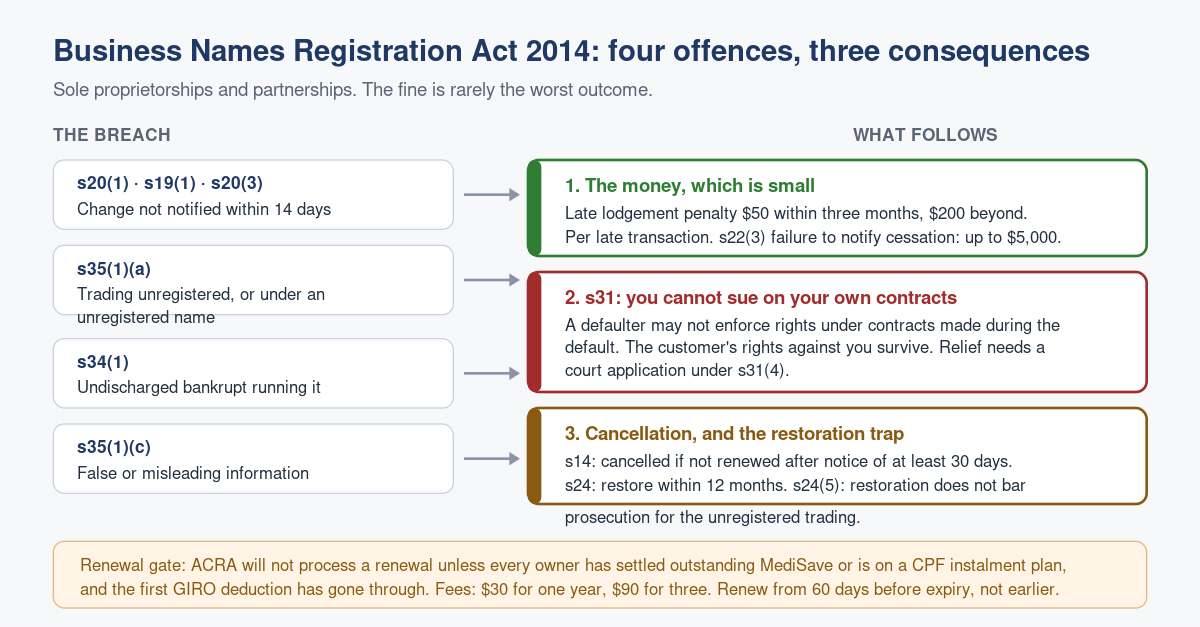
The four offences, and what they mean in practice
| The offence | Provision | What it actually catches |
|---|---|---|
| Failing to notify ACRA of a change in registered particulars within 14 days | Section 20(1) | Change of business address, business activity, owners, partners, authorised representatives |
| An undischarged bankrupt managing or running a business | Section 34(1) | Continuing to run the business through a personal bankruptcy without written permission from the Official Assignee or leave of the High Court |
| Carrying on business without proper registration | Section 35(1)(a) | Trading before registering, trading under a name you never registered, trading after the registration was cancelled or ceased |
| Providing false or misleading information | Section 35(1)(c) | Signing a Bizfile declaration that is untrue, or that omits something material |
There is one exemption worth knowing before you worry about the third one. Under section 4(1) of the Act you are not required to register if you are an individual proprietor carrying on business under only your full legal name, or a firm of two or more individuals carrying on business under only the full names of all of them. Add a trading style, even a small one, and the exemption is gone. “Tan Wei Ming” is exempt. “Tan Wei Ming Design” is not.
The 14-day rule is wider than most owners think
Section 20(1) of the Business Names Registration Act 2014 requires that whenever a change is made or occurs in any of the particulars registered in respect of a person, that person must lodge a notice of the change within 14 days, or such further period as the Registrar may on application allow.
“Any of the particulars registered” is the operative phrase. Section 6(1) lists what gets registered at the outset: the business name, the general nature of the business, the principal place of business, the full name, identification, nationality and residential address of the individual proprietor or of every partner, and the same for every authorised representative. Change any of those and the clock starts.
Two related duties sit alongside it:
- Section 19(1): an individual proprietor, a partner of a registered firm, or an authorised representative who changes residential address must lodge notice within 14 days. If you are a Singapore citizen or permanent resident who has already reported the move to the Immigration and Checkpoints Authority under the National Registration Act 1965, section 19(2) treats you as having told the Registrar. Foreigners get no such relief.
- Section 20(3): where a person ceases to be a partner of a registered firm, both that person and the continuing partners must lodge notice within 14 days. A departing partner who assumes the others will handle it is still the one in default.
Late notices attract ACRA’s late lodgement penalty: $50 where the default is within three months and $200 beyond, for filing due dates from 9 December 2024. Penalties are charged per late transaction, so a partnership that changes address and swaps two partners in the same quarter and files late pays three times over.
The one everyone forgets: ceasing business
Section 22(1) requires a registered person who stops carrying on business under a registered business name to lodge notice within 14 days. Section 22(3) makes failure an offence carrying a fine of up to $5,000.
That is the highest verified figure in this article and it applies to the most passive possible failure: closing the shop and not telling anyone. Owners who wind down quietly and let the registration lapse on its own have not complied. Filing the cessation notice is the compliant exit, and section 22(2) even lets you give the Registrar advance notice of the date you intend to stop.
Section 31: the provision that stops you suing
This is the one to read twice.
Section 31 of the Business Names Registration Act 2014 applies where a person required to be registered either carries on business under a business name without being registered for it, carries on business after the registration has been cancelled or has ceased and not been restored, or fails to lodge a notice required under section 19(1) or 20(1) or (3).
Where it applies, section 31(2) says the defaulter may not enforce, by action or other legal proceeding, any right under or arising out of any contract relating to that business, if the contract was made at a time when the default existed.
Read plainly: if you were late notifying a change of partner and you signed a supply contract during that window, your ability to sue on that contract is impaired. The customer’s rights against you are untouched, because section 31(6) preserves them, and section 31(7) lets you raise your rights defensively by counterclaim or set-off if they sue you first. But you cannot go on the offensive.
There is relief. Section 31(4) lets the defaulter apply to the court, and section 31(5) lets the court grant it where the default was accidental, due to inadvertence or some other sufficient reason, or where it is just and equitable. Section 31(3) also lifts the disability where a cancelled or ceased registration is restored under section 24.
None of that is free or quick. A court application to recover the right to sue on a debt is a disproportionate way to collect a debt. A $50 late lodgement penalty paid on time is the cheap version.
Renewal is where registrations die
The most common reason a sole proprietorship ends up trading without registration is not defiance. It is a missed renewal.
- ACRA sends a renewal reminder letter to your residential address 60 days before expiry, and an SMS reminder if you have not renewed within 30 days of the expiry date.
- You can renew from 60 days before expiry, and no earlier. The fee is $30 for one year or $90 for three, non-refundable, and approval is immediate.
- Under section 14, if the registration expires the Registrar gives written notice that it may be cancelled unless renewed within a stated period of at least 30 days. ACRA indicates cancellation may follow 60 days after expiry.
- Section 14(4) matters: you remain registered after expiry unless the registration is cancelled. Expiry alone does not end it. Cancellation does.
- If it is cancelled, section 24 lets you apply to restore within 12 months, or such longer time as the Registrar allows in special circumstances, on payment of outstanding renewal fees and any prescribed late renewal penalty.
The sting in restoration
Section 24(4) treats a restored registration as if it had never been cancelled. Section 24(5) then says, in terms, that this does not prevent the person from being prosecuted and punished for an offence under section 35(1)(a).
Restoration cleans up the register. It does not retrospectively legalise the trading you did while unregistered.
MediSave is a renewal gate, not a CPF matter
Section 12(2) of the Act lets the Registrar cancel a registration where the CPF Board notifies that the person has failed to comply with the CPF Act 1953 obligation on contributions. In practice ACRA will not process a renewal unless every owner has paid outstanding MediSave in full or is on a monthly instalment arrangement with the CPF Board, and a three-year renewal requires either no outstanding MediSave or 24 consecutive months of instalment payments.
Setting up GIRO is not enough on its own. You must wait for the first successful deduction before the renewal will go through. Our guide to CPF MediSave contributions for self-employed persons explains how the liability is computed, and the CPF Board holds the definitive position on your account.
What goes wrong in practice
The reminder goes to an address you left. ACRA sends the renewal reminder to your residential address. If you have moved and not filed under section 19(1), you have committed one offence and disabled the warning system for a second. In our experience this is the single most common cause of a cancelled sole proprietorship.
The business name drifts. A sole proprietor registers one name, then starts invoicing under a shortened version, a new brand, or a second line of business. Trading under a name other than your registered business name is caught by section 15(1) and by section 35(1)(a). Section 5(2) requires a separate registration for each name: one registration does not cover a family of brands. If you have moved online, our note on setting up an online business in Singapore covers how registration, licensing and consumer protection interact.
All the owners move abroad. Section 11(1) requires at least one authorised representative, ordinarily resident in Singapore and at least 18, where the individual proprietor or all the partners do not reside here. If they cease to reside here after registration, the appointment must be made within 30 days, and notice of appointment and of consent lodged within 14 days of it. Failure to comply with section 11(1), (7) or (9) carries a fine of up to $1,000 under section 11(12), and under section 11(5) and (6) the representative is personally responsible for the business’s obligations and subject to the same penalties.
The declaration gets signed without reading. Section 35(1)(c) covers giving ACRA information you know to be untrue, information you have good reason to believe is false, or omitting something material so that the submission misleads. If a corporate service provider files on your behalf, the declaration is still yours. The Corporate Service Providers Act 2024 compliance FAQ sets out what your provider is separately obliged to verify.
Frequently asked questions
Do I need to register if I trade under my own name?
No. Section 4(1)(a) of the Business Names Registration Act 2014 exempts an individual proprietor carrying on business under only their full legal name, and section 4(1)(b) exempts a firm of individuals using only all their full names. Any additional word, brand or descriptor removes the exemption and registration becomes compulsory.
What happens if my business registration expires and I keep trading?
Expiry alone does not cancel your registration: section 14(4) keeps you registered until the Registrar cancels it. Once it is cancelled, continuing to trade is caught by section 35(1)(a), and section 31 may bar you from enforcing contracts made while unregistered. Renew or restore promptly.
Can I still sue a customer if I was late filing a change with ACRA?
Possibly not. Section 31(2) bars a defaulter from enforcing rights under contracts made during the period of default, including default on a section 20(1) notice. You may apply to the court under section 31(4) for relief, and the court may grant it where the default was accidental or inadvertent, but that is an extra application.
How much is the penalty for filing a change late?
ACRA’s late lodgement penalty for sole proprietorships and partnerships is $50 where the default is within three months of the due date and $200 where it is more than three months, for filing due dates from 9 December 2024. The penalty is charged per late transaction, so several late filings multiply.
Do I have to tell ACRA when I close the business?
Yes, within 14 days of stopping, under section 22(1). Failure is an offence carrying a fine of up to $5,000 under section 22(3). Section 22(2) also allows you to give advance notice of the date you intend to stop, which is the tidier way to do it.
My partner left the firm. Whose job is it to file?
Both. Section 20(3) imposes the duty on the departing partner and on the partners who continue. If one of those people cannot be located, section 20(4) allows the Registrar to let the others file alone. Do not assume the remaining partners will handle it on your behalf.
Keeping a small business out of this entirely
None of this is difficult. It is just easy to forget, because a sole proprietorship has no AGM, no auditor and no annual return to force an annual review. The register goes stale quietly.
Two habits cover almost all of it. File any change of particulars the week it happens rather than the month it happens, and diarise the renewal date yourself instead of relying on a letter reaching an address you may have left. If you are weighing whether the structure still fits, the compliance load on a private limited company is heavier, and our companion guide on the ACRA offences companies actually commit is a fair picture of what you would be taking on.
Raffles Corporate Services handles registration, renewals and changes of particulars for sole proprietorships and partnerships as well as for companies, and we file inside the 14-day window as a matter of routine. If your registration has already been cancelled, or you are not sure whether your trading name matches what is on the register, that is a short conversation. You can verify every provision cited here on Singapore Statutes Online, check the current penalty scale on ACRA’s late lodgement penalties page, and read more on Singapore practice at Singapore Secretary Services.
— The Editorial Team, Raffles Corporate Services
Need help with corporate secretarial or compliance matters?
If you would like help with your company's corporate secretarial, governance or compliance requirements, email [email protected] or WhatsApp +65 8501 7133.
Our team can assist with corporate secretarial, accounting and tax matters. Where legal advice is needed, advisers from our associated law firms can assist.