

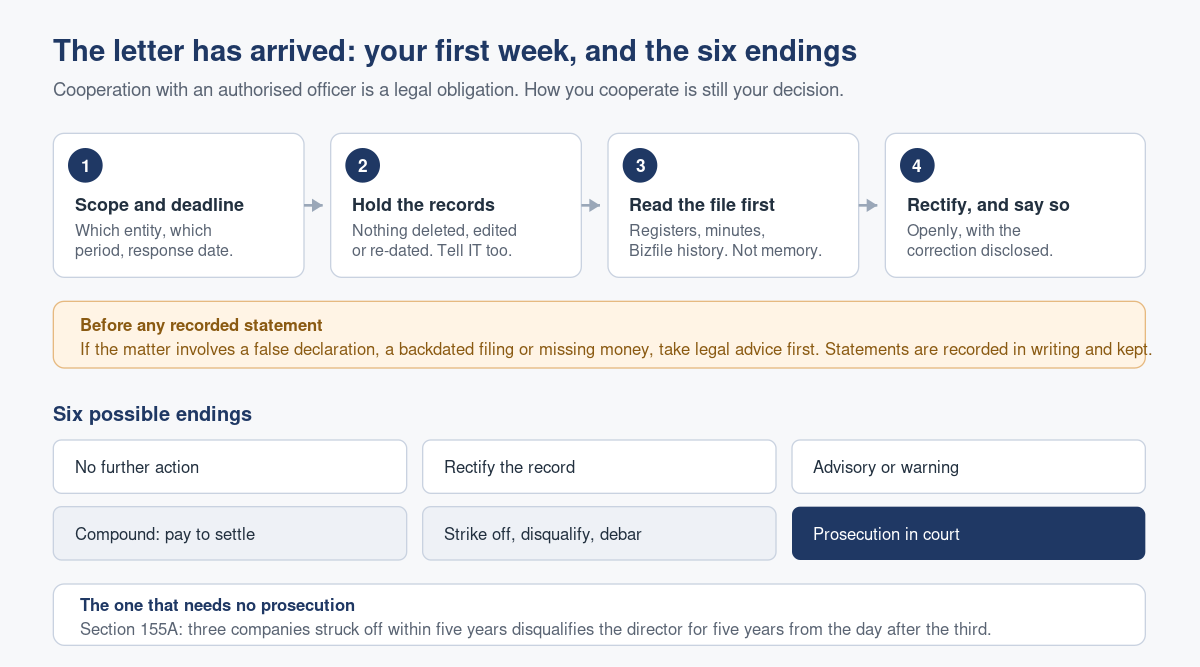
Do three things before you do anything else. Work out precisely what the letter is asking for and by when. Stop anyone in the company from altering, tidying or discarding any record that touches the subject matter. Then get the full underlying file in front of you, not a summary of it.
Raffles Corporate Services works with a panel of experienced Singapore law firms who offer cost-effective and efficient legal service and advice. This article is general information only and is not legal advice.
Cooperation is not optional. When an authorised ACRA officer exercises the investigation powers in the ACRA Act 2004, you are legally obliged to comply. Arguing with that is not a strategy.
But cooperation is not the same as improvisation. Most of the damage directors do to themselves happens in the first fortnight, before anybody has been prosecuted, and it is nearly always one of two things: silence, or answering from memory when the documents would have said something better.
What the officer can actually require of you
It is worth knowing the shape of the powers, because it tells you what to prepare for.
| The power | What it means for you |
|---|---|
| Proof of identity | If the officer reasonably believes you committed an offence, you must produce evidence of who you are |
| Information and documents | Any person can be required to give information and produce any book, document or copy in their possession, and the officer may inspect, copy or take extracts at no cost |
| Attendance as a witness | By order in writing, you can be required to attend before the officer if you are in Singapore and appear to know the circumstances of the case |
| Interview | You can be questioned if the officer reasonably believes you know the facts or circumstances, and your answers are recorded in writing |
| Taking evidence | Premises and people connected with the investigation may be photographed or video recorded |
| Access to premises | You must give the officer free access to your premises for the investigation |
These powers are conditional: exercisable where the officer reasonably believes an offence has been committed, or that you hold relevant information. In practice the trigger is obvious from the letter.
Two features deserve attention. First, the power to require documents reaches anyone who has them, including your corporate service provider, your accountant and your bank. What you hand over is not the only version ACRA will see. Second, your answers in an interview are recorded in writing, and a recorded statement is durable. It will be read back to you months later and compared against the documents.
The first week, in order
- Read the letter for two things only: the scope and the deadline. Which entity, which period, which obligation, and what date the response is due. Diary it immediately. If you genuinely cannot meet it, ask for an extension before it passes rather than after.
- Issue a hold on records. Tell whoever has custody of the books, filings, minutes, bank records and email that nothing relating to the subject matter is to be deleted, edited, re-dated or “cleaned up”. This is the most important instruction you will give, and it needs to reach your bookkeeper and your IT support, not just your co-directors.
- Assemble the file, then read it. Registers, board minutes, filed documents and the Bizfile transaction history for the period. Know what the record says before you tell anyone what you remember.
- Separate the record problem from the conduct problem. A late annual return is a record problem. A consent to act that nobody signed is a conduct problem. Conflating them is how an administrative matter acquires a dishonesty flavour it never had.
- Fix what is properly fixable, and say that you have. Where the breach is a filing that can still be made or a record that can be corrected, rectification counts in your favour. Do it and disclose it. What you must not do is quietly amend records mid-investigation and hope nobody notices the amendment date.
- Decide whether you need counsel before you need it. If the subject matter involves a false declaration, a backdated filing, missing money, or anything where somebody could say you knew, take legal advice before giving a recorded statement. If it is arrears of annual returns, you need a corporate secretary and a cheque, not a lawyer.
- Answer in writing, with documents attached. Then keep a copy of everything you sent and the date you sent it.
What not to do
Do not ignore it. Non-response is the pattern that pushes a company towards striking off, and it removes every soft landing that was available.
Do not let someone else answer in your name. If your corporate service provider drafts the reply, read it line by line. It is your statement.
Do not guess at dates. “Around the middle of last year” in a recorded statement, contradicted later by a Bizfile timestamp, is how an honest director acquires a credibility problem.
Do not assume it is about the thing you are worried about. Directors routinely volunteer an unrelated problem. Answer what was asked.
The six ways this can end
When the investigation is complete, the matter is assessed on its own facts. Severity, your cooperation during the investigation and whether you have been here before are the factors that move the outcome. The possible endings are:
- No further action. It happens, and more often than directors expect.
- A request that you rectify the matter. The record gets fixed and that is the end of it.
- An advisory or a warning. On file, but not a penalty.
- An offer to compound. You pay a sum to settle the breach without a prosecution.
- Other regulatory tools. Striking off, disqualification, or a debarment order.
- Prosecution in court.
Cooperation and rectification are both named factors, and both are within your control after the letter arrives, which is more than can be said for the underlying breach.
The consequences that follow you, not the company
Two of the tools attach to you personally and survive the company.
Striking off, and the three-company rule
ACRA may strike a company off the register where there are reasonable grounds to believe it is not in operation. The signals are cumulative: repeated failure to hold AGMs, unfiled annual returns, a registered office address that no longer works, and no response to ACRA’s letters. A struck-off company ceases to exist as a legal entity.
Then section 155A of the Companies Act 1967 does something many directors have never heard of. A director with at least three companies struck off by ACRA within five years is disqualified from acting as a director and from taking part in the management of any company, for five years from the day after the third striking off.
Read that again if you hold directorships in several dormant or wound-down entities. Nobody has to prosecute you and you need not have done anything dishonest. Letting three shells lapse into striking off inside a five-year window is enough, and the consequence hits every other company you are involved in, including the profitable one. Leaving a directorship properly, rather than abandoning it, matters for exactly this reason: see the trapped nominee director’s exit.
Debarment
A debarment order under section 155B stops you taking on new appointments as a director or company secretary. It is aimed at repeated failure to meet Companies Act 1967 requirements, and it restricts what you can do next rather than punishing a single act. If you take on multiple appointments, professionally or across a family group of companies, debarment is the outcome that costs you most.
How the decision to prosecute is made, and what that means for your reply
Two questions drive it: is there enough evidence, and would another tool do the job better.
That second question is a genuine opening. Where the breach is a missed AGM or a late annual return, first-time offenders may be asked to attend a compliance programme rather than face proceedings. If that is your position, your objective in the reply is straightforward: establish that you are a first-timer, that the failure was administrative, and that it has been put right.
If it does go to court, the sentencing considerations are premeditation, how prevalent the offence is, and whether you are a repeat offender. Premeditation is where the record-keeping you did in week one earns its value, because contemporaneous documents are how you show an oversight was not a plan. The courts have not been getting softer at the serious end: our note on nominee director sentencing shows where the line now sits.
What goes wrong in practice
The letter never arrived. The registered office address was a former service provider’s, the engagement ended, and nothing was forwarded. The director learns about the investigation when the company is already deep into striking off. Correspondence sent to your registered address counts as having reached you. If you take one preventive step from this article, check that address today.
The clean-up. Someone senior decides the sensible thing is to get the records in order before responding, and edits them. Amendment dates are visible in Bizfile and in accounting systems. A corrected record with a timestamp inside the investigation window reads very differently from a corrected record with an explanation attached. Correct things openly or not at all.
The confident statement. A director gives a recorded statement from memory in week one, because asking for time felt evasive. The documents arrive later and do not match. Nothing dishonest was intended, but the inconsistency now has to be explained, and that is a far worse position than a slightly slower first answer.
Treating it as the secretary’s problem. Your corporate service provider can produce documents, reconstruct filing history and make good arrears. What it cannot do is answer for your state of knowledge. Where the two roles part company, our note on the handoff from corporate secretary to counsel is a useful map, and ACRA’s enforcement approach explains why your matter was taken up at all. LLP managers have a narrower set of exposures, set out in common offences for LLPs.
Frequently asked questions
Do I have to attend an interview if ACRA asks me to?
Yes. Under the ACRA Act 2004, an authorised officer may require you by order in writing to attend before them if you are in Singapore and appear to know the circumstances of the case. Your answers will be recorded in writing. If the matter involves a false declaration, a backdated filing or missing money, take legal advice before you attend.
Does fixing the breach make the investigation go away?
Not automatically, but it helps materially. Rectification is one of the factors weighed when ACRA decides what action to take, and for some filing errors a correction is the entire outcome. Do the rectification openly and disclose it in your response. Amending records quietly during an investigation makes things worse.
What happens if I ignore ACRA’s letter?
Non-response is one of the signals that leads ACRA to conclude a company is no longer operating, which can result in striking off. It also removes the lighter outcomes, since cooperation is expressly one of the factors considered. Letters sent to your registered office address are treated as having reached you whether you read them or not.
Can I be banned from being a director without going to court?
Yes. Under section 155A of the Companies Act 1967, a director with at least three companies struck off by ACRA within five years is disqualified for five years from the day after the third striking off, with no prosecution required. Separately, a debarment order under section 155B can block new director or secretary appointments.
If the letter is already on your desk
The useful version of this conversation happens early. Once the deadline has passed, a statement has been given, or the company has been struck off, the options narrow sharply and each one costs more.
Raffles Corporate Services reconstructs filing histories, clears arrears of annual returns and AGMs, corrects records properly and documents the correction, and will tell you plainly when a matter has stopped being a corporate secretarial problem and needs a lawyer. If you have received something from ACRA and are not sure how serious it is, that assessment is a short conversation.
You can reach us through Raffles Corporate Services, or read more on Singapore corporate secretarial practice at Singapore Secretary Services.
— The Editorial Team, Raffles Corporate Services
Need help with corporate secretarial or compliance matters?
If you would like help with your company's corporate secretarial, governance or compliance requirements, email [email protected] or WhatsApp +65 8501 7133.
Our team can assist with corporate secretarial, accounting and tax matters. Where legal advice is needed, advisers from our associated law firms can assist.