

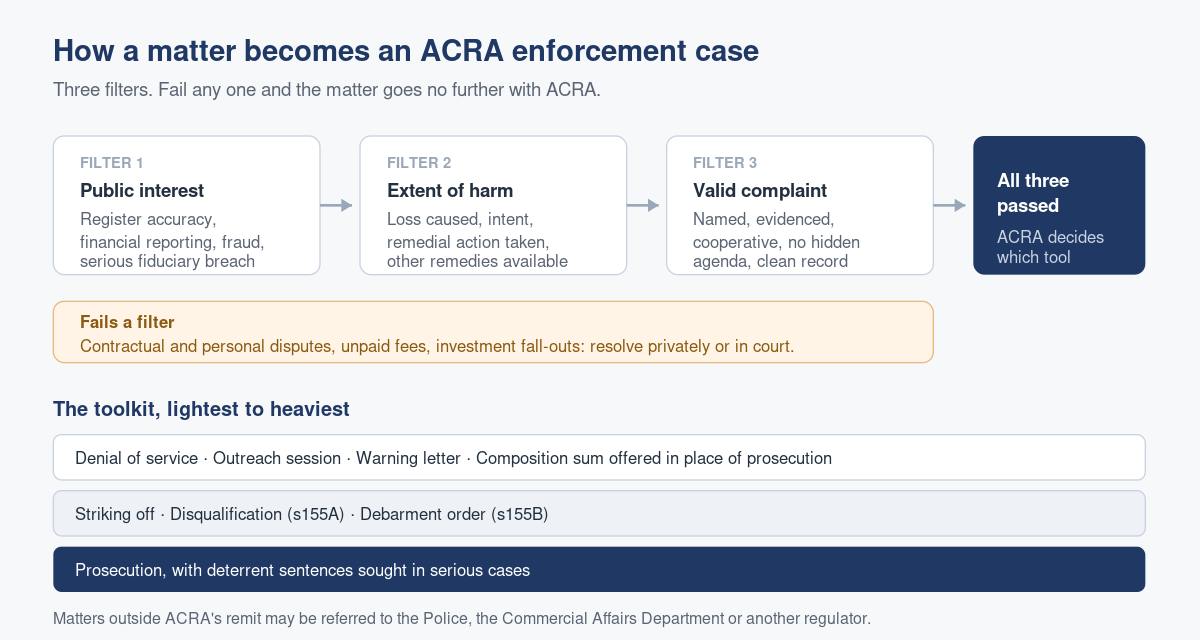
ACRA does not investigate every breach of the legislation it administers. It applies three filters: does the matter affect the public interest and the accuracy of the public registers, how much harm was caused, and is the complaint itself valid and properly evidenced. A matter that fails any one of them is not pursued.
Raffles Corporate Services works with a panel of experienced Singapore law firms who offer cost-effective and efficient legal service and advice. This article is general information only and is not legal advice.
That single fact is worth more to a business owner than any amount of policy language. It tells a director which failures attract attention, and it tells a complainant, usually a shareholder or an ex-officer with a grievance, whether they are about to spend six months waiting for a regulator that was never going to act.
The organising idea is narrower than people assume. ACRA is the keeper of Singapore’s business registers. Banks, investors, counterparties and government agencies make decisions on the strength of what those registers say. Anything that makes the registers wrong is ACRA’s core business. Almost everything else is somebody else’s.
Education, enforcement, eradication
For the high-volume breaches, principally failure to hold an annual general meeting and failure to file an annual return, ACRA works along a spectrum rather than reaching straight for prosecution.
At the mild end sits education. A first-time offender who has missed an AGM or an annual return is more likely to be pointed at training than prosecuted, and ACRA runs a free directors’ training programme precisely so that the excuse of not knowing runs out.
The middle is enforcement proper, reserved for the cases education cannot explain: multiple breaches in the same company, or the same person offending repeatedly across companies. That is where composition sums, meaning a payment offered in place of prosecution, and court prosecution live.
The far end is eradication. Where there is reason to believe a company is no longer carrying on business at all, ACRA can strike its name off the register. That is not a punishment in form, but in effect it ends the company, and it starts a clock on the directors that most of them do not know about. We cover that consequence in ACRA’s investigation process.
Filter one: does it touch the public interest?
This is the gate, and it is narrower than the phrase sounds. In practice it means: does the breach damage the accuracy or integrity of what ACRA publishes, or the reliability of the financial information companies are required to file?
Four categories carry real weight.
Register accuracy. Unfiled annual returns and unrecorded changes of director or registered office address are the bread and butter, pursued routinely because they go directly to what the register exists to do.
Financial reporting. Failure to file financial information that is timely, accurate and compliant with the applicable accounting standards. The weight scales with who relies on it, so listed and larger private companies attract more attention than a dormant holding company.
Fraud and false declarations. Anything dishonest that feeds into the register or the financial information. The recurring pattern is a person with filing access using it to put something untrue on the record: a consent to act that was never given, a resignation backdated so a period of office appears never to have happened. That is a different order of problem from a missed deadline, and the Corporate Service Providers Act 2024 has tightened the obligations of the people most likely to hold that access.
Fiduciary breach. Section 157 of the Companies Act 1967 requires a director to act honestly and use reasonable diligence. ACRA looks at breaches of that duty selectively: either the breach affects the integrity of the registers, or it is serious enough to warrant attention on its own. General mismanagement, without one of those features, is a matter for the company and its shareholders.
Filter two: how much harm?
Once a matter is inside the public interest gate, four considerations rank it.
| Consideration | What moves the needle |
|---|---|
| Extent of harm | Loss to identifiable victims, damage to Singapore’s standing as a financial centre, and how systematically the entity or the people behind it have abused the system |
| Intent | Deliberate or accidental. For some filing errors a correction is the whole outcome. A wrong digit in an address is an error. A manufactured consent to act is not |
| Remedial action | Whether the offender rectified the record, restored what was lost or compensated those affected, and how promptly |
| Other available remedies | Whether the complainant has a better route through the civil courts. If they do, that is where they will be sent |
The intent point matters most to an honest company that has made a mess. ACRA distinguishes between a company that got something wrong and a company that wanted something wrong on the record. Fixing the record quickly, on your own initiative, is materially better than fixing it after a letter arrives.
Filter three: is the complaint any good?
If you are thinking of complaining to ACRA, this is the section to read twice. A complaint has to survive scrutiny of its own before the alleged breach is looked at.
- Put your name to it. Anonymous complaints are not accepted. Name and contact details are required.
- It must not be a private dispute in regulatory clothing. Most alleged breaches reaching ACRA arise out of disagreements between private parties. Where there is no public interest, the answer is to resolve it privately and rectify the record.
- Stay engaged. If ACRA asks for clarification or further evidence, you are expected to respond. Complainants who go quiet end the matter.
- Evidence has to be specific. Who the offender is, when and how the offence was committed, and the supporting documents. The source must be credible and verifiable. Suspicion is not evidence.
- No hidden agenda. A complaint made to gain leverage in a civil case, or in a fight over control of a business, is recognised for what it is.
- Clean hands. A complainant with adverse records of their own, for instance someone who has failed to answer an ACRA summons, is poorly placed to ask for enforcement resources.
The two complaints ACRA hears most and acts on least
The first is the unpaid service provider. Someone acted as a director, company secretary or registered address provider for a fee, was not paid, resigned, and then complains that the company failed to file the cessation or is still using the address. The underlying grievance is a debt, and the forum for a debt is a court.
The second is the disappointed investor. Money went into a company on the understanding that shares and a directorship would follow, and neither materialised. That is a contractual claim, often a strong one, but it is a claim. ACRA will not litigate it for you.
None of this means those complainants have no remedy. It means the remedy is civil. Note also that giving ACRA false information is itself an offence, so a complaint dressed up beyond what the evidence supports carries its own risk.
The toolkit, from lightest to heaviest
ACRA is not limited to prosecute or ignore. Roughly in ascending order of severity, the tools are:
- Denial of service, meaning transactions are blocked until the position is regularised
- A requirement to attend an outreach or compliance session
- A warning letter
- An offer to pay a composition sum in place of prosecution
- Striking off the company
- Disqualification from acting as a director or taking part in management, including the automatic route under section 155A of the Companies Act 1967 for directors of struck-off companies
- A debarment order under section 155B, which prevents you taking on new appointments as a director or company secretary
- Prosecution, with deterrent sentences sought in serious cases
One or more of these may be applied to the same matter. Which one is used turns on the nature and severity of the breach, and on whether the person has been here before.
The two tools directors underestimate are disqualification and debarment, because they attach to the individual rather than the company and follow you to every other company you are involved in. Sentencing at the serious end has also been getting firmer: our note on nominee director sentencing shows where the courts have moved.
What ACRA hands to somebody else
ACRA’s remit has edges. Where conduct crosses into criminal offences outside its purview, for example criminal breach of trust under the Penal Code or securities-related offences under the Securities and Futures Act, the matter is referred out, usually to the Singapore Police Force, the Commercial Affairs Department or whichever regulator has jurisdiction.
For a director, “ACRA closed the file” is therefore not the same as “nothing further will happen”. A referral is a continuation, not an ending.
What goes wrong in practice
The most expensive mistake is not the original breach. It is the assumption that a small breach stays small.
A company misses one annual return. Nothing happens. It misses the next one. The registered office address is stale by now, so ACRA’s letters arrive nowhere. Without anyone deciding to, the company has assembled the exact profile that triggers eradication: repeated filing failures, an address that does not work, and no response to correspondence. It is struck off, and if the same director collects enough of those, the disqualification consequence follows automatically.
The second mistake belongs to the complainant. Filing with ACRA feels cheaper and faster than instructing solicitors, so people try it first on disputes that were always civil. Months pass, the limitation clock keeps running, and the eventual answer is that the matter should be resolved privately. If your grievance is really about money or control rather than register accuracy, get advice on the civil route in parallel rather than instead.
For the everyday obligations behind all of this, our Companies Act 1967 deep-dive FAQ is the practical starting point, and LLPs have their own smaller set of exposures in common offences for LLPs.
Frequently asked questions
Will ACRA investigate my complaint against a business partner?
Only if it affects the public interest, principally the accuracy of ACRA’s registers or the reliability of filed financial information. Complaints arising from contractual, investment or unpaid-fee disputes are generally declined and referred back to private resolution, even where the complainant is clearly in the right on the underlying dispute.
Can I complain to ACRA anonymously?
No. ACRA requires your name and contact details, and expects you to respond to requests for clarification or further evidence. A complaint from someone who cannot be contacted, or who stops responding, will not proceed. Complainants are also expected not to have a vested interest or adverse records of their own.
What is a composition sum?
It is a payment ACRA may offer you in place of prosecution. Paying it settles the matter without a court conviction. It is one of several tools available, and whether it is offered depends on the nature and severity of the breach and on whether you have offended before. It is not a right and it is not automatic.
If ACRA decides not to investigate, is that the end of it?
Not necessarily. ACRA may refer matters that fall outside its remit to the Singapore Police Force, the Commercial Affairs Department or another regulator. Separately, a decision not to take regulatory action says nothing about your civil liability, which is decided in court on entirely different criteria.
Staying on the education end of the spectrum
Nobody sets out to become an enforcement case. It happens by accumulation: a late filing, a stale address, an unread letter, then another year of the same.
ACRA’s escalation logic rewards the company that is boringly current. File on time, keep the registered office live, and correct errors the moment you find them rather than after someone else does. Raffles Corporate Services runs the filing calendar, holds the registered office and reconciles your records against ACRA’s for companies and LLPs across Singapore. If you have arrears, or a letter you have not answered, the earlier we look the more options there are.
You can reach us through Raffles Corporate Services, or read more on Singapore corporate secretarial practice at Singapore Secretary Services.
— The Editorial Team, Raffles Corporate Services
Need help with corporate secretarial or compliance matters?
If you would like help with your company's corporate secretarial, governance or compliance requirements, email [email protected] or WhatsApp +65 8501 7133.
Our team can assist with corporate secretarial, accounting and tax matters. Where legal advice is needed, advisers from our associated law firms can assist.