

Every company listed on SGX must report its Scope 1 and 2 greenhouse gas emissions for financial years beginning on or after 1 January 2025. Large non-listed companies are not caught until FY2030. Everything else is voluntary, and the deadlines for smaller listed companies were pushed back in August 2025.
Raffles Corporate Services works with a panel of experienced Singapore law firms who offer cost-effective and efficient legal service and advice. This article is general information only and is not legal advice.
That last point is why so many boards are working off the wrong dates. Singapore’s climate reporting roadmap has been revised, and the version circulating in most 2024 board packs is out of date. ACRA and SGX RegCo extended most of the timelines on 25 August 2025, and the current position looks noticeably more forgiving than the original plan.
This part answers the first two questions any director asks: are we in scope, and from when. Part 2 deals with what you actually have to put in the report and who has to assure it.
The two populations that are caught
There are exactly two categories of company in scope, and they are treated very differently.
Listed companies. Every company listed on the Singapore Exchange is in scope. There is no size floor. What your market capitalisation determines is not whether you report but how much and from when.
Large non-listed companies, or Large NLCos. A private company is only caught if it meets both of two thresholds: annual revenue of $1 billion or more, and total assets of $500 million or more. Both, not either. A private company with $1.4 billion of revenue and $300 million of assets is not a Large NLCo.
Everyone else, which is the overwhelming majority of Singapore companies, has no mandatory climate reporting obligation under this framework. That does not mean it is irrelevant to you, and we come back to why at the end.
The three tiers for listed companies
| Tier | Who | Why it matters |
|---|---|---|
| Tier 1 | Straits Times Index constituents | Earliest and broadest obligations. Leads on everything. |
| Tier 2 | Non-STI listed companies with market capitalisation of $1 billion and above | Full climate disclosures from FY2028 |
| Tier 3 | Non-STI listed companies with market capitalisation below $1 billion | Full climate disclosures from FY2030 |
The timeline as it currently stands
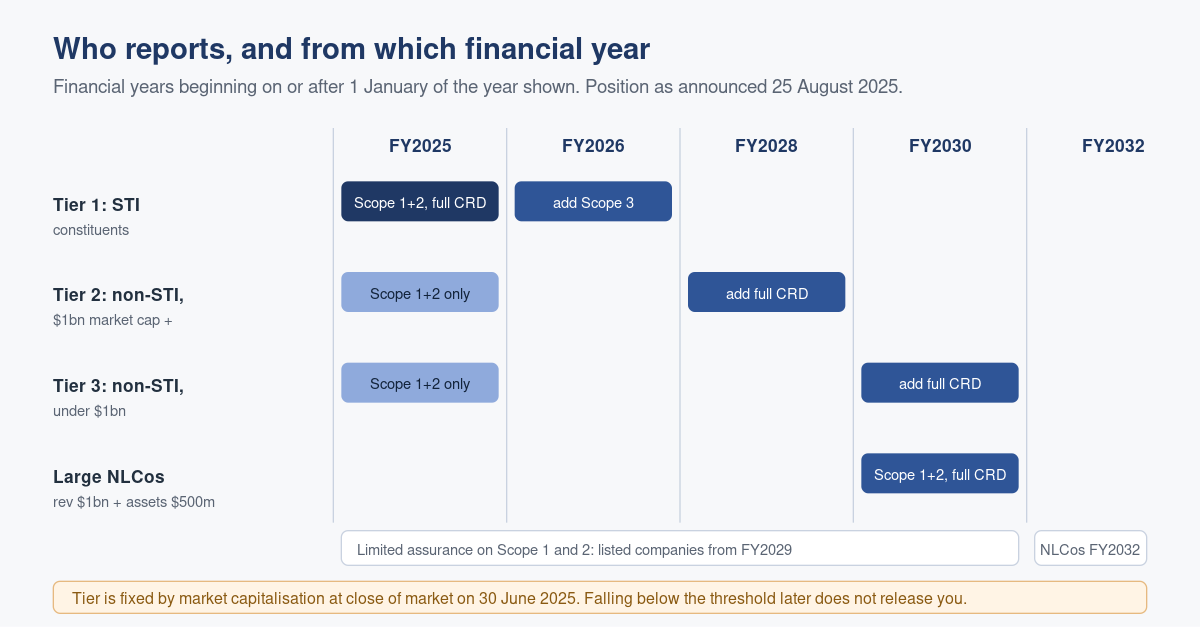
Read this table as financial years beginning on or after the date shown, not calendar years. A company with a 30 June year end that starts its financial year on 1 July 2025 has an FY2025 obligation.
| Financial year starting on or after | What is required |
|---|---|
| 1 January 2025 | Every listed company reports Scope 1 and Scope 2 GHG emissions. STI constituents also report the other ISSB-based climate-related disclosures. |
| 1 January 2026 | STI constituents add Scope 3 GHG emissions. |
| 1 January 2028 | Tier 2 non-STI listed companies, market capitalisation of $1 billion and above, report the other ISSB-based climate-related disclosures. |
| 1 January 2030 | Tier 3 non-STI listed companies, market capitalisation below $1 billion, report the other ISSB-based climate-related disclosures. Large NLCos begin reporting ISSB-based disclosures including Scope 1 and 2 emissions, unless exempted. |
Scope 3 reporting is voluntary until further notice for every listed company that is not an STI constituent, and for Large NLCos. That is the current position, expressly stated as open to change.
External limited assurance is a separate layer with its own dates, from FY2029 for listed companies and FY2032 for Large NLCos. Part 2 covers what limited assurance means and who is allowed to provide it.
The mechanic nobody reads: the 30 June 2025 snapshot
This is the part that catches finance teams, and it is worth understanding properly because it is a one-way ratchet.
Tier 2 status is fixed by a snapshot. If your market capitalisation was $1 billion or more at the close of market on 30 June 2025, you are a Tier 2 company and you report the fuller disclosures from FY2028. The obligation stays with you even if your market capitalisation later falls below $1 billion. There is no dropping back to Tier 3.
The STI test works the same way. A company that was an STI constituent on 30 June 2025 carries the STI obligations whether or not it stays in the index.
Companies that listed after 30 June 2025 are assessed at the close of market on their listing date. If they crossed $1 billion then, they report the fuller disclosures from the later of FY2028 or their first full financial year after listing. Again, a later fall below the threshold does not release them.
The practical consequence: a valuation on a single day in mid-2025 determines a compliance obligation running for years, and for some companies that valuation was a high water mark. Check where you actually sat on that date rather than where you sit now.
The parent company exemption for Large NLCos
A Large NLCo can be exempted, but both of two conditions must be satisfied.
First, an immediate, intermediate or ultimate parent company, local or foreign, is at a minimum preparing climate or sustainability reports using ISSB-based local reporting standards or equivalent standards.
Second, your company’s own activities are covered in that parent report, and the parent report is publicly available.
Both limbs are doing real work. A foreign parent that reports under a framework nobody would call ISSB-equivalent does not help you. Nor does a parent that reports properly but excludes your subsidiary, or one that prepares a group sustainability report purely for internal or investor-only circulation.
The equivalence question is genuinely unresolved. ACRA has said it will issue guidance on which international standards count as equivalent, on the basis that sustainability disclosure standards keep evolving. That guidance is the difference between an exemption and a reporting programme for a number of Singapore subsidiaries of overseas groups.
What is confirmed and what is still moving
Be careful with this topic. The timeline has already been revised once, and parts of the framework are still in draft. Here is the honest split.
Confirmed. The tier structure, the FY2025 start for Scope 1 and 2 across all listed companies, the FY2026 Scope 3 start for STI constituents, the FY2028 and FY2030 dates for Tier 2 and Tier 3, the FY2030 start for Large NLCos, and the two Large NLCo size thresholds. These were set out in the joint ACRA and SGX RegCo announcement of 25 August 2025 and carried through to ACRA’s current requirements page.
Still being settled. The local sustainability disclosure standards themselves. ACRA is developing Singapore standards based on the ISSB Standards, and its Interim Sustainability Standards Committee has run a public consultation on the drafts. Until those standards are finalised, the detailed content of what you file is drawn from IFRS S1 and IFRS S2 rather than from a settled local rulebook. Our note on ACRA’s draft sustainability disclosure standards sets out what the consultation proposed.
Explicitly open. Scope 3 for everyone outside the STI, which remains voluntary “until further notice”. Treat that as a requirement deferred, not a requirement abolished.
What goes wrong in practice
Treating the deferral as a reprieve. The commonest reaction to the August 2025 extension was to stand the project down. That is a mistake for a specific reason: the data you need for FY2028 or FY2030 disclosures includes historical baselines and trend information that you cannot reconstruct after the fact. Utility bills, fuel purchase records, refrigerant top-ups and fleet mileage are easy to capture prospectively and painful to rebuild three years later.
Assuming the group report covers you. Singapore subsidiaries of large foreign groups routinely assume the parent’s sustainability report solves the problem. It only does so if the parent’s standard qualifies as ISSB-based or equivalent, your activities are in it, and it is public. Two out of three is not an exemption.
Measuring the thresholds on the wrong figures. Revenue of $1 billion and total assets of $500 million sound simple until you ask which financial statements they come from and over what period. Get that determination made deliberately, with the basis documented, rather than eyeballed from last year’s management accounts.
Forgetting that customers and lenders ask anyway. A company with no mandatory obligation still gets asked for emissions data by listed customers meeting their own Scope 3 requirements, and increasingly by banks pricing sustainability-linked facilities. If you supply an STI constituent, their FY2026 Scope 3 obligation becomes your data request. Our piece on the corporate secretary’s role in ESG and sustainability reporting covers how that lands on a small company’s governance calendar.
Frequently asked questions
Does my private Singapore company have to produce a sustainability report?
Almost certainly not. Mandatory climate reporting applies to SGX-listed companies and to large non-listed companies that have both annual revenue of $1 billion or more and total assets of $500 million or more. If you do not meet both of those thresholds and you are not listed, there is no mandatory obligation under this framework.
When do large non-listed companies have to start reporting?
From financial years beginning on or after 1 January 2030, unless the parent company exemption applies. This was deferred from an earlier date by ACRA and SGX RegCo on 25 August 2025. Scope 3 emissions reporting remains voluntary for large non-listed companies until further notice.
We are listed but very small. Are we really in scope from FY2025?
Yes, for Scope 1 and Scope 2 greenhouse gas emissions. Every SGX-listed company reports those from financial years beginning on or after 1 January 2025, with no size exemption. The fuller ISSB-based climate disclosures are what get deferred for smaller listed companies, to FY2028 or FY2030 depending on your tier.
Our market capitalisation has fallen below $1 billion. Do we drop to Tier 3?
No. Tier 2 status is fixed by your market capitalisation at the close of market on 30 June 2025, or on your listing date if you listed later. Once you are in Tier 2 you stay there, and the FY2028 obligation applies even if your market capitalisation subsequently falls below $1 billion.
Our foreign parent already publishes a group sustainability report. Are we exempt?
Only if two conditions are both met: the parent is at minimum preparing climate or sustainability reports under ISSB-based local standards or equivalent standards, and your company’s activities are included in a parent report that is publicly available. ACRA has said it will issue guidance on which standards count as equivalent.
Is there funding available to get ready?
Yes. The Sustainability Reporting Grant is offered by the Economic Development Board and Enterprise Singapore to help companies prepare for ISSB-based climate disclosures before mandatory compliance begins. Application deadlines were revised after the August 2025 timeline extension, so check the current deadline rather than an older one.
Next: what you actually have to disclose
Knowing you are in scope is the easy half. The harder question is what a compliant climate disclosure contains, how Scope 1, 2 and 3 differ in practice, and what external limited assurance will require of your records. That is covered in part 2 of this guide, on the content of the disclosure and the assurance requirement.
For the wider policy picture, our Singapore sustainability reporting roadmap note covers how the SGX, ISSB and Sustainability Reporting Advisory Committee pieces fit together, and our carbon tax explainer covers the separate obligation that actually attaches a price to emissions.
If you are not certain which side of the thresholds your group sits on, Raffles Corporate Services can make that determination properly and document the basis, which is the part auditors ask about later. ACRA’s own requirements page is at acra.gov.sg, and the August 2025 announcement that reset the timeline is here.
— The Editorial Team, Raffles Corporate Services
Need help with corporate secretarial or compliance matters?
If you would like help with your company's corporate secretarial, governance or compliance requirements, email [email protected] or WhatsApp +65 8501 7133.
Our team can assist with corporate secretarial, accounting and tax matters. Where legal advice is needed, advisers from our associated law firms can assist.