

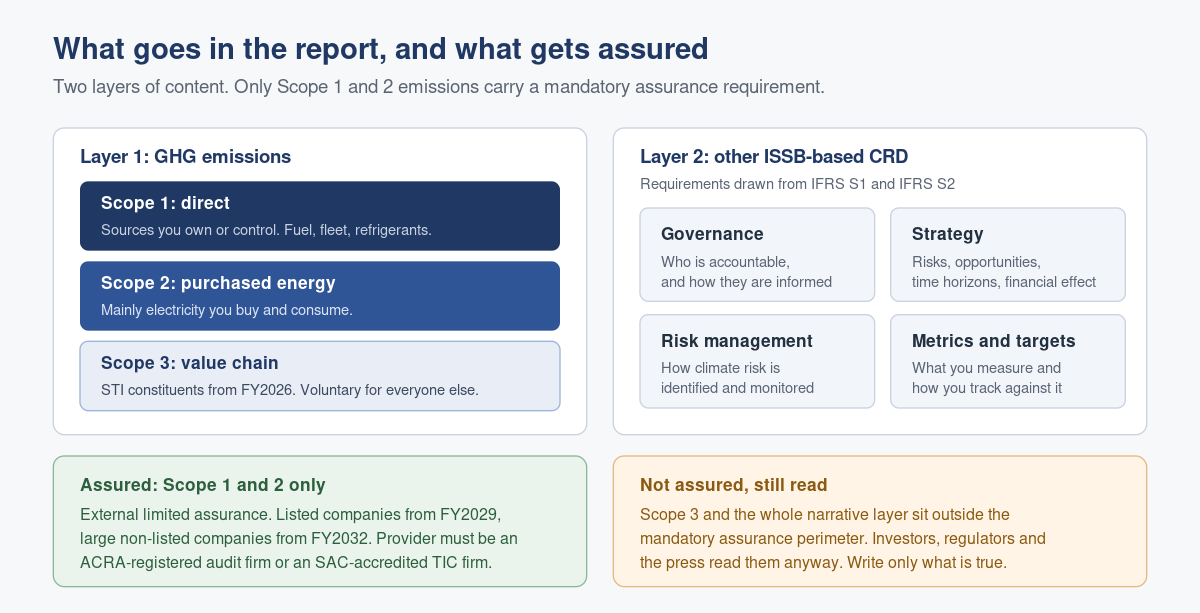
A Singapore climate disclosure has two layers. The first is your greenhouse gas emissions, split into Scope 1, Scope 2 and Scope 3. The second is a narrative built on four pillars: governance, strategy, risk management, and metrics and targets. Only the first layer gets externally assured, and only Scope 1 and 2 within it.
Raffles Corporate Services works with a panel of experienced Singapore law firms who offer cost-effective and efficient legal service and advice. This article is general information only and is not legal advice.
That asymmetry is the single most useful thing to understand about the framework. The numbers that carry assurance risk are a small and specific subset of what you publish, which means your data controls need to be far tighter on emissions than on the narrative around them.
Part 1 of this guide covered who is in scope and from when. This part covers what goes in the report, what limited assurance means, who is allowed to provide it, and where companies find themselves short.
Layer one: greenhouse gas emissions
The three scopes are not degrees of seriousness. They are a boundary question: whose emissions are they, and how close to you did they happen.
Scope 1 is direct emissions from sources you own or control. Fuel burned in your own boilers, vehicles and generators. Refrigerant leakage from your own equipment. Process emissions from your own plant.
Scope 2 is indirect emissions from generating the purchased energy you consume. In practice, for most Singapore companies, this means electricity. It is emissions that happened at the power station, attributed to you because you bought the output.
Scope 3 is everything else indirect that happens in your value chain, upstream and downstream. Purchased goods and services, business travel, employee commuting, transport and distribution, use of your sold products, end-of-life treatment. It is typically far larger than Scope 1 and 2 combined, and far harder to measure, because most of the data sits with somebody else.
Scope 3 is currently mandatory only for Straits Times Index constituent listed companies, from FY2026. For every other listed company and for large non-listed companies it remains voluntary until further notice.
Why Scope 1 and 2 got picked for the mandatory start
Because they are the two you can actually pin down from your own records. Scope 1 comes from your fuel purchases and equipment. Scope 2 comes from your electricity bills. The regulators made the point themselves when they extended the other timelines in August 2025: Scope 1 and 2 are more circumscribed, so the start date held while the rest slipped.
Layer two: the other ISSB-based climate-related disclosures
The phrase “other ISSB-based CRD” means everything beyond the emissions numbers. It is information about how you manage climate-related risks and opportunities, organised under four headings.
| Pillar | What a reader is meant to learn |
|---|---|
| Governance | Who on the board and in management is accountable for climate risk, how they are informed, and how it feeds into decisions |
| Strategy | Which climate risks and opportunities affect your business model, over what time horizons, and what the financial effects are |
| Risk management | How you identify, assess, prioritise and monitor climate risk, and how that sits inside your wider risk process |
| Metrics and targets | What you measure, what targets you have set, and how you are tracking against them |
Anyone who has read a TCFD report will recognise that structure, because the ISSB built on it. The detailed requirements sit in the ISSB Standards, meaning IFRS S1 General Requirements for Disclosure of Sustainability-related Financial Information and IFRS S2 Climate-related Disclosures.
ACRA is developing local sustainability disclosure standards based on the ISSB Standards. Its Interim Sustainability Standards Committee has run a public consultation on the draft standards. Until those are finalised and in force, the substantive content of what you prepare comes from IFRS S1 and S2 rather than from a settled Singapore rulebook. Our note on ACRA’s draft sustainability disclosure standards sets out what the consultation put on the table.
The assurance requirement
You will need external limited assurance over your Scope 1 and Scope 2 greenhouse gas emissions.
| Who | From which financial year |
|---|---|
| Listed companies | FY2029 |
| Large non-listed companies | FY2032 |
Both dates were deferred from earlier ones in the August 2025 announcement. Nothing else in the report requires assurance at this stage: not Scope 3, not the governance and strategy narrative, not your targets.
Limited assurance is not an audit
This distinction matters commercially, because it determines what the engagement costs and what the conclusion is worth.
In a reasonable assurance engagement, which is what a financial statement audit is, the practitioner gathers sufficient evidence to express a positive opinion: the information is properly stated. In a limited assurance engagement, the practitioner does less work and expresses a negative conclusion: nothing came to their attention suggesting the information is materially misstated.
Less work, weaker conclusion, lower fee. It is a deliberate first step rather than a soft option, and the direction of travel internationally is towards reasonable assurance in time.
The relevant professional framework is the International Standard on Sustainability Assurance (ISSA) 5000 General Requirements for Sustainability Assurance Engagements, with independence and ethics governed by the International Ethics Standards for Sustainability Assurance.
Who is allowed to sign it
Your assurance provider must be a registered climate assurance provider, drawn from one of two pools:
- Audit firms registered with ACRA.
- Testing, inspection and certification firms accredited by the Singapore Accreditation Council.
That second route is deliberate. Verifying an emissions inventory is closer to an engineering and measurement exercise than to an accounting one, and the accreditation regime for testing and certification bodies already governs exactly that kind of work. It also widens the supply of providers ahead of a large cohort of listed companies needing assurance in the same year.
Your existing statutory auditor is not automatically your climate assurance provider, and independence considerations may cut against it. If your audit firm also prepared or helped compile your emissions inventory, that is a problem to raise early rather than discover during the engagement.
What goes wrong in practice
No audit trail behind the number. A company computes its emissions on a spreadsheet, the person who built it leaves, and nobody can reconstruct which electricity bills went in, which emission factor was applied, or why the factor changed between years. Limited assurance is still assurance: the provider will ask for the source documents and the calculation logic. Build the workings as a workpaper, versioned, with source documents attached, from the very first year you report.
Emission factors chosen and then forgotten. The factor you apply to purchased electricity moves over time, and applying last year’s factor to this year’s consumption produces a variance that has nothing to do with your actual behaviour. Record which factor you used, from which published source, for which period, every year.
Organisational boundary drawn loosely. Which entities are in your inventory, and on what basis, has to be settled before you count anything. Groups with joint ventures, leased premises and partly owned subsidiaries get this wrong quietly, and a boundary that shifts between years makes every comparative useless.
Engaging the assurance provider in the reporting year. Assurance providers will want to look at how the data was captured, not just the final total. Companies that bring one in for the first time in the year assurance becomes mandatory discover that the controls they needed should have been in place a year earlier. If you are a listed company facing FY2029, a dry run on FY2027 or FY2028 numbers is cheap insurance.
Overstating the narrative. The governance and strategy sections are not assured, which makes them tempting. They are still read by regulators, investors and the press, and describing a transition plan you are not executing is a reputational and potentially a disclosure problem.
Where to get help and funding
Two ACRA capability frameworks sit behind this regime. The Sustainability Reporting Body of Knowledge guides training providers building preparer programmes, covering IFRS S1, IFRS S2 and the Greenhouse Gas Protocol. The Sustainability Assurance Body of Knowledge does the same for assurance, covering ISSA 5000 and the sustainability assurance ethics standards. Both are available from ACRA on request, and ACRA has curated aligned courses with the Skills and Workforce Development Agency under the SkillsFuture Green Workplace programme, with substantial fee subsidies.
On funding, the Sustainability Reporting Grant is offered jointly by the Economic Development Board and Enterprise Singapore, and is aimed squarely at companies preparing for ISSB-based climate disclosures before their mandatory start date. Application deadlines were revised after the August 2025 timeline extension, so check the current deadline rather than one quoted in an older article. Our overview of the Enterprise Sustainability Programme covers the adjacent capability-building support for smaller companies.
Frequently asked questions
What is the difference between Scope 1, 2 and 3 emissions?
Scope 1 is direct emissions from sources you own or control, such as fuel burned in your own vehicles and boilers. Scope 2 is indirect emissions from generating the energy you purchase and consume, mainly electricity. Scope 3 is all other indirect emissions across your value chain, upstream and downstream, including purchased goods, travel and use of sold products.
Does my whole sustainability report need to be audited?
No. Only Scope 1 and Scope 2 greenhouse gas emissions require external limited assurance, from FY2029 for listed companies and FY2032 for large non-listed companies. Scope 3 emissions and the governance, strategy, risk management and targets narrative are not subject to mandatory assurance at this stage.
What is limited assurance, and how is it different from an audit?
Limited assurance is a lower level of engagement than an audit. The practitioner performs less extensive procedures and concludes that nothing has come to their attention suggesting the information is materially misstated. An audit gives reasonable assurance, a positive opinion that the information is properly stated, and involves substantially more work.
Who can provide climate assurance in Singapore?
A registered climate assurance provider, which must be either an audit firm registered with ACRA or a testing, inspection and certification firm accredited by the Singapore Accreditation Council. Your statutory auditor is not automatically eligible, and independence issues may arise if the same firm helped prepare your emissions inventory.
Which standards do I actually prepare the disclosures under?
The requirements are based on the ISSB Standards, meaning IFRS S1 on general sustainability disclosure requirements and IFRS S2 on climate-related disclosures. ACRA is developing local Singapore standards based on those, and has consulted publicly on the drafts. Confirm the status of the local standards before you finalise a reporting policy.
We are not required to report Scope 3. Should we measure it anyway?
If you supply listed customers, probably yes. Straits Times Index constituents must report Scope 3 from FY2026, and their Scope 3 includes emissions from their suppliers. That obligation arrives at your door as a customer data request regardless of whether you have any reporting duty of your own.
Start with the data, not the report
The mistake we see most often is treating this as a disclosure project. It is a data project with a disclosure at the end of it. Companies that build a clean, versioned emissions workpaper in year one find the report writes itself and the assurance engagement is uneventful. Companies that leave it to the reporting team in the final quarter spend three times as much and get a qualified experience.
If you have not read it yet, part 1 of this guide covers who is in scope and from which financial year, including the 30 June 2025 market capitalisation snapshot that fixes your tier permanently.
Raffles Corporate Services works with Singapore companies on the governance and record-keeping side of this: who owns the data, where it is kept, and whether the board can evidence the oversight it says it has. Our note on directors’ responsibilities for financial reporting covers the adjacent duty that directors already carry. ACRA’s requirements page is at acra.gov.sg, and more Singapore corporate secretarial commentary is at Singapore Secretary Services.
— The Editorial Team, Raffles Corporate Services
Need help with corporate secretarial or compliance matters?
If you would like help with your company's corporate secretarial, governance or compliance requirements, email [email protected] or WhatsApp +65 8501 7133.
Our team can assist with corporate secretarial, accounting and tax matters. Where legal advice is needed, advisers from our associated law firms can assist.