

ACRA will only investigate your complaint if it clears three gates: the matter engages the public interest, the breach caused real harm, and your complaint is valid and backed by evidence. Miss any one of them and the file closes without an investigation.
Raffles Corporate Services works with a panel of experienced Singapore law firms who offer cost-effective and efficient legal service and advice. This article is general information only and is not legal advice.
That is the single most useful thing to know before you start, and most complainants discover it too late. People arrive at the complaint form because a business partner has behaved badly, and they treat ACRA as a lever. It is not a lever. It is a registry regulator with finite resources and a published set of filters.
So the question is not “has someone breached the Companies Act 1967”. Very often someone has. The question is whether your complaint is the kind ACRA acts on, and whether you have the evidence that lets it.
What ACRA actually regulates
ACRA administers the registry legislation, not commercial morality. Its remit covers the Companies Act 1967, the Business Names Registration Act 2014, the Limited Liability Partnerships Act 2005 and the Limited Partnerships Act 2008, plus the accountancy and corporate service provider statutes.
That gives you a workable test. If the wrong you want redressed is a wrong against the accuracy of a public register, or against a duty the statute imposes on a company or its officers, it is in scope. If the wrong is that someone broke a promise to you, it is not, however genuine the grievance.
The breaches ACRA sees most often are unglamorous:
- A company operating without a registered office, or one that has moved and never told the Registrar. Section 143(1) of the Companies Act 1967 requires notification of a change of registered office within 14 days.
- Director and secretary changes filed late or not at all. Section 173A(1)(b) sets the same 14-day clock for a director joining or leaving.
- No director who is ordinarily resident in Singapore. Section 145(1) requires at least one.
- Undischarged bankrupts or disqualified persons acting as directors or managers.
- Annual general meetings not held, and annual returns not filed.
- False statements made in a filing.
- A business carrying on without registration at all.
The three gates
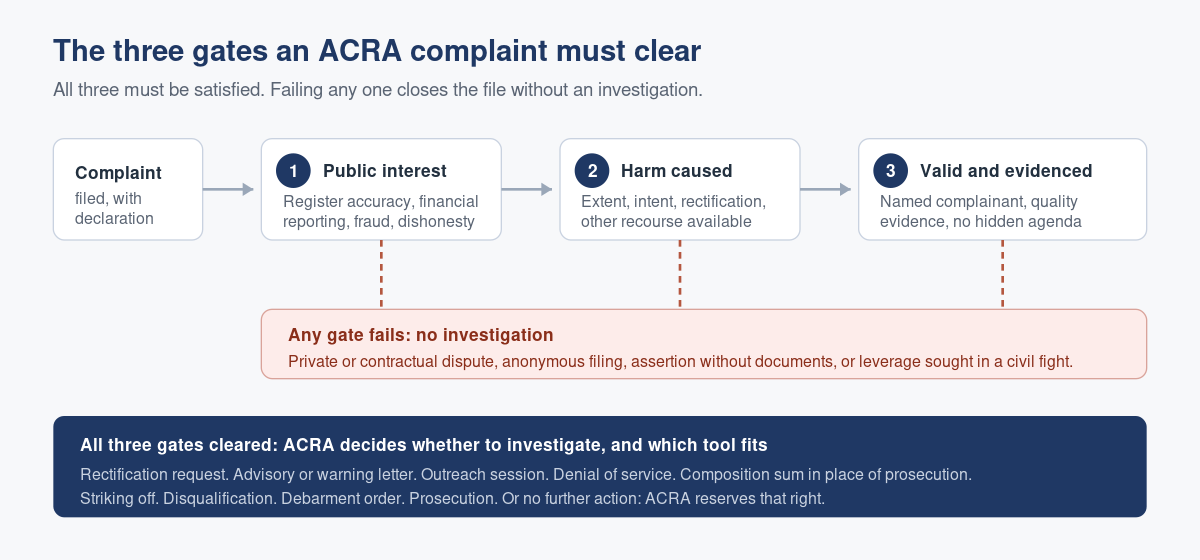
Gate one: public interest
ACRA’s stated priority is the accuracy and integrity of the public registers, because banks, investors, counterparties and the public rely on them. A complaint that a company has filed nothing for three years therefore lands well. A complaint about the same company’s internal politics does not.
Two other public interest categories matter. The first is timely and accurate financial reporting, weighted towards listed companies and larger private ones. The second is fraud, false declaration and dishonesty that corrupts the register or the financial information in it.
Breach of a director’s duties can qualify. Section 157 of the Companies Act 1967 requires a director at all times to act honestly and to use reasonable diligence in discharging the duties of the office. ACRA will consider a complaint under that section where the breach touches the integrity of its registers or is particularly serious. It will not adjudicate every allegation of a director behaving badly.
Gate two: harm
ACRA weighs how much damage the breach did, to identifiable victims and to Singapore’s standing as a financial centre. It also weighs intent. A deliberate false filing is treated very differently from a typographical error in an address, and for some errors the only outcome will be a request to correct the record.
Two factors work directly against a complainant. If the offender has already rectified, made restitution or paid compensation, the case for enforcement weakens. And if you have a perfectly good civil remedy available, ACRA will expect you to use it.
Gate three: a valid, evidenced complaint
This is the gate that fails most often, and it is entirely within your control.
| Requirement | What it means in practice |
|---|---|
| Not anonymous | Your name and contact details are mandatory. Anonymous complaints are not accepted. |
| Not a private dispute | If the breach arises out of a contractual or personal falling-out, expect to be told to resolve it privately. |
| You will cooperate | If ACRA asks for clarification or more evidence, you must respond. |
| Evidence of quality | Name of the offender, the date of the offence, a description of how it was committed, and supporting documents. The source must be credible and capable of verification. |
| No hidden agenda | Using ACRA enforcement to gain leverage in a civil suit or in a boardroom fight disqualifies the complaint. |
| No adverse record | A complainant who is, for example, under a warrant for failing to answer an ACRA summons will not be assisted. |
The “no hidden agenda” requirement deserves emphasis, because it catches sympathetic complainants. ACRA’s own published examples include the company secretary or nominee director who resigns over unpaid fees and then complains that the company failed to file the resignation, and the investor who paid money, was never entered in the register of members, and asks ACRA to investigate. Both describe real breaches. Neither gets investigated, because the complaint is a by-product of a commercial dispute.
The steps, in order
- Read ACRA’s enforcement policy and process first, and be honest with yourself about the three gates.
- Confirm the alleged breach falls under legislation ACRA administers. If it is a Penal Code matter, a securities matter or a police matter, it goes elsewhere. ACRA may refer such cases on, but you will lose time.
- Assemble the evidence before you touch the form. Identify the offender by name and, where you can, by identification or UEN. Fix the date of the offence. Write a plain description of how it was committed. Attach documents.
- Complete the statutory declaration form that ACRA requires with the complaint. This is a declaration, not a covering letter, and it carries consequences if what you say in it is untrue.
- Submit the complaint through ACRA’s online complaint form.
The warning attached to that last step is not decorative. Providing false information is an offence and can attract a fine or imprisonment or both. Overstating your case to make it land is the worst available strategy.
What happens after you file
| Stage | What to expect |
|---|---|
| Acknowledgement | ACRA confirms receipt of the complaint. |
| Investigation decision | Once ACRA is satisfied all three factors are met, it decides whether to investigate and which regulatory tool fits. It expressly reserves the right not to take enforcement action. |
| Updates | You are updated at appropriate stages. Timing depends on the evidence, the complexity and ACRA’s caseload. |
| Clarifications | ACRA may come back to you for more. What you provide is treated as confidential. |
Do not expect a quick answer. A complaint that looks simple on paper can stall for reasons that have nothing to do with its merits, most commonly because the individuals at the centre of it cannot be located or sit outside Singapore’s jurisdiction.
If ACRA does investigate, its officers have real powers under the Accounting and Corporate Regulatory Authority Act 2004: to require proof of identity, to require information and documents, to summon witnesses in writing, to record statements, to photograph or video premises, and to have free access to premises. Cooperation is a legal obligation, not a courtesy.
The tools ACRA can reach for
An investigation does not automatically end in court. ACRA may deny services to the entity, require attendance at an outreach session, issue a warning letter, offer a composition sum in place of prosecution, strike the company off, disqualify a director, issue a debarment order, or prosecute. Prosecution is reserved for the serious end, and for repeat offenders.
What goes wrong in practice
The complaint is really a shareholder dispute in disguise. This is the commonest failure. If the substance is that you were promised shares, or a directorship, or payment, the register irregularity is a symptom and ACRA will treat it as one. Pursue the civil remedy. Our note on judicial review and challenging a government decision explains the limits of what a regulator can be made to do, and the no reflective loss rule explains why a shareholder’s own claim is often the wrong vehicle too.
The evidence is assertion, not documentation. “They never filed anything” is not evidence. A dated business profile or register extract showing the last filing date is. Pull the ACRA record first and attach it.
The complainant files, then goes quiet. Cooperation is a stated requirement. If ACRA writes and you do not answer, the file closes.
The complainant is also in default. Before you complain about someone else’s filing hygiene, check your own. It is an uncomfortable position to be in, and it is a disqualifying one.
Nobody considered self-reporting. If the breach is inside your own group, filing the overdue documents and correcting the register yourself beats waiting to be found: rectification is a factor ACRA weighs. See our guide to filing your annual return with ACRA and, where penalties have landed, appealing an ACRA late filing penalty.
Frequently asked questions
Can I file a complaint against a company anonymously?
No. ACRA does not accept anonymous complaints. You must provide your name and contact details, and you must respond if ACRA asks you for clarification or further evidence. Confidentiality of the information you supply is a separate matter, and ACRA treats what you provide as confidential.
Will ACRA investigate because a company never paid my invoice?
No. Non-payment is a civil matter. Even where the non-payment has produced a genuine statutory breach, such as an unfiled resignation of a secretary who quit over fees, ACRA’s published position is that complaints arising out of contractual or personal disputes fall outside its enforcement priorities.
How long does an ACRA investigation take?
There is no published timeline. ACRA updates complainants at appropriate stages, and the duration turns on the evidence gathered, the complexity of the case and the current caseload. Cases where the key individuals cannot be found or are outside Singapore’s jurisdiction can take considerably longer than their apparent simplicity suggests.
What is the difference between a complaint about a breach and a name complaint?
A statutory breach complaint alleges an offence under legislation ACRA administers, such as a failure to file or a false declaration. A name complaint objects to the business name an entity has registered. They run through different channels, and a name objection will not be treated as a breach complaint.
Does filing a complaint guarantee enforcement action?
No. ACRA expressly reserves the right to take enforcement action or not, even where a complaint meets all three factors. It may instead ask the offender to rectify, issue an advisory or warning, or take no further action at all.
Can I complain about my company secretary or corporate service provider?
Complaints about corporate service providers and about public accountants run through their own routes, because those professions sit under separate statutes. A false filing made by a service provider is squarely within ACRA’s interest. A billing dispute with one is not.
Before you file anything
Most of the complaints we see clients contemplating would be better spent on two hours of records work. Pull the register extracts, establish exactly what has and has not been lodged, and you usually find either that the breach is smaller than it felt, or that the real remedy is civil and urgent.
If the breach is inside your own group, the priority is rectification rather than explanation. Raffles Corporate Services reconstructs neglected filing histories, brings overdue returns current, and reconciles statutory registers against what the Registrar actually holds. Our note on restoring statutory registers and records covers the harder version of that job, and the Companies Act 1967 deep-dive FAQ the everyday version. You can also read more on Singapore corporate secretarial practice at Singapore Secretary Services.
— The Editorial Team, Raffles Corporate Services
Need help with corporate secretarial or compliance matters?
If you would like help with your company's corporate secretarial, governance or compliance requirements, email [email protected] or WhatsApp +65 8501 7133.
Our team can assist with corporate secretarial, accounting and tax matters. Where legal advice is needed, advisers from our associated law firms can assist.