

You can ask ACRA to waive or reduce a late lodgement penalty, or to waive or reduce a composition sum, but only after the underlying breach has been rectified. An appeal is a request for leniency on the amount. It is not a way to argue the filing was not late, and it does not pause anything.
Raffles Corporate Services works with a panel of experienced Singapore law firms who offer cost-effective and efficient legal service and advice. This article is general information only and is not legal advice.
That framing matters, because directors routinely appeal for the wrong reason and are surprised by the outcome. The penalty is applied mechanically when you file. Whether the deadline was missed is arithmetic, and arithmetic is not appealable. What is genuinely open is how much of the consequence ACRA is willing to relieve, given the circumstances and given what you did about it.
Each case is decided on its own merits and review takes about four weeks, longer in peak periods or if ACRA needs to come back to you. Nobody, including us, can promise you a reduction.
First, know which number you are appealing
Three different amounts get loosely called “the fine”, and they behave differently.
| What it is | How it arises | Typical amount |
|---|---|---|
| Late lodgement penalty, annual return | Applied automatically in Bizfile when you file the overdue annual return | $300 up to three months late, $600 more than three months late, for filing due dates on or after 14 January 2022 |
| Late lodgement penalty, other company filings | Applied when you file the overdue transaction, and charged per late transaction | $50 within three months, $200 more than three months, for filing due dates from 9 December 2024 |
| Composition sum | Offered by ACRA as a way to settle a breach without going to court, often covering a late AGM and the resulting late annual return together | At least $500 per breach in ACRA’s published example |
| Court fine | Imposed on conviction if a composition is not accepted, not offered, or the defaults are repeated | Up to $10,000 per charge, with a default penalty also possible |
Two practical consequences follow.
The penalty on an overdue annual return is charged at the point of filing, so you cannot appeal it into existence in advance. You file, you pay, and then you ask for relief. Section 197 of the Companies Act 1967 is the filing obligation, and section 175 requires the annual general meeting that usually sits in front of it.
The “other filings” penalty is per transaction. That is why a company that quietly lets three director changes and an address change drift past their 14-day windows does not receive one penalty. It receives four.
What an appeal can and cannot achieve
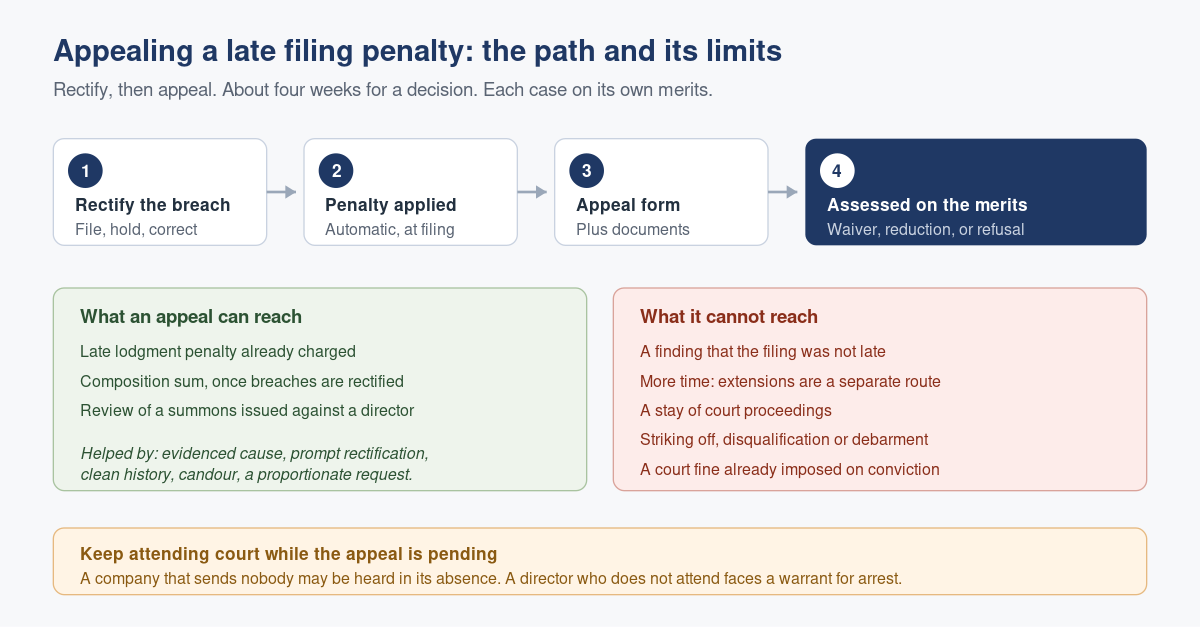
What is on the table
- A waiver or reduction of a late lodgement penalty already charged.
- A waiver or reduction of a composition sum, once the breaches have been rectified.
- A review of a summons issued against you as a director.
What is not
- A ruling that you were not late. If the filing date is after the due date, the breach happened. Appeals are about consequence, not liability.
- More time. An extension is a different product with a different route. Companies can apply for a 60-day extension of time to file an annual return, and that application carries its own fee. Once you are already late, that door has closed.
- A stay of court proceedings. This is the trap that does the most damage. A pending appeal does not excuse you from a court date. A company that sends nobody may be heard in its absence. A director who does not turn up faces a warrant for their arrest.
- Relief for the group at once. A penalty attaches to a filing by an entity. Six dormant subsidiaries in default are six problems.
- Protection from the other tools. Late filing can also trigger ACRA-initiated striking off under section 344(1) of the Companies Act 1967, disqualification under sections 155 and 155A, or a debarment order. Getting a penalty reduced does not touch any of those.
How to submit the appeal
- Rectify first. File the overdue return or transaction, hold the meeting that should have been held, correct the register. ACRA’s appeal route for composition sums is expressly framed around rectified breaches, and an appeal lodged while the company is still in default reads as a request to be excused from complying rather than forgiven for having been slow.
- Pull the facts. The exact due date, the exact filing date, the penalty or composition reference, the entity’s UEN, and the names of the officers affected. Get these right. An appeal that misstates its own dates does not inspire confidence.
- Write the explanation as a chronology, not a plea. What happened, when, and what you did about it. One page.
- Attach the documents that corroborate it. Not the narrative, the proof. Medical documentation, correspondence with a departed service provider, evidence of the trigger event.
- Submit the ACRA late filing appeal form through ACRA’s appeal form, with the supporting documents attached.
- Keep attending court if a summons has been issued, and keep filing everything else on time while you wait.
Reckon on about four weeks for a decision, and longer if the case is complex or if ACRA has to ask you for clarification.
What makes an appeal credible
There is no published scoring rubric, and anyone who tells you there is has invented it. But ACRA’s stated approach to enforcement generally turns on a small number of factors, and an appeal that speaks to them is doing something useful rather than just asking.
Intent. ACRA distinguishes deliberate breaches from accidental ones. If the default was the product of an identifiable, evidenced event rather than indifference, say so plainly and prove it. A director’s serious illness, a bereavement, a corporate service provider who abandoned the file mid-engagement, records lost in a genuine disaster: these are facts, and facts can be documented.
Rectification. Having already put it right, promptly and completely, is the strongest thing in your favour. It is also the cheapest.
Compliance history. A first default by a company that has otherwise filed on time for a decade reads very differently from the fourth default in five years. Repeat offending is explicitly a factor that pushes ACRA towards stronger tools, not weaker ones.
Candour. Own the failure. An appeal that blames ACRA’s reminder system, or the accountant, or the postal service, invites the obvious reply that the obligation was the director’s throughout.
Proportion. A modest, specific request (“we ask that the penalty be reduced”) is easier to grant than a demand for total waiver on thin facts.
Arguments that do not travel well
Cash flow difficulty, on its own, is not an argument about the breach. Ignorance of the deadline is not either, given that the obligation sits on the director personally. “The company is dormant” is a particularly weak line, because a dormant company’s filing obligations are the easiest in the world to meet on time. And “our corporate secretary did not remind us” is a statement about your service arrangements, not about your statutory position.
What goes wrong in practice
The appeal is filed and the court date is ignored. ACRA’s position is unambiguous: you must still attend scheduled court dates while an appeal is being processed. A director who treats the appeal as a stay converts a manageable penalty into a warrant.
Only the newest default is dealt with. Companies frequently clear the current year’s annual return, appeal that penalty, and leave two earlier years outstanding. The earlier years are still breaches, and they are the ones that put the company inside the striking off and disqualification territory.
The registered office address is stale, so nothing arrives. Summonses go by registered mail to the registered office or the director’s home address. A company that never updated its address under section 143(1) of the Companies Act 1967 will not receive the letter, and not receiving it changes nothing. This is also, on ACRA’s own account, one of the signals that a company is no longer in operation.
Nobody counts the transactions. Because non-annual-return penalties are charged per late filing, a backlog cleared in one afternoon produces a bill that is a multiple of what the director expected. Budget for it before you file, not after.
The same appeal is submitted twice. Appeals are assessed on their merits once. Resubmitting the same facts with more adjectives does not help, and consumes the four weeks again.
The underlying cause is never fixed. If the reason you filed late is that nobody owns the compliance calendar, you will be back. Our guides to filing your annual return with ACRA and changing your financial year end cover the two things most often behind a repeated miss.
Frequently asked questions
Can I appeal an ACRA late lodgement penalty before I file the overdue return?
No, in practical terms. The penalty for a late annual return is calculated and applied automatically when you submit the overdue filing in Bizfile, so there is nothing to appeal until you have filed. For composition sums, ACRA’s appeal route is framed around breaches that have already been rectified.
How long does ACRA take to decide an appeal?
About four weeks, depending on complexity. It can take longer during peak filing periods, or where ACRA needs to ask you for clarification or further documents. There is no expedited track, and each case is assessed on its own merits rather than against a published tariff.
Does an appeal postpone my court date?
No. ACRA states expressly that scheduled court dates must still be attended while an appeal is being processed. If a company sends no representative, the court may hear the matter in the company’s absence. If a director does not attend, a warrant may be issued for their arrest.
Who submits the appeal, the company or the director?
A director can appeal to reduce a penalty or to have a summons against them reviewed. In practice the company’s officers or its corporate secretary prepare and submit the form, but the obligations and the exposure sit with the directors personally, so a director should read and own what is submitted.
Will a successful appeal remove the breach from the company’s record?
A reduction or waiver addresses the money. It does not rewrite the filing history, and the late filing remains a late filing for the purposes of ACRA’s view of your compliance record. That record is what matters if there is ever a next time.
Can I appeal a court fine?
No. Once a court has convicted and imposed a fine, that is a judicial outcome, not an administrative penalty, and the appeal form is the wrong instrument. The window for ACRA leniency is before that point, which is exactly why the summons stage is not one to sleep through.
The cheaper version of all of this
Every one of these penalties is avoidable, and the cost of avoiding them is a calendar and somebody whose job it is to watch it. The appeal is the expensive path, and it is the one where the outcome is not in your hands.
Raffles Corporate Services runs the compliance calendar for several hundred Singapore companies: annual returns filed inside the statutory window, officer and address changes lodged inside the 14 days, and the year-end sequence scheduled backwards from the deadline rather than forwards from whenever the accounts arrive. Where a company has already fallen behind, we clear the backlog in the right order and prepare the appeal on the facts that actually matter.
Related reading: how to file a complaint with ACRA about a suspected statutory breach, the Companies Act 1967 map for directors, and the Companies Act 1967 costs and fees breakdown. You can also read more on Singapore corporate secretarial practice at Singapore Secretary Services.
— The Editorial Team, Raffles Corporate Services
Need help with corporate secretarial or compliance matters?
If you would like help with your company's corporate secretarial, governance or compliance requirements, email [email protected] or WhatsApp +65 8501 7133.
Our team can assist with corporate secretarial, accounting and tax matters. Where legal advice is needed, advisers from our associated law firms can assist.