

The Corporate Service Providers Act 2024 took effect on 9 June 2025, and its central move was to stop defining a regulated firm by whether it files things with ACRA. The old registered filing agent regime caught you if you lodged transactions. This Act catches you if you provide a corporate service, full stop, and the definition of corporate service is wider than most firms assumed.
Raffles Corporate Services works with a panel of experienced Singapore law firms who offer cost-effective and efficient legal service and advice. This article is general information only and is not legal advice.
That is the whole story of this statute. If you form companies for clients, supply directors or secretaries, provide a registered office, hold shares as a nominee, or do accounting work that touches a client’s money, entities or transactions, you are inside a licensing regime with criminal penalties attached, whether or not you have ever logged in to Bizfile on a client’s behalf.
The Act was passed by Parliament on 2 July 2024, assented to on 31 July 2024, and came into operation on 9 June 2025, alongside the Companies and Limited Liability Partnerships (Miscellaneous Amendments) Act 2024. It runs to nine Parts and forty-six sections, and the substantive obligations sit in a very small number of them.
If you are a business owner rather than a provider, the practical question is different and simpler: is the firm keeping your registers and filing your annual return actually registered? The register is public, and checking is a two-minute job.
The structure of the Act
The Act is published free on Singapore Statutes Online, and the Corporate Service Providers Regulations 2025 carry most of the operational detail.
| Part | Sections | What lives there |
|---|---|---|
| Part 1, Preliminary | 1 to 6 | The definitions that decide everything, plus the Registrar and the two public registers |
| Part 2, Regulation of provision of corporate services | 7 to 13 | The prohibition on operating unregistered, and the registration criteria for firms and individuals |
| Part 3, Duties and responsibilities | 14 to 17 | Supervision by qualified individuals, nominee director vetting, and the AML obligations |
| Part 4, Regulatory actions | 18 to 22 | The Registrar’s civil toolkit: cancellation, suspension, restriction, financial penalty, censure |
| Part 5, Appeals | 23 to 24 | Appeal to the Minister |
| Part 6, General offence | 25 | Providing false information to the Registrar |
| Part 7, General | 26 to 35 | Composition, recovery of penalties, corporate liability, publication powers, regulations |
| Part 8, Consequential amendments | 36 to 40 | Amendments to the ACRA Act, Business Names Registration Act 2014, Companies Act 1967, LLP Act 2005 and VCC Act 2018 |
| Part 9, Saving and transitional | 41 to 46 | How existing filing agents and qualified individuals were carried across |
Section 4 states the purpose in terms that explain everything else: to regulate corporate service providers and the qualified individuals who provide or supervise corporate services, and to impose requirements on them so as to detect or prevent money laundering, proliferation financing and terrorism financing.
What counts as a “corporate service”?
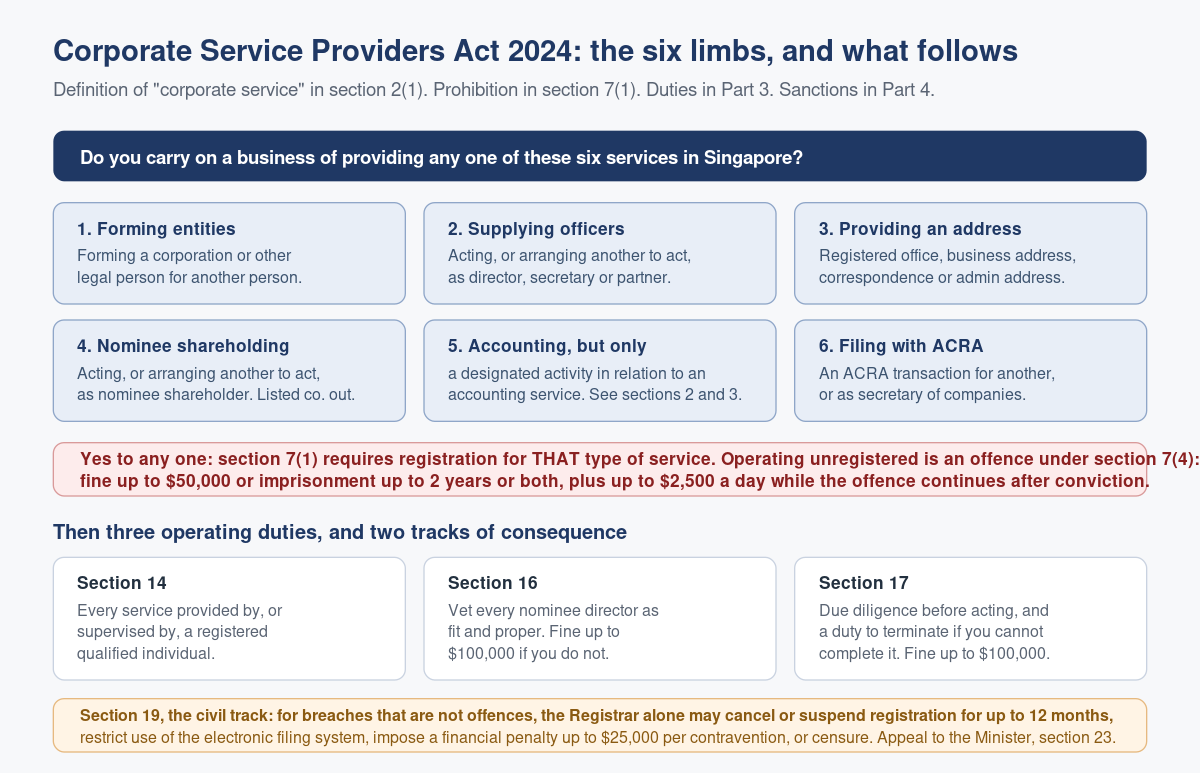
This is the provision to read before any other. Section 2(1) defines “corporate service” as any of six things:
- Forming a corporation or other legal person on behalf of another person.
- Acting, or arranging for another person to act, as a director or secretary of a corporation, as a partner of a partnership, or in a similar capacity in relation to other legal persons.
- Providing a registered office, business address, correspondence or administrative address, or other related services for a corporation, partnership or other legal person.
- Acting, or arranging for another person to act, as a nominee shareholder on behalf of a corporation, other than a corporation whose securities are listed on an approved exchange within the meaning of section 2(1) of the Securities and Futures Act 2001.
- Carrying out any designated activity in relation to the provision of any accounting service.
- Carrying out an ACRA transaction with the ACRA Registrar using the electronic transaction system, either on behalf of another person, or for one or more companies as secretary of each of those companies.
A “corporate service provider” is then simply a person who carries on a business of providing any corporate service. Section 2(2) extends the references to corporations, legal persons and partnerships to entities formed outside Singapore.
Limb 6 is the old filing agent concept, now only one entry on a list of six. Limbs 3 and 4 catch firms that thought of themselves as landlords or administrators. Limb 5 is the one that surprised the accounting profession.
The accounting limb, unpacked
Limb 5 has two moving parts, and you need both before you are caught.
“Designated activity” is defined in section 2(1) as the preparation to carry out, or the carrying out of, transactions for a customer concerning any of: buying or selling real estate; management of client money, securities or other assets; management of bank, savings or securities accounts; organisation of contributions for the creation, operation or management of corporations; or the creation, operation or management of legal persons or legal arrangements, or buying and selling of business entities.
“Accounting service” is defined separately in section 3(1) as financial accounting service, internal audit service, management accounting service or taxation service, each of which is then defined in turn. Section 3(2) adds a filter that matters: a service is not any of those unless its performance requires the application of an accounting or related skill.
So ordinary bookkeeping for a client is not, by itself, a corporate service. Handling the client’s money, opening or operating accounts for them, organising the funding of a company, or arranging the purchase or sale of a business entity, is.
The prohibition, and what breaching it costs
Section 7(1) is the operative prohibition: a person must not carry on a business in Singapore of providing any corporate service unless the person is a registered corporate service provider for that type of corporate service. Registration is service-specific, not a general licence.
Section 7(4) sets the penalty. A person who contravenes section 7(1) is guilty of an offence and liable on conviction to a fine not exceeding $50,000 or imprisonment for a term not exceeding two years, or both, and in the case of a continuing offence to a further fine not exceeding $2,500 for every day or part of a day during which the offence continues after conviction. The daily accrual is the part that turns a compliance oversight into a serious number.
Section 7(2) creates a deemed registration for accounting entities. An accounting entity carrying on a business of designated activities in relation to its own provision of accounting services is treated as registered under section 8 as a registered corporate service provider for that type of service, and stays so treated until the deemed registration is suspended or cancelled under section 18(2) or section 19(2) or (3). Section 7(3) then bites: despite anything in the Accountants Act 2004, if that deemed registration is suspended or cancelled, the accounting entity is not authorised to carry out designated activities in relation to accounting services at all. For an accounting firm, a regulatory action under this Act reaches into work it does under a different statute.
On registration mechanics, ACRA has published that registration now runs for two years rather than one or two, with a fee of $400 for two years for a corporate service provider and $200 for two years for a registered qualified individual, replacing the former annual fees under the filing agent regime.
The three operating duties in Part 3
Section 14: everything must run through a qualified individual
A registered corporate service provider must ensure that the corporate service it carries on a business in is provided either by one or more registered qualified individuals, or by one or more prescribed persons under the supervision of a registered qualified individual. Section 14(2) allows the regulations to prescribe different descriptions of persons for different types of corporate service.
In practice this is a staffing constraint. You cannot have a service line with no qualified individual attached to it.
Section 16: you vet the nominee director, and you carry the fine
Section 16(1) prohibits a registered corporate service provider from arranging for a person to act as a nominee director of a company unless it is satisfied that the person is a fit and proper person. Section 16(2) tells you what satisfying yourself requires: taking all reasonable steps to satisfy yourself that the person is not disqualified from acting as a director under any written law, and considering such factors as may be prescribed. Section 16(3) makes failure an offence carrying a fine not exceeding $100,000.
“Nominee director” is defined in section 2(1) as a director who is accustomed or under an obligation, whether formal or informal, to act in accordance with the directions, instructions or wishes of another person. The words “or informal” close the obvious gap.
The mirror obligation sits on the individual. A person must not act as a nominee director by way of business unless the appointment is arranged by a registered corporate service provider, a prohibition inserted into the Companies Act 1967 by the consequential amendments in Part 8. ACRA has published the maximum fine for that offence as $10,000.
For the practical consequences of that regime, see our guides on nominee director arrangements and ACRA’s central registers and on sentencing for nominee directors after Public Prosecutor v Zheng Jia.
Section 17: customer due diligence, and the duty to walk away
Section 17(1) requires a registered corporate service provider to perform customer due diligence measures before providing any corporate service to a customer, where it has reason to suspect money laundering, proliferation financing or terrorism financing, where it has reason to doubt the veracity or adequacy of information obtained from earlier due diligence, and in other prescribed circumstances.
Section 17(4) is the provision with real commercial teeth. Where the provider is for any reason unable, or chooses not, to complete a due diligence measure, it must decline to provide the service, terminate any ongoing provision of the service, determine whether to make a disclosure under section 45 of the Corruption, Drug Trafficking and Other Serious Crimes (Confiscation of Benefits) Act 1992 or section 8 or 10 of the Terrorism (Suppression of Financing) Act 2002, record the basis of that determination, and carry out any other prescribed measures.
Note the second limb. It is not only “do not take the client”, it is “stop acting for the client you already have”. Section 17(3) allows a provider to stop short of completing due diligence where it suspects the transaction relates to money laundering, proliferation financing or terrorism financing and believes that performing the measures would tip off the customer or another person.
Section 17(5) requires records obtained through due diligence to be kept in the prescribed manner and for the prescribed period. Section 17(6) sweeps in further prescribed requirements, including giving effect to Financial Action Task Force recommendations and self-assessing and reporting compliance to the Registrar. Section 17(7) makes failure to comply with subsections (1), (2), (4), (5) or (6) an offence carrying a fine not exceeding $100,000.
ACRA has also published that the senior management of a registered corporate service provider who fails to ensure the firm complies with its anti-money laundering obligations commits an offence carrying a fine of up to $100,000 for each breach.
Two tracks of consequence, and why the civil one bites harder
The Act runs criminal offences and civil regulatory action in parallel, and the division between them is deliberate.
| Criminal offence | Regulatory action | |
|---|---|---|
| Who decides | The court, on prosecution | The Registrar, under Part 4 |
| Trigger | A contravention that the Act makes an offence, for example sections 7, 16 or 17 | A breach of a registration condition, or of a requirement whose breach is not an offence: section 19(1) |
| Outcome | Fine, and for section 7 imprisonment up to 2 years | Cancellation, suspension up to 12 months, restriction of electronic transaction system use, financial penalty not exceeding $25,000 per contravention, or censure: section 19(2) |
| Follow-on | Composition is available under section 27 | Non-payment of a financial penalty can itself lead to cancellation, suspension or restriction: section 19(3) |
Section 19 applies where the Registrar is satisfied that a provider is contravening, or has contravened, a condition of its registration or a requirement under the Act or the regulations whose breach is not an offence. Sections 20 and 21 do the equivalent job for registered qualified individuals, and section 22 governs the proceedings. Section 23 gives an appeal to the Minister.
Restriction of electronic transaction system use is the sanction that hurts a working firm most. A corporate service provider that cannot file loses the ability to serve clients immediately, without a conviction, without a fine, and without a hearing in open court. Section 32 gives the Registrar power to publish or disclose information, so the commercial damage is not confined to the operational one.
What goes wrong in practice
Assuming you are outside because you do not file. This is the single most common error, and it is the exact gap the Act was written to close. Firms that supply a registered office, or hold shares as nominee, or arrange directors, and route their filings through someone else, are inside section 7(1) on the face of the definition.
Registering for the wrong service type. Section 7(1) requires registration for that type of corporate service. A firm registered for one limb of the definition and quietly providing another is not partially compliant. It is unregistered for the service it is providing.
Treating the nominee director check as paperwork. Section 16(2) requires all reasonable steps to confirm the candidate is not disqualified under any written law. A signed declaration from the candidate is not, on its own, all reasonable steps. Our note on the Form 45 money-laundering disqualification covers what the disqualification landscape now looks like.
Onboarding faster than due diligence. Section 17(1)(a) requires the measures before providing any corporate service. Incorporating first and completing the file later is a contravention of a provision carrying a six-figure maximum fine.
Forgetting that accounting entities can lose more than the registration. Section 7(3) removes the entity’s authorisation to carry out designated activities in relation to accounting services once the deemed registration is suspended or cancelled. For a firm whose income is accounting rather than corporate secretarial, that is the greater loss. Our note on ACRA’s practice direction on external capital in accounting firms covers the parallel regulatory pressure on firm structure.
Frequently asked questions
Do I need to be a registered corporate service provider if I never file anything with ACRA?
Very possibly, yes. Section 7(1) is triggered by carrying on a business of providing any corporate service, and section 2(1) defines that to include forming entities, supplying directors or secretaries, providing a registered office or business address, acting as a nominee shareholder, and certain accounting work. Filing with ACRA is only one of the six limbs.
Is my accounting firm caught by this Act?
Only if it carries out a designated activity in relation to an accounting service. Designated activities are defined in section 2(1) and centre on handling client money or assets, operating accounts, organising funding for corporations, and creating, operating or managing legal persons or buying and selling business entities. Preparing accounts and tax returns, without more, does not by itself bring the firm inside section 7(1).
How do I check whether my corporate secretary is registered?
Section 6 requires the Registrar to keep and maintain a register of registered corporate service providers and a register of registered qualified individuals. Both are public. Ask for the firm’s registration and the name of the registered qualified individual responsible for your account, then check them against the register. A firm that hesitates at that question has told you something.
What is the difference between a fine and a financial penalty under this Act?
A fine follows a criminal conviction for an offence, for example under section 7(4), 16(3) or 17(7). A financial penalty is imposed by the Registrar under section 19(2)(d), without a prosecution, up to $25,000 for each contravention, for breaches of registration conditions or of requirements that the Act does not make offences. Failing to pay it can itself trigger cancellation or suspension under section 19(3).
Can a corporate service provider drop my company mid-engagement?
Yes, and in one situation it must. Section 17(4) requires a provider that cannot or does not complete customer due diligence to decline the service and to terminate any ongoing provision of it. That is a statutory duty, not a commercial choice, and it can arise partway through a relationship if the provider comes to doubt information it holds.
Where do the detailed compliance requirements actually live?
Mostly in the Corporate Service Providers Regulations 2025, made under section 35. The Act sets the duties at a high level and leaves the prescribed measures, records, periods and factors to the regulations. Our Corporate Service Providers Act 2024 compliance FAQ works through the operational side.
The question this Act asks of you
If you are a provider, the Act asks whether every service line you run has a registration and a qualified individual attached to it. If you are a client, it asks one question: is the firm holding your registers, your registered office and your controller register properly registered, and can it tell you who the responsible qualified individual is?
Raffles Corporate Services is a Singapore corporate services firm operating inside this regime. If you want to understand what your current provider is and is not authorised to do for you, or where the boundary sits between corporate secretarial work and work that needs a lawyer, our note on the CSP and counsel handoff is a good place to start, and we are happy to have the conversation directly.
Related reading: the Companies Act 1967, a map for directors, nominee shareholder arrangements and beneficial ownership, and removing filing access for an appointed CSP in Bizfile. You can also read more on Singapore corporate secretarial practice at Singapore Secretary Services.
— The Editorial Team, Raffles Corporate Services
Need help with corporate secretarial or compliance matters?
If you would like help with your company's corporate secretarial, governance or compliance requirements, email [email protected] or WhatsApp +65 8501 7133.
Our team can assist with corporate secretarial, accounting and tax matters. Where legal advice is needed, advisers from our associated law firms can assist.