

The Companies Act 1967 is the statute that creates your company, defines what a director is, and sets almost every filing obligation you will ever be penalised for missing. It is organised into Parts running up to Part 12, and as a director of a private company you will spend your entire career inside about four of them.
Raffles Corporate Services works with a panel of experienced Singapore law firms who offer cost-effective and efficient legal service and advice. This article is general information only and is not legal advice.
It came into force on 29 December 1967, modelled on Malaysia’s Companies Act 1965, which was itself modelled on the Companies Act 1961 of Victoria, Australia. That lineage explains the drafting style, and why the definitions section is where so much of the real work happens.
One thing the Act no longer does is govern insolvency. Winding up, judicial management and receivership moved to the Insolvency, Restructuring and Dissolution Act 2018, and the Companies Act now cross-refers to that statute for concepts such as when a winding up commences and how a judicial manager is appointed. If an older precedent sends you to the Companies Act for a liquidation question, it is out of date.
What follows is a map, not a summary.
The structure, Part by Part
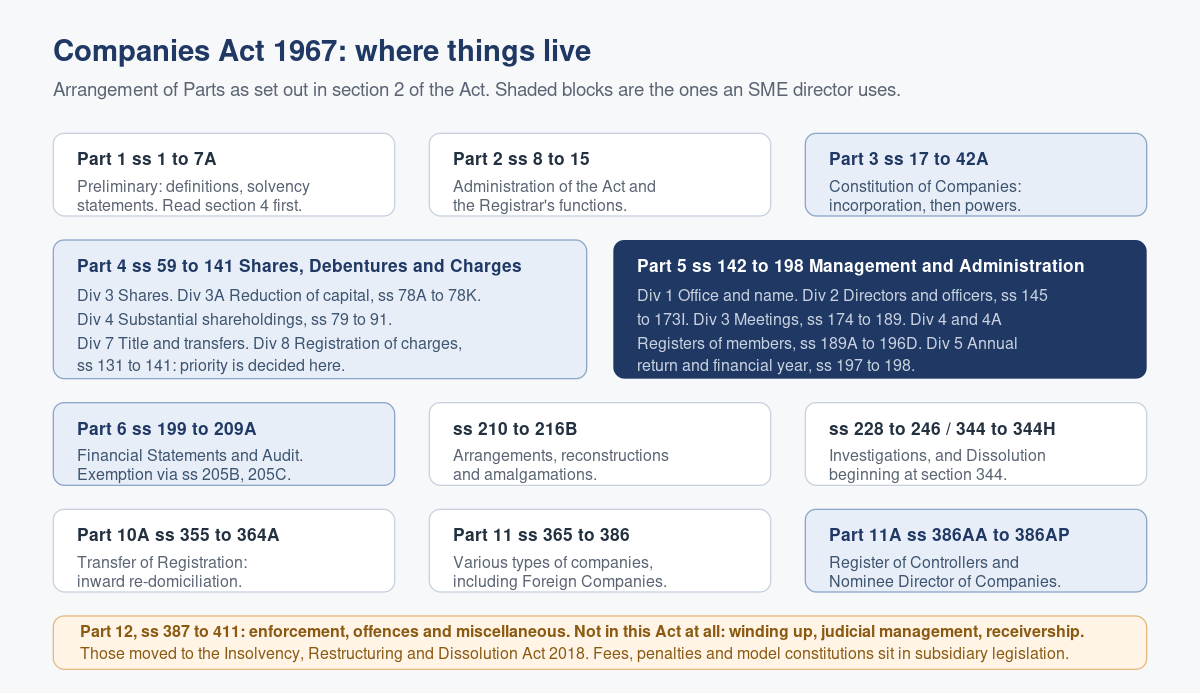
Section 2 sets out the Act’s own arrangement of Parts and Divisions, which is the fastest orientation available and the one most people never read.
| Subject area | Where it sits | Sections |
|---|---|---|
| Preliminary: definitions, solvency statements | Part 1 | 1 to 7A |
| Administration of the Act, the Registrar | Part 2 | 8 to 15, not continuous |
| Constitution of Companies | Part 3 | 17 to 42A |
| Shares, Debentures and Charges | Part 4 | 59 to 141 |
| Management and Administration | Part 5 | 142 to 198 |
| Financial Statements and Audit | Part 6 | 199 to 209A |
| Arrangements, reconstructions, amalgamations | Middle of the Act | 210 to 216B |
| Investigations | Middle of the Act | 228 to 246 |
| Dissolution | Later in the Act | 344 to 344H |
| Transfer of Registration | Part 10A | 355 to 364A |
| Various company types, incl. foreign companies | Part 11 | 365 to 386 |
| Register of Controllers and Nominee Director | Part 11A | 386AA to 386AP |
| General: enforcement, offences, miscellaneous | Part 12 | 387 to 411 |
The four Parts an SME director actually lives in
Part 3: how the company exists
Incorporation sits here, and so does the status of the constitution. Since 3 January 2016, a company’s memorandum and articles are collectively deemed to constitute its constitution, and any reference in a contract or another statute to the memorandum or articles is read as a reference to the constitution. For a pre-2016 company, that rule is doing quiet work behind every document you sign.
Part 4: shares, debentures and charges
The Part most likely to produce an expensive surprise, because the mechanics of ownership are prescribed rather than left to the parties. Division 3 covers shares, and Division 3A, sections 78A to 78K, reduction of share capital. Division 4, sections 79 to 91, is substantial shareholdings and its disclosure duties. Division 7 handles title and transfers. Division 8, sections 131 to 141, is registration of charges: the regime that decides the priority of your lender’s security, and the one where a missed deadline cannot be cured by agreement between the parties. See our notes on registering and releasing a charge and on allotting and transferring shares.
One cross-reference is worth flagging. A solvency statement, defined in section 7A, is the gateway to redeeming preference shares out of capital under section 70, to giving financial assistance under section 76(9A) or (9B), and to reducing share capital under section 78B or 78C. A director who makes one without reasonable grounds for the opinions in it commits an offence carrying a fine not exceeding $100,000 or imprisonment for up to three years, or both. That is personal criminal exposure attached to a document directors sign routinely and read rarely.
Part 5: management and administration
If you only ever read one Part, read this one. It runs from section 142 to section 198, and it contains almost every obligation ACRA will chase you for.
- Division 1, sections 142 to 144: office and name. Section 143(1) requires notification of a change of registered office within 14 days.
- Division 2, sections 145 to 173I: directors and officers. Section 145(1) requires at least one director ordinarily resident in Singapore, and where the company has a single member that sole director may also be the sole member. Section 145(2) requires directors to be natural persons of at least 18 and otherwise of full legal capacity. Section 145(5) is the one people forget: a director must not resign or vacate office unless at least one Singapore-resident director remains, and a purported resignation in breach of that is invalid. Section 173A(1)(b) sets the 14-day filing window when a director joins or leaves. Section 157 requires a director at all times to act honestly and to use reasonable diligence in discharging the duties of the office. Sections 155 and 155A carry the disqualification regime.
- Division 3, sections 174 to 189: meetings and proceedings. Section 175 is the annual general meeting requirement.
- Divisions 4 and 4A, sections 189A to 196D: registers of members. Division 4 covers the register kept by a public company, with section 190 as the principal register. Division 4A covers the Registrar’s electronic register, sections 196A to 196D, which for a private company is the one that matters. A printout from your own files is not the authoritative record.
- Division 5, sections 197 to 198: annual return and financial year. Section 197(1) is the annual return obligation; section 198 governs how a company’s financial year is determined.
Section 145 has a sting in its tail. Under section 145(10), if a company carries on business for more than six months without at least one Singapore-resident director, a member who knows it is doing so becomes personally liable for the debts the company contracts during that period, and can be sued for them. That is limited liability switching off, and it is the strongest argument there is for not letting a resident directorship lapse. Our note on the trapped nominee director’s exit covers the other side of that problem.
Part 6: financial statements and audit
Division 1 covers financial statements and Division 2 covers audit. The Act’s definition of “audit requirements” points to sections 201(8) and (9) and section 207, and exemption from them runs through sections 205B and 205C, which is where the small company concept lives. Accounting Standards, for the purposes of this Act, are those made under Part 3 of the Accounting Standards Act 2007.
Part 11A: the one that catches people out
Part 11A, sections 386AA to 386AP, is the register of controllers and nominee directors. Introduced by the 2017 amendments to make ownership and control more transparent, it obliges companies and LLPs, unless exempted, to obtain and maintain beneficial ownership information. It is a separate register with its own duties, and it does not appear in the free register extracts most directors download. Corporate service providers carry their own overlay here, set out in our Corporate Service Providers Act 2024 compliance FAQ.
Its near neighbour, Part 10A, sections 355 to 364A, is the inward re-domiciliation regime, which lets a foreign corporate entity transfer its registration to Singapore rather than incorporate afresh and migrate assets.
How to read the Act on Singapore Statutes Online
The Act is published free at sso.agc.gov.sg, the subsidiary legislation made under it sits alongside, and ACRA maintains a landing page for the Act with its amendment history. Five habits will save you from the commonest errors.
- Start at section 2, not section 1. The arrangement of Parts and Divisions is the table of contents the Act gives itself.
- Read section 4 before anything substantive. Definitions do enormous work here. “Director” includes anyone occupying the position by whatever name called, and anyone on whose directions or instructions the board is accustomed to act. “Officer” reaches receivers, liquidators and judicial managers.
- Check the amendment markers and commencement notes. Provisions carry bracketed references such as [36/2014] or a “wef” date, telling you which amending Act changed the text and from when. Amendments have been commenced in phases more than once.
- Follow the cross-references out. Insolvency goes to the Insolvency, Restructuring and Dissolution Act 2018, accounting standards to the Accounting Standards Act 2007, regulatory architecture to the Accounting and Corporate Regulatory Authority Act 2004.
- Remember the subsidiary legislation. Fees and late lodgement penalties, composition of offences, model constitutions, striking off and the register of controllers all live in regulations rather than in the Act. If you are hunting for a figure and cannot find it, that is why.
What goes wrong in practice
Citing a section from memory. The Act has been amended repeatedly since 1967, most heavily by the Companies (Amendment) Act 2014 and again in 2017, and section numbers have been inserted, deleted and re-lettered. A confident wrong citation in a board paper is worse than no citation, because the next reader relies on it.
Assuming the constitution can override. Some provisions apply despite anything in the constitution or in any agreement with the company. Section 145(5) says so expressly. Drafting around a mandatory provision does not work.
Treating the Act as the whole of a director’s duties. The statutory statement in section 157 sits on top of a body of general law duties, and alongside obligations under tax, employment and sector legislation. The Act is the floor, not the ceiling.
Frequently asked questions
Is the Companies Act 1967 the same as “Chapter 50”?
Yes, in substance. The Act was long cited as Chapter 50, and older documents, court judgments and even some current government pages still refer to it that way. Under the revised citation convention it is called the Companies Act 1967, by name and year, but the instrument is the same one and the section numbers are the same.
Does the Companies Act still cover liquidation and judicial management?
No. Winding up, judicial management and receivership are now dealt with under the Insolvency, Restructuring and Dissolution Act 2018, and the Companies Act cross-refers to it for those concepts. The Companies Act retains the dissolution provisions beginning at section 344, which is where ACRA-initiated striking off sits.
Which Part should a first-time director read?
Part 5, Management and Administration, sections 142 to 198. It contains the registered office and name rules, the directors and officers provisions including the resident director requirement, the meetings rules including the annual general meeting, the registers of members, and the annual return obligation. Almost every ACRA penalty a private company incurs traces back to this Part.
How do I know if a provision I am reading is still in force?
Check the bracketed amendment references and any commencement note attached to the provision on SSO, and confirm the version date of the text you are viewing. Amendments to this Act have been commenced in phases, so a provision can be enacted but not yet operative.
Where the map stops and the work starts
Knowing the shape of the Act is useful. What keeps a company out of trouble is somebody applying the handful of provisions in Part 5 to a calendar, every year, without being reminded.
Raffles Corporate Services does that for several hundred Singapore companies: registers maintained under Part 5, changes lodged inside the statutory 14 days, annual returns filed under section 197, and the controller register kept current under Part 11A. If you are not certain which of those is currently true of your company, that is a short conversation.
Related reading: the Companies Act 1967 deep-dive FAQ, timeline and processing benchmarks, and if you are already in default, appealing an ACRA late filing penalty. You can also read more on Singapore corporate secretarial practice at Singapore Secretary Services.
— The Editorial Team, Raffles Corporate Services
Need help with corporate secretarial or compliance matters?
If you would like help with your company's corporate secretarial, governance or compliance requirements, email [email protected] or WhatsApp +65 8501 7133.
Our team can assist with corporate secretarial, accounting and tax matters. Where legal advice is needed, advisers from our associated law firms can assist.