

Your company can only buy back its own shares if its constitution expressly permits it. Section 76B(1) of the Companies Act 1967 says so, and if the constitution is silent the answer is no. Not “probably fine”. No. You amend the constitution by special resolution first, then you buy the shares.
Raffles Corporate Services works with a panel of experienced Singapore law firms who offer cost-effective and efficient legal service and advice. This article is general information only and is not legal advice.
We open with that because it is where most buybacks in Singapore stall, and because it is almost always discovered late. A shareholder wants out, a price is agreed, the board is ready, and then somebody reads the constitution and finds a document adopted from a template in 2011 that says nothing about share purchases at all.
Once the authority is there, a buyback is one of the cleaner ways to return capital or remove a shareholder. Here is how the statute is built, which of the four routes you are on, and the filing that makes it stick.
What a buyback is, and how it differs from a capital reduction
A share buyback is the company purchasing shares it issued, from the holder, for consideration: the shareholder decides whether to sell, and gets paid. A reduction of share capital under Division 3A of Part 4 is structurally different, because the company cancels or writes down share capital by statutory process and a dissenting shareholder cannot simply decline.
| Share buyback (sections 76B to 76G) | Reduction of share capital (sections 78A to 78K) | |
|---|---|---|
| Does the shareholder choose? | Yes. It is a purchase from a consenting holder | No. Shares can be cancelled without the individual holder’s consent |
| Is the shareholder paid? | Yes, that is the transaction | Not necessarily. A write-off of lost capital pays nobody |
| Gateway condition | Constitution must expressly permit it | Constitution must not exclude or restrict the power |
| Approval | Ordinary or special resolution depending on the route | Special resolution, or a court order |
| Creditor protection | Solvency at the date of payment, section 76F | Solvency statement plus publicity and a six week creditor window, or the court |
| Quantitative cap | 20% of the class during the relevant period | None in the statute |
| Typical timetable | Days, once authority is in place | Eight to ten weeks on the solvency route |
Note the gateway asymmetry. For a buyback the constitution must expressly permit. For a reduction, section 78A(3) says the constitution may exclude or restrict the power, so silence leaves the power intact. Opposite defaults, same document.
If a reduction turns out to be the better tool, we have covered both routes: reducing share capital by solvency statement and capital reduction by court application.
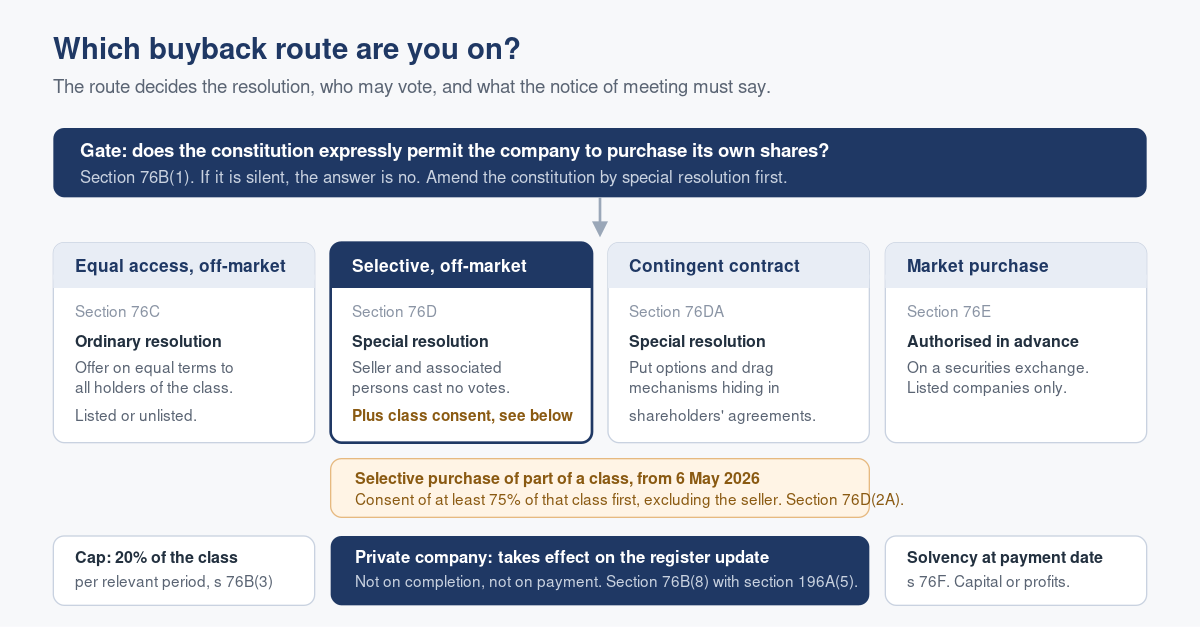
The four routes, and picking the right one
Sections 76C to 76E give four ways to acquire your own shares. The route determines the resolution, who can vote, and what has to go in the notice of meeting.
Off-market purchase on an equal access scheme, section 76C
The company offers to buy from all holders of the class on equal terms. Authorised in advance by ordinary resolution in general meeting, and available to listed and unlisted companies alike for purchases made off exchange.
Section 76C(2) is prescriptive about the notice of meeting. It must specify the maximum number or percentage of ordinary shares authorised to be purchased, the maximum price, an expiry date no later than the next annual general meeting or the date one is required by law to be held, and the sources of funds including the amount of financing and its impact on the company’s financial position. The resolution itself must state the number or percentage, the maximum price and the expiry date.
That last item, the impact of the financing, is routinely reduced to a sentence. It should not be. It is what a liquidator reads first if the company fails within a year.
Selective off-market purchase, section 76D
The company buys from one identified shareholder, or some but not all of them, off exchange and not on equal access terms. This is the route for buying out a departing founder or a minority holder.
It needs a special resolution, and no votes may be cast by the person whose shares are being bought or by that person’s associated persons. The seller cannot vote themselves out of the company. As with section 76C, the notice must specify the expiry date of the authority and the sources of funds and their impact.
Since 6 May 2026 there is an additional gate. Where the shares being bought belong to a class and do not constitute all the shares in that class, section 76D(2A) requires the company, before passing the special resolution, to obtain the consent of at least 75% of the holders of that class, excluding the seller and associated persons. Class consent first, special resolution second. We deal with that change in full in the new two-tiered shareholder approval requirement for selective share buy-backs, which is the piece to read if this is your route.
Contingent purchase contract, section 76DA
A contract under which the company may become entitled or obliged to purchase its own shares on a contingency, for example a put option granted to an investor. It needs a special resolution to authorise the contract.
This is the route most often missed entirely, because the buyback lives inside an investment document rather than a board paper labelled “buyback”. If your shareholders’ agreement contains any mechanism by which the company may have to acquire shares, section 76DA applies to it.
Market purchase, section 76E
Buying on a securities exchange, authorised in advance in general meeting. Relevant to listed companies, not to the private companies most readers of this article run.
The caps, and why treasury shares confuse them
Section 76B(3) limits the ordinary shares and stocks in any class that may be purchased during the relevant period to 20% of the total in that class, measured at the date of the authorising resolution. Section 76B(3B) applies the same ceiling to non-redeemable preference shares in a class. Section 76B(3D) imposes no limit on redeemable preference shares.
“Relevant period” is defined in section 76B(4): it starts on the date of the authorising resolution and expires when the next annual general meeting is held, or is required by law to be held, whichever is earlier. The cap is an annual allowance, not a lifetime one.
Two refinements matter. Section 76B(3E) disregards ordinary shares held as treasury shares. And where the company has reduced its share capital under section 78B or 78C, or the court has approved a reduction under section 78I, sections 76B(3A) and (3C) rebase the denominator to the altered total. The Minister can also prescribe a different percentage by notification, so check the current figure before sizing a programme close to the ceiling.
Funding, solvency and the accounting consequence
Section 76F(1) permits payment out of the company’s capital or profits, so long as the company is solvent, and section 76F(1A) confirms the payment includes expenses incurred directly in the purchase, such as brokerage or commission.
Solvency here is defined in section 76F(4) and tested at the date of payment, not the date of the resolution: no ground on which the company could be found unable to pay its debts; the company will be able to pay its debts as they fall due over the following twelve months; and assets are not worth less than liabilities including contingent liabilities, and will not become so after the purchase.
Section 76F(3) puts that on directors personally. Any director or chief executive officer who approves a purchase of the company’s own shares, knowing the company is not solvent, is guilty of an offence and liable on conviction to a fine not exceeding $100,000 or to imprisonment for a term not exceeding three years.
Section 76G handles the accounting follow-through. Where shares are purchased and cancelled, the company must reduce share capital if they were bought out of capital, profits if bought out of profits, or both proportionately, by the total purchase price paid. This is why the notice of purchase asks whether the shares came out of profits or capital: that single field drives the entries. See share capital, share premium and reserves.
Cancel, or hold as treasury?
Section 76B(5) deems ordinary shares cancelled immediately on purchase unless held in treasury in accordance with section 76H. Section 76B(5A) is stricter for preference shares: they are deemed cancelled immediately, full stop. Section 76B(6) extinguishes the rights attached to a cancelled share.
Hold them in treasury and three constraints follow. Section 76I caps treasury holdings at 10% of the total number of shares, with an equivalent cap by class where the capital is divided into classes. Section 76J strips the rights, so no votes and no dividends. Section 76K sets out what a private company may then do with them, including selling for cash or transferring under an employee share scheme.
Treasury is useful if you intend to recycle the shares into an employee plan, and an administrative burden with no upside if you do not. Fuller treatment in treasury shares in Singapore.
The filing, and when the buyback actually takes effect
Here is the part that surprises people. For a private company the purchase does not take effect on completion. Section 76B(8) provides that a purchase by a private company on or after 3 January 2016 does not take effect until the Registrar updates the electronic register of members under section 196A(5).
Section 76B(7) sets out what a private company lodges: a copy of the authorising resolution, and a notice of purchase in the prescribed form giving the date of purchase, the number of shares purchased, cancelled and held as treasury shares, issued share capital before and after, the consideration paid, and whether the shares came out of profits or capital. For a public company, section 76B(9) sets two 30 day deadlines: the authorising resolution within 30 days after it is passed, and the notice of purchase within 30 days after the purchase.
| Private company | Public company | |
|---|---|---|
| Resolution filing | Lodged with the notice under section 76B(7) | Within 30 days after the resolution is passed, section 76B(9)(a) |
| Notice of purchase | Lodged to give effect to the purchase | Within 30 days after the purchase, section 76B(9)(b) |
| When the purchase takes effect | On the Registrar updating the electronic register of members, section 76B(8) | On the date the company would become entitled to exercise the rights attached to the shares, section 76B(9)(c) |
| Fee | Free | Free |
| Processing | Immediate | Immediate |
The filing is made through the update shares information eService in Bizfile. A director or the company secretary can file directly, or a registered corporate service provider can file on the company’s behalf. There is no fee and processing is immediate. Because the register is the operative record, see our explainer on the electronic register of members.
What goes wrong, and what it costs
No express authority in the constitution. The transaction is not permitted by section 76B(1). Fixing it means a special resolution to amend the constitution before the buyback resolution, which moves the completion date. Check the constitution before you agree a price, not after.
Paying the seller before the register is updated. For a private company the purchase does not take effect until the Registrar updates the electronic register of members. If funds leave on Monday and the filing is made on Friday, the company has paid for shares it has not yet acquired, and the seller remains on the register with all the rights that carries. Sequence payment and filing on the same day.
The seller voting, or the class not consenting. On a selective off-market purchase under section 76D the seller and associated persons cast no votes, so in a two-shareholder company where one is selling the other decides alone. If the minutes show the seller voting in favour, the special resolution is defective and so is the buyback. Since 6 May 2026 there is a second trap in the same place: a purchase of part of a class also needs 75% class consent obtained before the special resolution.
Blowing the 20% cap, or forgetting the section 76G reduction. The cap runs by class over the relevant period, which resets at each annual general meeting, so a company doing two buybacks eight months apart under the same authority can exceed the ceiling while feeling it has done nothing unusual. Separately, if the notice of purchase says “out of profits” and the accounts reduce share capital, the filing and the financial statements disagree, and the auditor will find it.
Filing the wrong transaction. A buyback, a transfer, a reduction and a redemption of preference shares are four Bizfile transactions on four statutory bases. Filing a transfer where a buyback belongs produces a register that does not reflect what happened, and correcting it means a notice of error or, failing that, a court order. See our pieces on section 70 and the redemption of preference shares and how to allot and transfer shares.
Frequently asked questions
Can any Singapore company buy back its own shares?
Only if its constitution expressly permits it. Section 76B(1) of the Companies Act 1967 makes express constitutional authority a precondition, so silence means the company cannot proceed until the members amend the constitution by special resolution. This applies to private and public companies, listed or not.
How many shares can a company buy back in a year?
Not more than 20% of the ordinary shares and stocks in the class, measured at the date of the authorising resolution, during the relevant period running from that resolution to the next annual general meeting or the date one is legally required, whichever is earlier. The same ceiling applies to non-redeemable preference shares. There is no cap on redeemable preference shares.
Can a company pay for a buyback out of capital, or only out of profits?
Either, or both. Section 76F(1) permits payment out of capital or profits so long as the company is solvent at the date of payment, and section 76F(4) defines solvency. A director who approves a buyback knowing the company is not solvent commits an offence punishable by a fine of up to $100,000 or up to three years’ imprisonment.
When does a private company’s buyback legally take effect?
When the Registrar updates the company’s electronic register of members, under section 76B(8) read with section 196A(5). Not on the date of the sale and purchase agreement, and not when the money moves. Until the register is updated, the seller remains the registered holder.
What happens to the shares after the company buys them?
Ordinary shares are deemed cancelled immediately on purchase unless held as treasury shares under section 76H. Preference shares are always deemed cancelled. Treasury holdings are capped at 10% of total shares under section 76I, and under section 76J they carry no votes and no dividends.
Doing this once and doing it right
A buyback looks like a share transfer with the company as buyer. It is not. It is a statutory procedure with a constitutional gateway, a route-specific resolution, a voting exclusion, a quantitative cap, a solvency test carrying personal criminal liability, a funding election that drives the accounting, and a filing that is itself the completion event.
That is a lot to assemble once, for a transaction most companies do a handful of times. Raffles Corporate Services runs buybacks end to end: constitution review before anything is agreed, the right route identified, resolutions drafted to the section’s own requirements, the solvency position documented, and the notice of purchase filed so payment and the register update land together.
If you have a departing shareholder and a price in mind, start with the constitution. Reach us through Raffles Corporate Services, or read more at Singapore Secretary Services. The primary sources are sections 76B to 76G of the Companies Act 1967 and ACRA’s page on buying back shares.
— The Editorial Team, Raffles Corporate Services
Need help with corporate secretarial or compliance matters?
If you would like help with your company's corporate secretarial, governance or compliance requirements, email [email protected] or WhatsApp +65 8501 7133.
Our team can assist with corporate secretarial, accounting and tax matters. Where legal advice is needed, advisers from our associated law firms can assist.