

Treasury shares can only leave your company’s balance sheet by one of five routes set out in section 76K of the Companies Act 1967: sold for cash, transferred under a share scheme, transferred as consideration for an acquisition, cancelled, or used for a purpose the Minister has prescribed. Everything else is not available to you.
Raffles Corporate Services works with a panel of experienced Singapore law firms who offer cost-effective and efficient legal service and advice. This article is general information only and is not legal advice.
That closed list matters more than it sounds. Once your company has bought back its own shares and parked them in treasury, the shares are in a holding pattern that is legally quite unlike ordinary shareholding. The company is entered on its own register of members as the holder, but it cannot vote them, cannot receive a dividend on them, and cannot simply hand them to whomever it likes.
And the filing mechanics differ depending on whether your company is private or public. For a private company, the filing is not a report of something that has already happened. It is the event.
What a treasury share actually is
When a company buys back its own ordinary shares, those shares are deemed cancelled immediately on purchase unless the company holds them in treasury under section 76H. That is the default rule in section 76B(5). Holding in treasury is the exception you elect into, not the automatic outcome. The buy-back itself is a separate exercise with its own approval requirements, and the rules changed recently for targeted buy-backs: see our note on the selective share buy-back approval requirement.
Once held, section 76H(2) requires the company to be entered in the register of members as the member holding those shares. Section 76J then strips the shares of everything that normally makes a share worth holding. The company must not exercise any right attached to them, and a purported exercise is void. No attendance, no voting, no dividend, no distribution on a winding up.
Two carve-outs survive under section 76J(5): bonus shares may be allotted in respect of treasury shares, and a treasury share may be subdivided or consolidated provided total value is unchanged. Any bonus shares so allotted are treated as themselves purchased into treasury.
Preference shares cannot be held in treasury at all. Section 76B(5A) deems purchased or acquired preference shares cancelled immediately, full stop. If someone tells you the company is holding redeemable preference shares in treasury, something has gone wrong in the paperwork.
Our broader note on treasury shares in Singapore covers the accounting and commercial side. This article is about getting them out again.
The five permitted exits
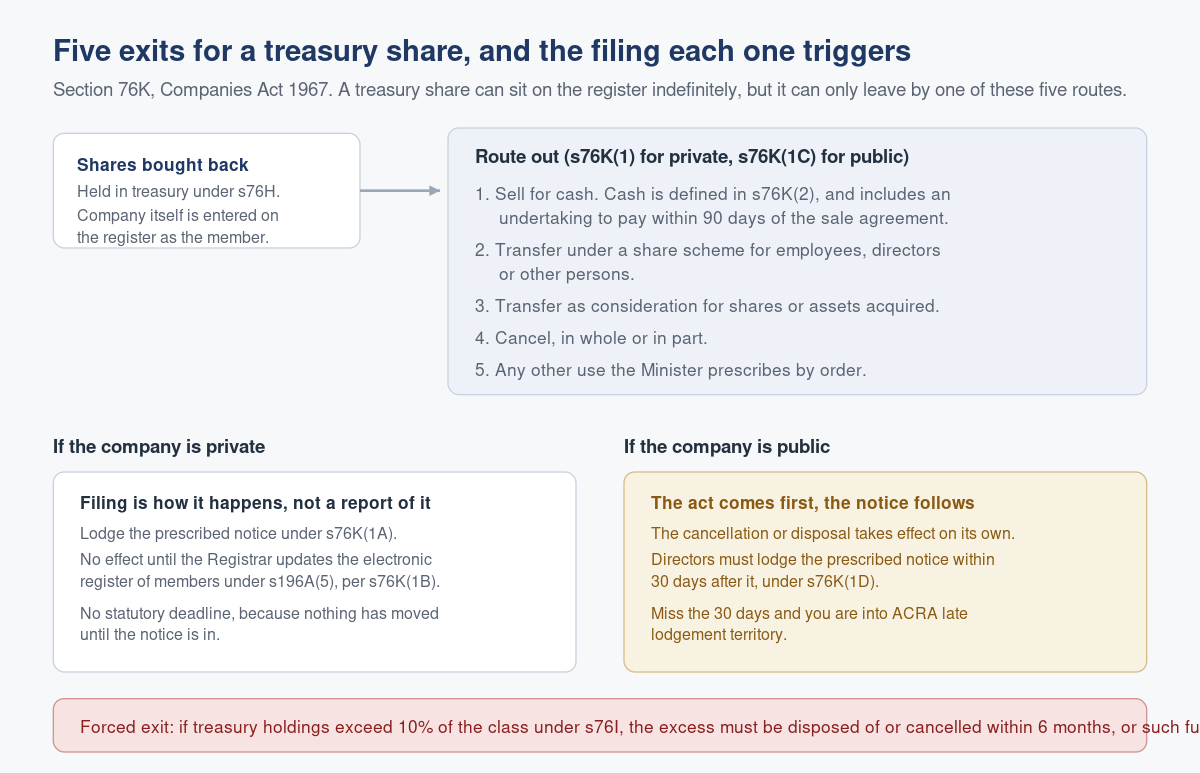
Section 76K(1) applies to private companies and section 76K(1C) to public companies. The list of permitted dealings is the same in both:
- Sell the shares for cash. “Cash” is defined in section 76K(2) and is wider than it looks. It covers cash including foreign currency, a cheque the directors have no reason to suspect will bounce, a release of a liability of the company for a liquidated sum, and an undertaking to pay the company on or before a date not more than 90 days after the sale is agreed.
- Transfer under a share scheme, whether for employees, directors or other persons. This is the route most SMEs eventually use, and it is why a buy-back is sometimes the cleanest way to fund an option pool without diluting anyone. If that is your plan, read it alongside our guide to share vesting and ESOPs.
- Transfer as consideration for the acquisition of shares in, or assets of, another company, or assets of a person. Paper for paper, using shares you already own.
- Cancel the shares, in whole or in part. Full or partial cancellation are both available.
- Any other purpose the Minister prescribes by order.
One restriction sits outside that list. Under section 76K(3), if the company has received a notice under section 215 that a person wishes to acquire the shares in a compulsory acquisition following a 90 per cent scheme, the company must not sell or transfer those shares to anyone except that person.
Cancelling treasury shares does not require a capital reduction
This is the quiet gift in the section. Section 76K(4) allows the directors to take the steps needed to cancel treasury shares without complying with section 78B, section 78C or section 78I. In plain terms, you do not need a solvency statement, a creditor objection period or a court order.
Compare that with what it would otherwise take. Our guides to reducing share capital by solvency statement and to capital reduction by court application set out the full machinery. Cancelling from treasury sidesteps all of it, because the capital and profit reduction was already dealt with at the buy-back stage under section 76G.
Which filing your company owes, and when
| Private company | Public company | |
|---|---|---|
| Governing subsection | Section 76K(1) and (1A) | Section 76K(1C) and (1D) |
| What the notice does | Effects the cancellation or disposal | Reports a cancellation or disposal that has already taken effect |
| Deadline | No statutory deadline, because nothing has moved until the notice is lodged | Within 30 days after the cancellation or disposal |
| Who must lodge | The company | The directors of the company |
| When it takes effect | Not until the Registrar updates the electronic register of members under section 196A(5) | On the cancellation or disposal itself |
| Filing fee | No fee is charged for this notice | No fee is charged for this notice |
The asymmetry is the whole point. For a private company, section 76K(1B) provides that a cancellation or disposal of treasury shares does not take effect until the electronic register of members is updated by the Registrar. Your board resolution, your share transfer form and your share scheme documents are all necessary, and none of them moves the shares. The lodgement does.
For a public company the logic is reversed. The disposal happens, and then section 76K(1D) puts the directors on a 30-day clock to lodge the prescribed notice. Miss it and you are in ordinary late lodgement penalty territory, on a scale that steps up with delay.
The 10 per cent cap, and the forced exit
Section 76I sets a ceiling. Where a company has shares of only one class, treasury holdings must not exceed 10 per cent of the total number of shares at any time. Where there are multiple classes, the 10 per cent test applies class by class.
If the cap is breached, section 76I(3) requires the company to dispose of or cancel the excess shares in accordance with section 76K before the end of six months beginning with the day the contravention occurred, or such further period as the Registrar allows. The excess shares are defined in section 76I(4) as the number that resulted in the limit being exceeded.
A breach can happen without the company doing anything active. Reduce the share capital, or cancel shares elsewhere in the same class, and a treasury holding that was comfortably under the ceiling can tip over it. That is when the six-month clock starts, and nobody sends you a reminder.
What goes wrong in practice
The private company treats the filing as administrative. A board resolves in March to transfer treasury shares to two employees under the option plan, the share certificates are issued, and the filing is done in September when someone is preparing for the year end. On the statute, those employees were not members between March and September. If a dividend was declared in that window, or a resolution passed on a headcount that assumed they were shareholders, you now have a problem that a backdated certificate cannot fix.
The wrong exit is used. Section 76K is a closed list. A gift of treasury shares to a founder’s family trust for no consideration is not a sale for cash, not a share scheme transfer and not acquisition consideration. If it does not fit a limb of section 76K, do not file it as though it does.
Cancellation and disposal get conflated in the numbers. Cancelled treasury shares cease to exist and the issued share capital falls. Disposed treasury shares continue to exist in the hands of a new holder and issued capital is unchanged. Those produce different figures in the register of members, in the financial statements, and in every shareholding percentage anyone calculates from them.
The company assumes the error can be corrected quietly. Some filing errors can be put right through ACRA’s notice of error route. Where they cannot, the remaining option is an Order of Court to rectify the register, which costs a multiple of what getting the filing right would have cost.
The cap is breached by accident and nobody notices for a year. See above. The six months runs from the contravention, not from discovery.
Frequently asked questions
Do I have to file anything if my private company cancels treasury shares?
Yes, and the filing is what makes it happen. Under section 76K(1A) a private company cancels or disposes of treasury shares by lodging the prescribed notice with the Registrar. Section 76K(1B) provides that it does not take effect until the electronic register of members is updated. Until then, nothing has legally changed.
How long does a public company have to lodge the notice?
Thirty days. Section 76K(1D) requires the directors of a public company to lodge the prescribed notice of cancellation or disposal within 30 days after the cancellation or disposal. Unlike the private company position, the transaction itself takes effect without waiting for the filing, so the clock runs from the event.
Can my company hold treasury shares indefinitely?
Yes, subject to the 10 per cent cap in section 76I. There is no statutory time limit on holding treasury shares within that ceiling. If the cap is exceeded, the excess must be disposed of or cancelled within six months of the breach, or such further period as the Registrar allows.
Do treasury shares carry votes or dividends?
No. Section 76J prohibits the company from exercising any right in respect of treasury shares, and any purported exercise is void. That includes attending and voting at meetings. No dividend may be paid and no distribution of assets made to the company in respect of them, including on a winding up.
Is there a filing fee for the notice of cancellation or disposal?
No fee is charged for lodging the notice of cancellation or disposal of treasury shares, and ACRA processes it immediately. That said, the absence of a fee is the cheapest part of the exercise. Getting the resolutions, the register entries and the accounting treatment aligned is where the real work sits.
Can we cancel treasury shares without a capital reduction procedure?
Yes. Section 76K(4) allows the directors to take the steps required to cancel treasury shares without complying with section 78B, section 78C or section 78I. No solvency statement, no creditor objection period and no court order are needed for the cancellation itself.
Getting the sequence right the first time
Treasury shares are one of the few areas of Singapore company law where the filing is the transaction rather than a record of it. That single feature causes most of the trouble we see, because it inverts the instinct that paperwork follows the deal.
If your company bought back shares and is now deciding what to do with them, the order of operations is worth agreeing before anything is signed: confirm which limb of section 76K you are using, confirm the company is still inside the section 76I ceiling, pass the resolutions, then lodge, and only then treat the new holder as a member.
Raffles Corporate Services handles share transactions of this kind for Singapore private companies, from the buy-back resolutions through to the treasury share filing and the register reconciliation afterwards. If you are holding treasury shares and are not sure whether your register matches what ACRA holds, that is a short conversation. Our Companies Act 1967 deep-dive FAQ covers the surrounding obligations, and there is more on Singapore corporate secretarial practice at Singapore Secretary Services.
— The Editorial Team, Raffles Corporate Services
Need help with corporate secretarial or compliance matters?
If you would like help with your company's corporate secretarial, governance or compliance requirements, email [email protected] or WhatsApp +65 8501 7133.
Our team can assist with corporate secretarial, accounting and tax matters. Where legal advice is needed, advisers from our associated law firms can assist.