
If you have resigned as a general partner, limited partner or local manager of a Singapore limited partnership and nobody has filed it, you can notify ACRA yourself. There is no fee. You do not need the general partner’s cooperation, and you do not need to explain yourself to them first.
Raffles Corporate Services works with a panel of experienced Singapore law firms who offer cost-effective and efficient legal service and advice. This article is general information only and is not legal advice.
That is not the normal route. Normally the general partner lodges the cessation within 14 days and the matter ends there. But LP exits are often not friendly, and the person who is supposed to file is sometimes the person who has the least interest in filing.
The law anticipated this. Here is the ordinary route, the self-help route, and the point at which you should stop waiting.
The ordinary route: the general partner files
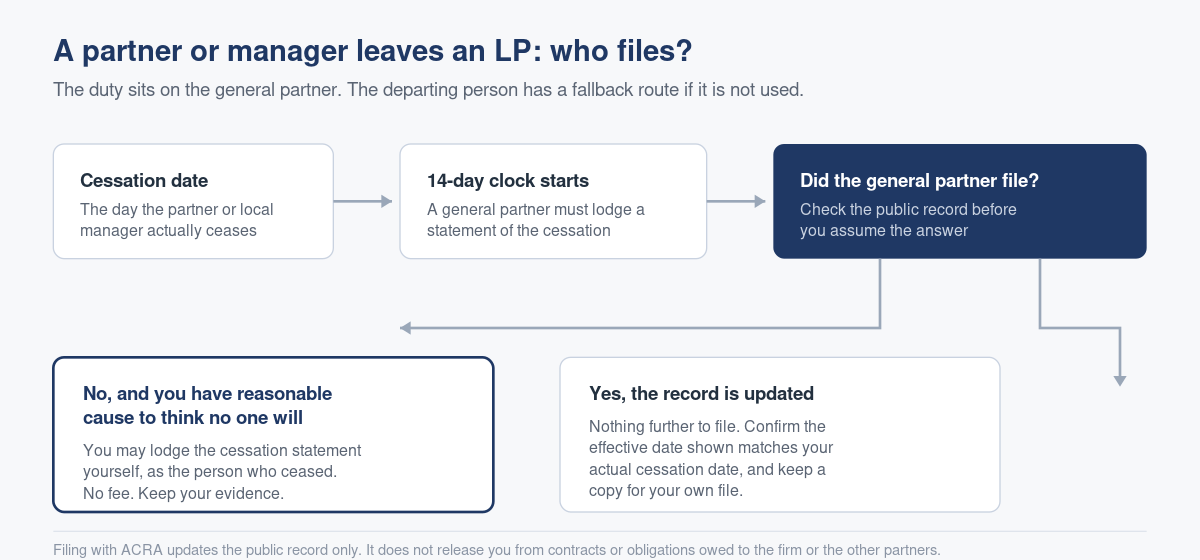
Section 18 of the Limited Partnerships Act 2008 requires a general partner to lodge a statement with the Registrar within 14 days after a partner or local manager ceases to be a partner or local manager of the limited partnership.
Note what the trigger is. It is the cessation itself, not the acceptance of a resignation letter, not the partnership meeting, not the settlement of accounts. If you ceased on 3 June 2026, the general partner’s deadline is 17 June 2026 whether or not anyone has agreed the exit terms.
Note also who is on the hook. The general partner carries the filing duty, in the same way the general partner carries unlimited liability for the firm’s obligations. A limited partner has no filing duty and, under the structure of the Act, no management role to exercise. If you are a limited partner walking away, you are relying on somebody else to do the paperwork.
Late filing attracts late lodgement penalties, charged per late transaction.
The self-help route: you file it yourself
Section 18(3) of the Limited Partnerships Act 2008 gives the departing person a direct remedy. Any person who ceases to be a partner or local manager of a limited partnership may lodge the cessation statement themselves, if they have reasonable cause to believe that no general partner will lodge it.
Three things about that condition.
“Reasonable cause to believe” is a low bar, but it is not nothing. You need a basis. Silence after a written request is a basis. A refusal is a basis. A general partner who has become uncontactable is a basis. A vague sense that they are disorganised, three days after you resigned, probably is not.
You do not need to wait for the 14 days to run out. The section does not say so. But in practice, waiting until the general partner’s own deadline has passed, having first asked them in writing, gives you a clean and obvious answer if anyone questions why you filed.
Put the request in writing. An email asking the general partner to file the cessation, with the date of cessation stated, costs you nothing and turns “reasonable cause” from an argument into a document.
What you need before you file
The notice of cessation is a short transaction, but it is easier if you have the details to hand.
| What you need | Detail |
|---|---|
| The LP’s unique entity number (UEN) | On any ACRA correspondence, in the LP’s business profile, or searchable on Bizfile |
| Your role in the LP | General partner, limited partner or local manager |
| Your effective date of cessation | The actual date you ceased, which drives everything else |
| Fee | None. Filing the notice of cessation is free |
| Your login | Individual user access, via Singpass |
Because you are filing in your personal capacity rather than on behalf of the LP, you log in as an individual rather than as a business user. Our guide to logging in to Bizfile as an individual covers the difference and the common access errors.
The steps, in order
- Fix your cessation date and write it down. Everything else follows from this. If there is any argument about the date, gather the evidence now rather than later.
- Ask the general partner in writing to file. Short email, states the date, asks them to lodge within the statutory window. Keep it.
- Wait out the 14 days. If the filing appears, you are done.
- Check the public record rather than assuming. A search on Bizfile will show whether the LP’s registered particulars have been updated. Our note on using Bizfile’s search functions before you sign anything explains what you can see and what you cannot.
- File the notice of cessation yourself. Log in to Bizfile with Singpass, select the notice of cessation or resignation of position holder transaction, and enter the UEN, your role and your effective date.
- Track the outcome. Straightforward applications may be approved quickly. Applications that need review take longer, and ACRA publishes a standard processing window measured in working days rather than hours. Check the status through Bizfile’s transaction status enquiry, or by email if you gave ACRA an email address.
- Download the confirmation and keep it. This is the document you will want three years from now when someone asks whether you were a partner at a particular date.
What the filing does, and what it does not do
This is the single most important paragraph in this article.
Notifying ACRA updates the public record. It tells the world that you are no longer a partner or local manager of that LP from the stated date. It does not:
- terminate or vary your partnership agreement;
- discharge any debt, guarantee or indemnity you have given;
- settle your capital account or your share of profits and losses;
- release a general partner from liability already incurred while a general partner; or
- resolve a dispute about whether you validly resigned at all.
Those are contractual and, if it comes to it, curial questions. The ACRA filing is a public notice, not a settlement.
It matters commercially all the same. Third parties dealing with a firm are entitled to rely on what the public record says. A general partner who remains on the register long after ceasing is, in the eyes of a counterparty doing due diligence, still a general partner of a firm whose debts general partners are personally liable for. That is precisely why you do not leave it to someone else’s diligence.
What goes wrong in practice
Waiting politely. By far the most common failure. Someone resigns, is told the paperwork is “being handled”, and finds out eighteen months later, usually during a bank application or a credit check, that they are still on the register.
Filing without evidence of the cessation date. If the general partner later disputes the date, and your only record is a verbal conversation, you have a problem. Resignation letters, emails and board or partnership minutes are cheap insurance.
Assuming resignation from the LP fixes everything else. Personal guarantees, tenancy agreements signed in the firm’s name, employment arrangements and licences do not unwind because ACRA’s record changed. Each one needs its own exit.
Confusing this with a company directorship. The mechanics and the statutes are different. If you are also leaving a Singapore private company, our guide on a director’s resignation in Singapore sets out that separate process.
Nobody watching ACRA’s mail. If the LP’s registered contact details are stale, ACRA’s alerts and queries go nowhere. See the ACRA alerts companies miss, and what they cost.
If you are the general partner rather than the one leaving
Your obligation is the 14-day filing, and it is not discharged by the departing person filing for themselves. Beyond that, an exit usually triggers more than one change: a partner leaves and the remaining partners’ details or roles shift, or the local manager position needs refilling.
Each of those is its own transaction with its own 14-day window, and penalties apply per transaction. The full map of what triggers a filing is in our companion article on updating limited partnership information with ACRA.
One structural warning. A limited partnership ceases to be a limited partnership if no person remains registered as a limited partner. The Limited Partnerships Act 2008 deals with what the remaining partners become in that situation. If your last limited partner is the one resigning, get advice before the exit rather than after.
Frequently asked questions
Can I notify ACRA of my own resignation from an LP?
Yes. Section 18(3) of the Limited Partnerships Act 2008 lets any person who ceases to be a partner or local manager lodge the cessation statement themselves, where they have reasonable cause to believe no general partner will do it. There is no fee for the filing.
How long does the general partner have to file my resignation?
Fourteen days from the date you ceased to be a partner or local manager. The clock runs from the cessation itself, not from the date a resignation letter was accepted or the exit terms were agreed. Late filing attracts ACRA’s late lodgement penalties.
Does filing with ACRA end my liability to the partnership?
No. The notification updates the public record only. Your partnership agreement, any guarantees or indemnities you gave, your capital account and any liabilities already incurred are untouched by the filing. Those have to be dealt with separately and, usually, contractually.
How long does ACRA take to process a notice of cessation?
Straightforward applications may be approved quickly. Where further review is needed, ACRA works to a published processing window measured in working days, and will tell you if more time is required. You can track progress through Bizfile’s transaction status enquiry or by email.
What do I need to prepare before filing?
The LP’s unique entity number, your role in the LP, and your effective date of cessation. You also need Singpass, because you file as an individual rather than on behalf of the entity. Having your resignation letter or email to hand is sensible even though it is not uploaded.
What if the general partner disputes my resignation date?
The ACRA filing does not decide that question. Keep the documentary trail: the resignation letter, the acknowledgement, any partnership minutes. If the dispute is real, it is a contractual matter between you and the firm, and the public record will follow whatever is ultimately established.
Getting out cleanly
Exiting a partnership is rarely just one form. The filing is the easy part. The part people get wrong is everything around it: the date, the evidence, the guarantees, the licences, and the quiet assumption that somebody else is handling it.
Raffles Corporate Services handles ACRA filings for limited partnerships, LLPs and companies, including the awkward ones where the parties are no longer speaking. If you have resigned and are not certain the public record reflects it, we can check in minutes and file the same day.
You can reach us through Raffles Corporate Services, or read more on Singapore corporate secretarial practice at Singapore Secretary Services.
— The Editorial Team, Raffles Corporate Services
Need help with corporate secretarial or compliance matters?
If you would like help with your company's corporate secretarial, governance or compliance requirements, email [email protected] or WhatsApp +65 8501 7133.
Our team can assist with corporate secretarial, accounting and tax matters. Where legal advice is needed, advisers from our associated law firms can assist.