

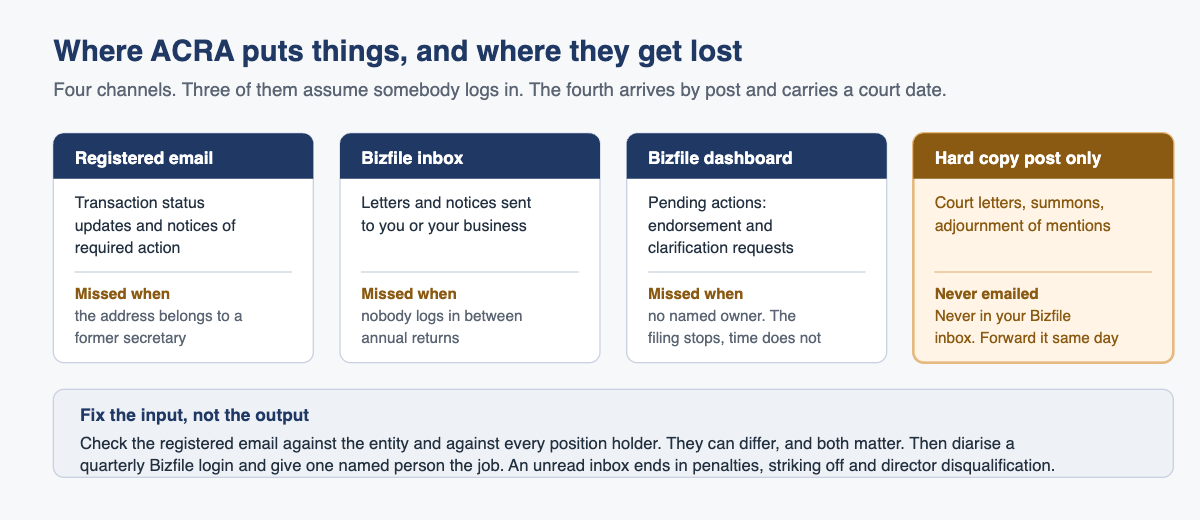
ACRA sends notifications to two places: the email address registered against your company or against you personally, and your Bizfile inbox. Anything needing your action, including endorsements and clarification requests, also appears on your Bizfile dashboard. Court letters go nowhere near either of those. They arrive in hard copy only.
Raffles Corporate Services works with a panel of experienced Singapore law firms who offer cost-effective and efficient legal service and advice. This article is general information only and is not legal advice.
That last point deserves its own paragraph. Summonses and notices about court mentions are sent physically. They will not appear in your Bizfile inbox and they will not trigger an email alert. If your registered office is a service address and nobody forwards the post promptly, the most serious document ACRA can send you is the one least likely to reach you in time.
Everything else in this article follows from a simpler problem: the alerts are being sent, and nobody is reading them.
Where ACRA actually puts things
There are three channels, and they carry different things.
| Channel | What arrives there | Who sees it |
|---|---|---|
| Registered email address | Transaction status updates and notices of required action | Whoever controls that mailbox |
| Bizfile inbox | Letters and notices sent to you or your business, including transaction status and transaction information | Anyone who logs in with access to that entity |
| Bizfile dashboard, pending actions | Endorsement requests and clarification requests, meaning things that will not progress until someone acts | Anyone who logs in with access to that entity |
| Physical post | Court letters, including summonses and adjournment of court mentions | Whoever opens the post at the registered office |
The design assumption is that someone logs in to Bizfile regularly. In practice, in a small company, nobody logs in between annual returns. The dashboard could be flashing for eleven months and no human would know.
Why alerts get missed
The reasons are boringly consistent, and none of them are about the alerts themselves.
The registered email belongs to a former company secretary. This is the single most common cause we see. A company changes provider, the outgoing firm’s mailbox stays on the record, and every ACRA notification for the next two years lands with a firm that no longer acts and has no obligation to forward it. The company hears nothing and assumes nothing is happening.
The email is a personal address that has fallen out of use. A founder registered with a Yahoo or Hotmail address in 2013. He has not opened it since 2018. It is still the address of record.
The email is a shared inbox that everyone deletes from. info@ addresses receive enough noise that a genuine ACRA notice is triaged as spam by a human rather than a filter.
The notice goes to spam. Automated government mail with links in it lands in junk more often than you would expect, particularly on aggressively filtered corporate domains.
Nobody logs in to Bizfile. The dashboard is the only place endorsement and clarification requests surface. If the last login was ten months ago, so was the last look at pending actions.
Nobody forwards the post. Registered office addresses provided as a service will forward mail, but the speed varies, and a summons has a court date on it that does not move for logistics.
The fix is one afternoon of work
- Log in to Bizfile and check what email address is actually recorded against the entity and against each position holder. They can differ, and both matter.
- Change anything stale. Use an address that a named person is contractually responsible for reading, not a founder’s personal account and not a defunct provider’s mailbox. A changed address also has to be verified before some transactions will proceed, and our note on verifying your email for Bizfile covers that step.
- Whitelist ACRA’s sending domain on your mail server so notices stop landing in junk.
- Check the Bizfile inbox and pending actions while you are in there. If something has been sitting for months, you want to know today.
- Diarise a quarterly login. Ten minutes, four times a year.
- Make sure whoever provides your registered office knows that anything from a court is forwarded the same day, by scan, not by post.
Point one is worth labouring. Companies must keep their entity information current within 14 days of a change under section 143(1) of the Companies Act 1967, and that includes the details you are reachable at. An out-of-date registered email address is not merely inconvenient. It is the failure that causes every other failure in this article.
The alerts that cost money if you ignore them
Not every notification matters. These do.
A clarification request on a pending filing. The filing is stopped until you answer. The statutory deadline underneath it is not stopped. This is the quiet one: no penalty is charged at the moment of the request, so nothing feels urgent, and then the window closes.
An endorsement request. Certain filings require another party, typically an officer or shareholder, to endorse the submission before it completes. Until they do, the filing has not been made. If the endorser does not know he is holding it up, he will not act.
A reminder that an annual return is due. Annual returns are filed under section 197 of the Companies Act 1967. Late filing is charged at S$300 where the return is up to three months late and S$600 beyond that, applied automatically when you eventually file. That is before you get anywhere near enforcement.
Anything relating to a change in officers or registered office. Companies must file a change of registered office within 14 days under section 143(1), and a director appointment or resignation within 14 days under section 173A(1)(b). Late lodgement penalties for a company are S$50 within three months and S$200 beyond, per late filing. Two director changes six months late is S$400.
A striking off notice. ACRA can strike a company off under section 344(1) of the Companies Act 1967 where it has reasonable cause to believe the company is not carrying on business, and repeated failure to file annual returns is a common trigger. You have 30 days from the date of the notice to object. Miss that and the company’s name goes into the first gazette notification, then into the final gazette 60 days later, at which point the company has been removed from the register and no longer legally exists. The whole sequence runs on notices that a dormant company’s unread mailbox is uniquely likely to swallow.
Where ignoring alerts stops being about money
Penalties are the cheap end. Beyond them, ACRA may offer a composition sum instead of prosecuting, which for a late AGM and a late annual return has been illustrated at at least S$500 for each breach. If a composition is not accepted, or the company is a repeat offender, ACRA may prosecute, and a conviction can carry a fine of up to S$10,000 per charge.
Then it reaches the directors personally. Under sections 155 and 155A of the Companies Act 1967, a director convicted of three or more filing offences within five years faces a five-year disqualification, and a director with three or more companies struck off by ACRA within five years faces a three-year disqualification, or five years for a repeat. A director can also be debarred for failing to lodge required documents for a continuous period of three months or more, and a debarred person cannot take any new appointment as a director or company secretary.
That is the real cost of an unread inbox: not a S$200 penalty, but a director who cannot take a board seat at the next company he wants to start. The full schedules sit on ACRA’s late lodgement penalties page and its page on penalties and enforcement for late annual return filing.
What goes wrong in practice
The provider changed and the email did not. Two years of notices to a mailbox at a firm that stopped acting in 2024. Nobody discovers it until a penalty arrives at the registered office.
The endorsement nobody was told about. A shareholder needed to endorse an allotment. He was never told. The filing sat pending for four months and the company thought it was done.
The dormant company that stopped being watched. Dormant does not mean exempt from filing. It usually means nobody is looking, which is exactly the profile ACRA-initiated striking off is designed to catch. The objection window is 30 days.
The summons in the forwarded post. Court letters are hard copy only. A registered office service that forwards weekly by post has, in effect, taken a fortnight off the notice period. If a director fails to attend court, a warrant for his arrest can be issued.
Assuming the corporate secretary is watching. Many are, and that is exactly what you pay them for. But if the notifications route to your registered email address and your provider does not have access to that mailbox, they are watching a channel that nothing arrives on. Ask your provider which address ACRA notices actually reach, and whether they see them.
If your records and ACRA’s have drifted apart to the point where you are not confident what is registered, start by pulling the position from source. Our guide to downloading your company registers from Bizfile shows how to do that free of charge, and your Bizfile transaction history shows how to confirm what has and has not been filed. If a filing is overdue, the penalty is collected when you file, so read our note on making payments on Bizfile before you are surprised by the total.
Frequently asked questions
Where does ACRA send notifications?
To the email address registered against your company or against you as an officer, and to your Bizfile inbox. Endorsement and clarification requests also appear under pending actions on your Bizfile dashboard. Court letters are sent in hard copy only and do not appear online.
Will ACRA email me about a court summons?
No. Letters relating to court proceedings, including summonses and adjournments of court mentions, are sent in hard copy only. They will not appear in your Bizfile inbox and will not trigger an email alert, so post reaching your registered office promptly matters.
Our old corporate secretary still receives ACRA emails. How do we change that?
Update the registered email address for the entity and for each position holder through Bizfile. Companies are required to keep entity information current within 14 days of a change under section 143(1) of the Companies Act 1967, so this is an obligation rather than housekeeping.
What happens if I ignore an ACRA striking off notice?
You have 30 days from the date of the notice to object. If you do not, your company is published in the first gazette notification, and 60 days later in the final gazette, at which point it is removed from the register and no longer legally exists.
Do I get a penalty just for missing an alert?
Not for the alert itself. The penalty attaches to the underlying late filing. For a company that is S$50 where the default is within three months and S$200 beyond, per late filing, and S$300 or S$600 for a late annual return.
How often should someone log in to Bizfile?
Quarterly is a sensible minimum for an active company, and it should be a named person’s job rather than whoever remembers. Pending actions only surface on the dashboard, so a company that never logs in will never see a clarification or endorsement request.
Somebody has to be reading
Almost every expensive ACRA problem we are asked to clean up began as a notice that reached an address nobody watched. The company was not negligent in any interesting way. It simply had no owner for the inbox.
Raffles Corporate Services monitors ACRA correspondence for the companies we act for, keeps the registered email address current, clears pending actions before they become penalties, and tells you when something needs a director’s signature rather than waiting for you to find out. If you are not certain which address ACRA currently has for your company, that is a two-minute check and it is worth making today.
You can reach us through Raffles Corporate Services, or read more on Singapore corporate secretarial practice at Singapore Secretary Services.
The Editorial Team, Raffles Corporate Services
Need help with this?
Raffles Corporate Services can handle the ACRA filings, compliance documentation and records for you, and where court proceedings or legal advice are needed, we work with a panel of experienced Singapore law firms who offer cost-effective and efficient legal service and advice.
Email: [email protected]
Call, SMS or WhatsApp: +65 8501 7133