

The return by the liquidator relating to the final meeting is the last filing in a voluntary winding up, and it is the one that dissolves the company. Not the resolution, not the appointment of the liquidator, not the distribution of assets. The company is dissolved three months after this return is lodged.
Raffles Corporate Services works with a panel of experienced Singapore law firms who offer cost-effective and efficient legal service and advice. This article is general information only and is not legal advice.
That last sentence is the whole point of this article, and it is the part that most directors get wrong. They assume the company died when the members passed the winding up resolution. It did not. It kept existing, with all its obligations, until the liquidator finished, laid the final accounts before a meeting, and lodged the return.
The governing provision is section 180 of the Insolvency, Restructuring and Dissolution Act 2018, which applies to every voluntary winding up, members’ and creditors’ alike. In a court-ordered winding up the equivalent sits at section 148 and works differently, so do not read across.
What the liquidator has to do before the meeting can happen
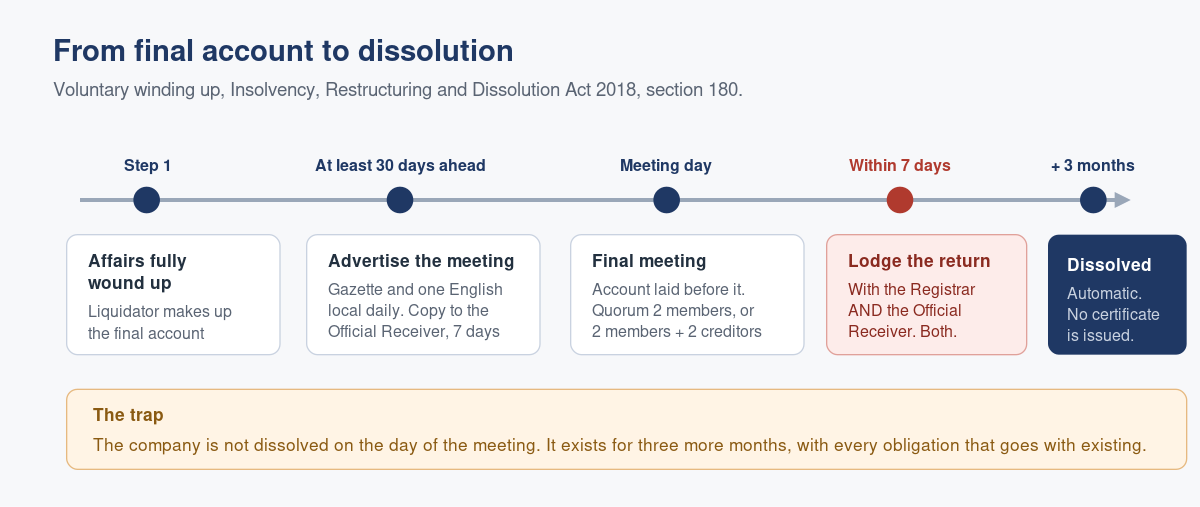
Section 180 sets out a sequence, and the sequence is not optional. As soon as the company’s affairs are fully wound up, the liquidator must make up an account showing how the winding up was conducted and how the company’s property was disposed of. Only once that account exists does the liquidator call the meeting to lay it before.
In a members’ voluntary winding up, the one that began with a declaration of solvency, the meeting is a general meeting of the company. In a creditors’ voluntary winding up, it is a meeting of the company and the creditors. Two audiences, one meeting, one account.
The meeting is called by advertisement, and the advertisement rules are strict:
- It must be published in the Gazette and in at least one English local daily newspaper.
- It must specify the time, the place and the object of the meeting.
- It must be published at least 30 days before the meeting.
- A copy must be sent to the Official Receiver within 7 days after publication.
There is no shortcut here. A liquidator who calls the meeting on two weeks’ notice has not complied, and the return that follows will record a meeting that was not duly summoned.
The quorum question that nobody plans for
Section 180 fixes the quorum. At a meeting of the company it is two members. At a meeting of the company and the creditors it is two members and two creditors.
This matters more than it sounds. By the time a company reaches its final meeting, the members have usually lost interest and the creditors have usually been paid or written the debt off. Turning up to hear an account of a company that no longer trades is nobody’s priority. No-quorum final meetings are common.
The statute anticipates this. If a quorum is not present, the liquidator lodges a return recording that the meeting was duly summoned and that no quorum was present. The winding up still completes. The company is still dissolved on the same timetable. What the liquidator cannot do is skip the meeting, or hold it without having advertised it properly, and then paper over the gap.
The return itself, and the three-month clock
Within 7 days after the meeting, the liquidator must lodge the return with the Registrar of Companies and with the Official Receiver. Two recipients, not one. The return records the holding and the date of the meeting, and the account is attached to it.
Then the clock runs. On the expiration of three months after the return has been lodged with both the Registrar and the Official Receiver, the company is dissolved. Nobody issues a certificate of dissolution and nobody needs to apply for one. It simply happens.
The Court may defer that date. On the application of the liquidator, or of any other person who appears to the Court to be interested, the Court may make an order deferring the date on which dissolution takes effect for such time as it thinks fit. Where such an order is made, the person who applied for it must lodge a copy with the Registrar and the Official Receiver within 14 days.
What section 180 costs a liquidator who ignores it
| Failure | Consequence under section 180 |
|---|---|
| Failing to lodge the return within 7 days after the meeting | Offence, fine not exceeding $1,000 on conviction, and a default penalty |
| Failing to call the final meeting at all | Offence, fine not exceeding $2,000 on conviction, and a default penalty |
| Failing to lodge a copy of a Court deferral order within 14 days | Offence, fine not exceeding $1,000 on conviction, and a default penalty |
A default penalty accrues for each day the default continues, which is why a forgotten final meeting return is not a fixed cost. It grows.
Filing it in Bizfile
The return is lodged through the Manage winding up eService on Bizfile, the same eService used for the rest of the winding up filings. The filing costs $20 and processing is immediate.
The people who may file are the appointed liquidator, and a registered corporate service provider filing on behalf of a client.
- Log in to Bizfile as a Business User through Corppass. If you are a CSP, select the Corporate Service Provider profile and, where you belong to more than one firm, pick the right firm from the dropdown.
- Confirm that the entity name and UEN showing on the top menu bar are the entity being wound up. Filing against the wrong entity is the single most expensive mistake available in this eService, and it is entirely avoidable by reading one line of text. Our note on switching profiles in Bizfile covers why this goes wrong.
- Open Manage winding up and select the return relating to the final meeting.
- Check the entity and liquidator details that Bizfile displays. These are pulled from what has already been filed, so if the liquidator’s particulars look wrong, the problem is upstream and needs fixing before you continue.
- Enter the type of meeting and the meeting details.
- Upload the final meeting documents, including the account laid before the meeting.
- Review, tick the declaration, pay and download the receipt.
Have ready before you start: the date of the meeting, the outcome of the meeting (including whether a quorum was present), and the final accounts in the file format the eService accepts.
What goes wrong in practice
The account is prepared after the meeting. Section 180 requires the liquidator to make up the account and then, upon doing so, call the meeting to lay it before. A meeting held to approve an account that does not yet exist is not the meeting the statute describes.
Only the Registrar is served. The seven-day lodgement obligation runs to the Registrar of Companies and to the Official Receiver. Lodging in Bizfile and stopping there leaves half the obligation undone, and the three-month dissolution clock runs from lodging with both.
The advertisement is missed or is short. Thirty days is thirty days. A liquidator who advertises 21 days out has not duly summoned the meeting, and a return saying otherwise is a false statement to the Registrar rather than a harmless approximation.
Someone assumes dissolution is instant. It is not. For three months after the return, the company still exists. Bank accounts, contracts, tax obligations and the liquidator’s own duties do not vanish on the day of the meeting. If a claim surfaces in that window, it surfaces against a company that is still there.
The company is dissolved with assets still in it. Property left in a dissolved company does not go to the members. It becomes an outstanding asset of a defunct company, and recovering it is a slow and expensive exercise. Sweep the balance sheet to zero before the final meeting, not after it.
For the wider question of whether a winding up was the right route at all, our comparison of voluntary winding up and striking off is the place to start, and the corporate secretarial steps when closing a business sets out what has to happen alongside the statutory filings.
Frequently asked questions
When is the company actually dissolved?
Three months after the liquidator lodges the final meeting return with both the Registrar of Companies and the Official Receiver. Section 180 of the IRDA makes dissolution automatic on the expiry of that period. No certificate is issued and no further application is needed.
What if nobody turns up to the final meeting?
The winding up still completes. The liquidator lodges a return stating that the meeting was duly summoned and that no quorum was present, with the account attached. The quorum is two members, or two members and two creditors in a creditors’ voluntary winding up.
How much does the filing cost and how long does it take?
The filing fee through the Bizfile Manage winding up eService is $20 and processing is immediate. The cost that matters is not the fee but the timing: the return must be lodged within seven days after the meeting.
Can the dissolution date be pushed back?
Yes. The Court may, on the application of the liquidator or any other interested person, defer the date on which dissolution takes effect. Whoever obtained the order must lodge a copy with the Registrar and the Official Receiver within 14 days of it being made.
Does this apply to a court-ordered winding up?
No. Section 180 applies to voluntary winding up. A compulsory winding up ends under the separate final account and dissolution provision in the same Act, with the Official Receiver playing a larger role, so the steps and the timings are not the same.
Who can file the return, the liquidator or the company secretary?
The appointed liquidator, or a registered corporate service provider filing on the liquidator’s behalf. The company’s own officers no longer have authority over the entity at this stage of the winding up.
Closing a company properly, and once
A winding up that stalls at the final meeting is a company that never quite dies. It stays on the register, it keeps generating obligations, and it becomes somebody’s problem years later, usually during a due diligence exercise on an unrelated transaction.
Raffles Corporate Services works alongside liquidators on the registry side of voluntary winding ups: the advertisement timing, the Bizfile lodgements, the service on the Official Receiver, and the closing reconciliation that makes sure nothing is left in the company before the final meeting. If you have a winding up that has gone quiet somewhere between the liquidator’s appointment and the final meeting, that is a short conversation.
You can reach us through Raffles Corporate Services, or read more on Singapore corporate secretarial practice at Singapore Secretary Services.
The Editorial Team, Raffles Corporate Services
Need help with corporate secretarial or compliance matters?
If you would like help with your company's corporate secretarial, governance or compliance requirements, email [email protected] or WhatsApp +65 8501 7133.
Our team can assist with corporate secretarial, accounting and tax matters. Where legal advice is needed, advisers from our associated law firms can assist.