

A liquidator has to account periodically for what has come into the estate and what has gone out of it. That is done by lodging an account of receipts and payments together with a statement of the position in the winding up, through the Manage winding up eService in Bizfile, at $20 a filing, processed immediately.
Raffles Corporate Services works with a panel of experienced Singapore law firms who offer cost-effective and efficient legal service and advice. This article is general information only and is not legal advice.
The obligation itself comes from the statute, not from Bizfile. Section 192 of the Insolvency, Restructuring and Dissolution Act 2018 is headed “Liquidator’s accounts”, and section 193 deals with the liquidator making good defaults. The eService is simply the channel through which the Registrar receives what section 192 requires.
Two things about this filing catch people out. The first is that the mechanics differ depending on whether the winding up commenced before or after the Act took effect on 30 July 2020. The second is a single yes or no question on the form that, answered wrongly, locks you out of filing anything further.
Who files this one
Unlike the appointment and cessation notices, which are entity filings, this transaction belongs to the office holder.
- The appointed liquidator, filing periodic accounts and statements during the winding up
- A registered corporate service provider filing on the liquidator’s behalf
That difference in filer matters where a practitioner has assumed the company’s secretarial agent will handle everything winding-up related. They will not, and typically cannot, unless they have been engaged to act for the liquidator.
What the filing actually covers
An account of receipts and payments is what it sounds like: cash in, cash out, over a defined period. Realisations of assets, recoveries, distributions, the liquidator’s own remuneration and disbursements, all of it.
A statement of position in the winding up sits alongside it and shows where the estate stands: what remains to be realised, what remains to be paid, and what the position is as between classes of creditor and, if it comes to it, contributories.
Together they are the public evidence that the liquidation is progressing. Creditors read them. So does the Registrar, and so does the Official Receiver. A liquidation with no accounts on file for three years invites the question of what has been happening, and it is not a comfortable question when the answer is nothing.
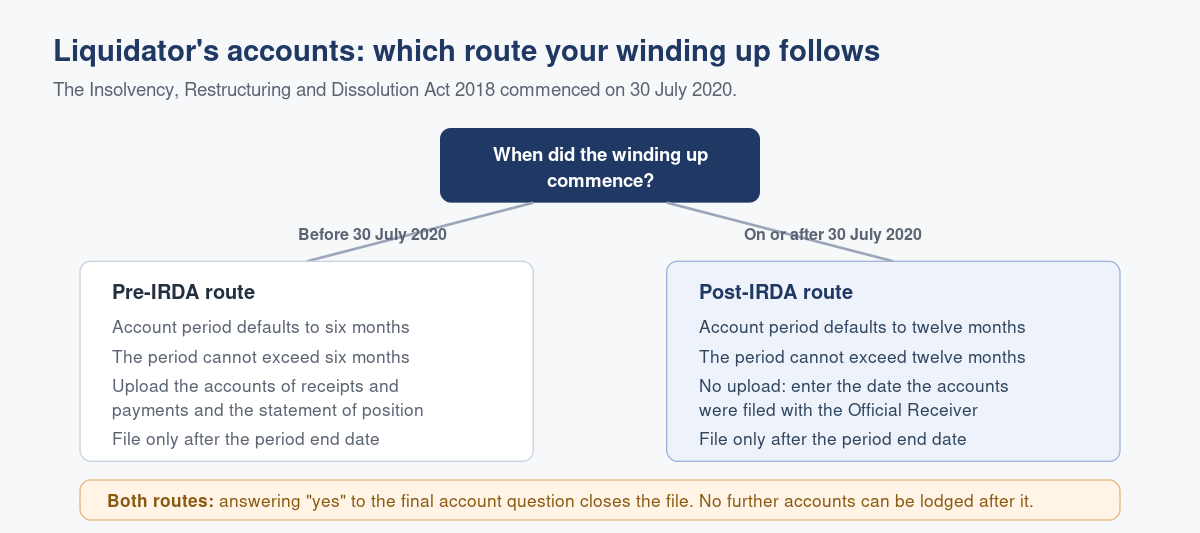
Pre-IRDA and post-IRDA: two different routes
Windings up that commenced before 30 July 2020
The account period defaults to six months from the start date, and the filing period cannot exceed six months. The first period starts from the liquidator’s earliest appointment date, which you can edit on the first filing. For every filing after that, the start date is fixed at the day after the end of the previous period and cannot be changed, which is the system’s way of making sure the periods form an unbroken chain.
You upload copies of the accounts of receipts and payments and the statement of position as part of the transaction.
Windings up that commenced on or after 30 July 2020
The account period defaults to twelve months and cannot exceed twelve months. The start date behaves the same way: editable on the first filing, then locked to the day after the previous period ended. The end date remains editable within the twelve-month limit.
The significant difference is that you do not upload the accounts here. Instead you enter the date on which you filed the accounts and statement with the Official Receiver. Under the Act, the substantive lodgement goes to the Official Receiver, whose insolvency office sits within the Ministry of Law, and the Bizfile transaction records that it happened.
That catches practitioners who are used to the older regime. Keying the Bizfile filing without having actually filed with the Official Receiver first means declaring a date for something that has not occurred.
The two routes compared
| Commenced before 30 July 2020 | Commenced on or after 30 July 2020 | |
|---|---|---|
| Default account period | Six months | Twelve months |
| Maximum account period | Six months | Twelve months |
| End date editable | Generally not, except where a liquidator ceased in the period | Yes |
| Accounts uploaded to Bizfile | Yes | No |
| Extra field | None | Date filed with the Official Receiver |
| Fee | $20 | $20 |
The filing, step by step
- Log in to Bizfile as a Business User through Corppass and confirm the entity name and UEN shown are the entity in liquidation.
- Corporate service providers select the Corporate Service Provider profile and the right CSP firm.
- Open the Manage winding up eService and select the liquidator’s account of receipts and payments and statement of position lodgement, then start.
- Check the entity details and the list of appointed liquidators that the system displays.
- Answer the final account question. Answer yes only if this genuinely is your last account, because you are ceasing to act or have obtained a Court order releasing you.
- Set the period using the date from and date to fields. The start must precede the end, and you cannot submit before the end date has passed.
- Pre-IRDA: upload the accounts and the statement of position. Post-IRDA: enter the date you filed them with the Official Receiver.
- Review, tick the declaration and pay the $20 fee.
- Download the receipt from the acknowledgement screen.
The final account question is a one-way door
On screen it looks like an ordinary radio button. It is not. Answering yes tells the system this is the last account for this liquidation, and once submitted you cannot lodge further accounts.
Answer yes only when both of the following are true: the estate’s receipts and payments are complete for the period you are reporting, and you are either ceasing to act or have been released by order of the Court.
If you tick yes on a routine interim account because you read the question quickly, the correction is not a matter of filing again. You are then dealing with a locked transaction type on a live liquidation, which means going back to ACRA to explain what happened. Read the question twice.
Things that are not filed through this eService
Several winding-up related lodgements look as though they belong here and do not. These go through the General lodgement eService in Bizfile instead:
- Notice of change in the situation of the office of a provisional liquidator or liquidator
- Statement of affairs
- Notice of holding of a creditors’ meeting
- Dissolution of the company
- Notice of early dissolution
Early dissolution is worth a particular flag. The Act provides for early dissolution where a company is being administered by the Official Receiver as liquidator, and separately where it is administered by another liquidator, in sections 209 and 210. Those are outcomes, not accounting events, and they are filed elsewhere.
What goes wrong in practice
Trying to file before the period has ended. The system will not accept a filing submitted before the end date of the account period. Practitioners who try to clear the job early find the transaction rejected and, having set a diary reminder for the date they attempted it, then forget to come back.
Periods left to drift. Because the start date of each subsequent account is locked to the day after the previous one ended, a long gap between filings does not shorten the chain, it just means you are late on each link in it. The obligation is periodic, and section 193 addresses a liquidator making good defaults for a reason.
Mixing up the two regimes. The commencement date of the winding up, not the date of the current account, determines which route applies. A liquidation that started in 2019 and is still running today follows the six-month route.
Filing the Bizfile record before filing with the Official Receiver. In the post-IRDA route the Bizfile field asks for the date you filed with the Official Receiver. It is a record of a completed act, not a substitute for it.
Losing track after a change of office holder. Where a liquidator ceases mid period, the accounting for that part period still has to be dealt with, and the incoming office holder inherits a chain that has to join up. The related filings are covered in our guides to the notice of appointment and the notice of cessation of a liquidator.
Frequently asked questions
How often must a liquidator file accounts?
The account period is capped at six months where the winding up commenced before 30 July 2020, and at twelve months where it commenced on or after that date. Each period runs from the day after the previous one ended, so the accounts form a continuous chain across the whole liquidation.
Do I upload the accounts themselves?
Only in the pre-IRDA route. For windings up that commenced on or after 30 July 2020, you file the accounts and statement of position with the Official Receiver, then record the date of that filing in the Bizfile transaction. No document is uploaded to Bizfile.
What happens if I answer yes to the final account question by mistake?
The system treats that filing as your last and will not accept further accounts for that liquidation. There is no self-service undo. You would need to take it up with ACRA, so read the question carefully before you answer it.
Can a corporate service provider file this for me?
Yes. A registered corporate service provider can file on the liquidator’s behalf, selecting the Corporate Service Provider profile in Bizfile. The liquidator remains responsible for the content of what is filed.
Is this the same as the statement of affairs?
No. The statement of affairs is a different document, filed through the General lodgement eService. The statement of position in winding up accompanies the periodic account of receipts and payments and shows where the estate stands at the end of that period.
The part of a liquidation that is easy to let slide
Realising assets and dealing with creditors feels like the work. The periodic accounts feel like paperwork. But the accounts are the record that anyone scrutinising the liquidation later will read first, including a creditor who thinks the process has stalled and a court considering whether it has. Our note on public examination of company officers under the IRDA is a reminder of how closely the conduct of an insolvency can end up being examined, and the powers and duties of a liquidator sit alongside the reporting obligations rather than above them.
Raffles Corporate Services handles ACRA lodgements for insolvency practitioners and for companies in winding up, including the periodic accounts calendar so that the chain of periods stays unbroken. If you have inherited a liquidation and are not sure where the last account left off, we can work that out from the register. There is more on Singapore corporate secretarial practice at Singapore Secretary Services, and the statutory provisions sit in the Insolvency, Restructuring and Dissolution Act 2018.
The Editorial Team, Raffles Corporate Services
Need help with corporate secretarial or compliance matters?
If you would like help with your company's corporate secretarial, governance or compliance requirements, email [email protected] or WhatsApp +65 8501 7133.
Our team can assist with corporate secretarial, accounting and tax matters. Where legal advice is needed, advisers from our associated law firms can assist.