

ACRA has its own prosecutors and they bring cases in the State Courts. The pattern is narrow and repetitive: directors who ignored an order to file overdue annual returns, people who put false information into a filing, and people who acted as directors when the law said they could not.
Raffles Corporate Services works with a panel of experienced Singapore law firms who offer cost-effective and efficient legal service and advice. This article is general information only and is not legal advice.
ACRA publishes the outcomes of those cases. It is worth understanding what that published record is for. It is not a scandal sheet. It is a deterrence exercise, and the deterrence works precisely because the offences it features are so ordinary. Nobody in that column set out to commit a crime. Most of them simply stopped answering letters.
This article is about the categories, not the individuals. What gets prosecuted, why those particular offences, what the courts do with them, and what a director or partner has to do to make sure none of it applies to them.
Who prosecutes, and under which Acts
ACRA prosecutors are authorised to prosecute breaches of the legislation ACRA administers. That is a wider net than most people picture, because ACRA is not only the companies registry. Its enforcement reach covers, among others:
- The Companies Act 1967, which supplies the large majority of prosecutions
- The Business Names Registration Act 2014, for sole proprietorships and partnerships
- The Limited Liability Partnerships Act 2005 and the Limited Partnerships Act 2008
- The Accountants Act 2004, covering public accountants and public accounting entities
- The Accounting and Corporate Regulatory Authority Act 2004, which carries its own offences for false information
- The Corporate Service Providers Act 2024, the newest source of charges
Cases are heard in the State Courts. They are criminal proceedings, which means the outcome is a conviction and a sentence, not a regulatory fine.
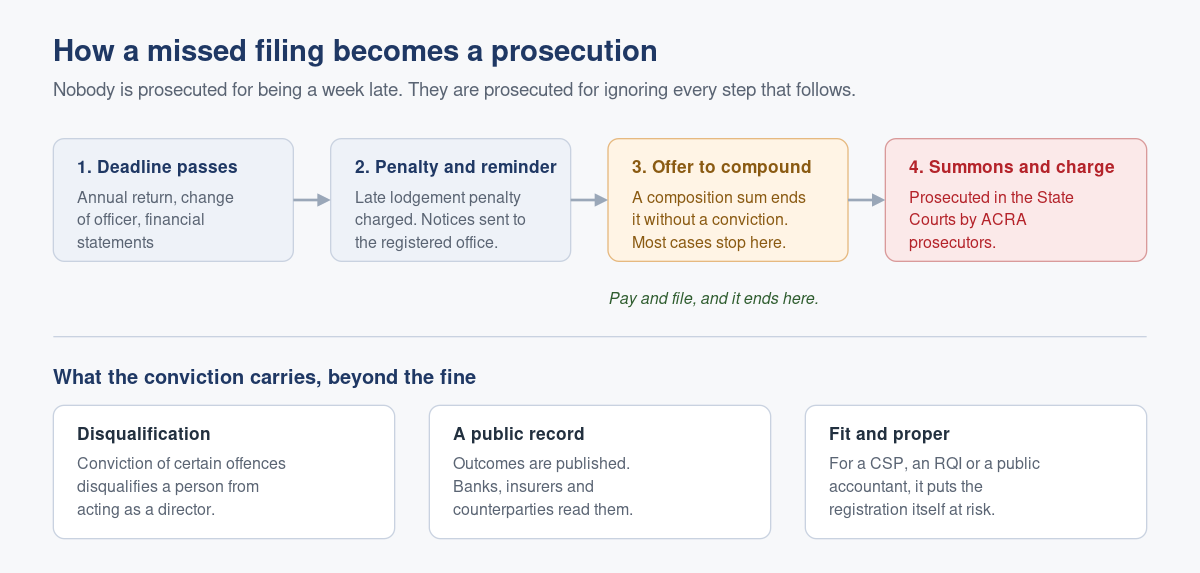
The offence families that actually appear
Persistent failure to file, after being told to file
This is the single largest category. It is not, strictly, a prosecution for being late with an annual return under section 197 of the Companies Act 1967. That is dealt with by a late lodgement penalty. What gets prosecuted is the failure to comply once the Registrar has formally required compliance, which engages the default penalty provisions in section 408 of the Companies Act 1967.
The distinction matters enormously and almost nobody outside the profession knows it. Being late is expensive. Being told to fix it and not fixing it is criminal. A company that is three years behind but responds to the notice and files will not end up in court. A company that is one year behind and bins the notice may.
False or misleading statements
Section 401 of the Companies Act 1967 deals with false and misleading statements, and the Accounting and Corporate Regulatory Authority Act 2004 carries a parallel offence for false information given to the Authority.
In practice these charges arise from a small number of recurring situations: a resident director address that was never real, an appointment declared with a consent that was never given, a shareholding recorded to conceal who actually controls the company, and declarations made on a filing by someone who had no basis for making them. Sentences here are materially heavier than for non-filing, because the conduct is deliberate rather than negligent.
Acting as a director when you are not permitted to
Two provisions do most of the work. Section 148 of the Companies Act 1967 restricts an undischarged bankrupt from acting as a director or being concerned in the management of a company. Section 154 disqualifies a person from acting as a director on conviction of certain offences.
The trap is that both operate automatically. There is no letter telling you that you are now disqualified. A person who is convicted, serves the sentence, and then quietly continues to run the company they have always run is committing a fresh offence every day. Prosecutions of this type frequently involve someone who genuinely did not realise the first conviction had this consequence. That is not a defence.
Breach of directors’ duties
Section 157 of the Companies Act 1967 imposes the statutory duty on a director to act honestly and use reasonable diligence in the discharge of their office, and it carries a criminal limb. In the prosecution record this typically appears alongside other charges rather than alone, and it is the charge that most often leads on to disqualification under section 154.
It is the provision that catches the director who signed things without reading them, allowed the company to be used by someone else, or took the fee for holding an office they never intended to actually perform. Our note on shadow directors and when someone never appointed can still be liable covers the mirror image of the same problem.
Carrying on business without registering
Section 405 of the Companies Act 1967 penalises carrying on business without registering a corporation, and the improper use of words such as “Limited”. The Business Names Registration Act 2014 carries the equivalent offences for unregistered business names and for false statements made on a business registration.
These are the charges that reach people who never thought of themselves as being in the ACRA system at all.
Corporate service provider offences
The Corporate Service Providers Act 2024 has begun producing charges. This is the newest and, for our profession, the most significant development in the enforcement picture. A CSP that fails its obligations under that Act is no longer facing a regulatory conversation; it is facing a prosecutable offence, and a conviction feeds straight back into the fit and proper assessment that its registration depends on.
The shape of the sentences
We do not publish case summaries and we will not name anybody. But the aggregate shape of the published outcomes is useful, and it is a fact pattern rather than anyone’s story.
| Offence family | Where it sits | Typical order of magnitude |
|---|---|---|
| Failure to comply with a requirement to file | Companies Act 1967 s408 | Low four figures per charge, multiplied by the number of charges |
| False or misleading statement | Companies Act 1967 s401; ACRA Act 2004 | Mid four figures to five figures |
| Acting while bankrupt or disqualified | Companies Act 1967 s148, s154 | Mid four figures upwards, with custodial exposure available |
| Breach of directors’ duties | Companies Act 1967 s157 | Mid four figures, often with disqualification following |
| Business registration offences | Business Names Registration Act 2014 | Four figures |
Two features of the record are worth noticing.
First, charges multiply. A director of several delinquent companies faces a charge per company, and sometimes per year. A fine that looks modest per charge becomes a serious number once it is aggregated. This is the mechanism by which people end up with five-figure penalties for what began as forgetting to file.
Second, fines have teeth. Where a fine is not paid, a default term of imprisonment is imposed. The custodial element is not reserved for the worst conduct; it is the enforcement mechanism for the fine itself.
And the sentence is not the whole consequence. A conviction can disqualify a person from directorship, sits on a public record that banks and counterparties will find, and for anyone holding a professional registration it puts that registration at risk. The disqualification machinery has been tightened in recent years, including through the money-laundering disqualification declarations we covered in our note on ACRA’s amended Form 45.
What goes wrong: the four failures that lead to court
The registered office is dead. Every enforcement path starts with a notice sent to the registered office. If that address is a former accountant’s office, a shophouse the company left in 2019, or a service address nobody has paid for in two years, the company will not know it is being escalated until a summons arrives. This is the single most common root cause and it is entirely preventable.
The company was abandoned but never closed. A dormant company that stopped trading and was never struck off keeps accruing filing obligations. The directors have moved on mentally; the Act has not. If you are finished with a company, close it properly rather than letting it drift.
The director never understood they were a director. Someone agreed to be named on a friend’s company, or a subsidiary’s board, and treated it as a formality. The duties in section 157 of the Companies Act 1967 apply in full to that person. If you would not be comfortable explaining the company’s affairs to a court, you should not be on the board.
The composition offer was ignored. ACRA will usually offer to compound an offence before prosecuting. Paying the composition sum and filing the outstanding document closes the matter without a conviction. Declining to engage converts a manageable problem into a criminal one. We set out how that route works in fixing common ACRA offences: composition and appeals, and the broader enforcement philosophy in ACRA’s enforcement approach.
How to stay out of that column
In order of how much risk each step removes:
- Make sure ACRA’s letters reach a human. Check the registered office address on Bizfile today. If post to it would not be opened within a week, change it.
- Answer every notice, even a late one. A reply that says “we are three years behind and here is our plan” is a materially different position from silence.
- Take the composition offer when one is made, and file the outstanding document at the same time. Paying without filing does not end the obligation.
- Clear the backlog in order. Overdue annual returns must usually be filed year by year. Starting is the hard part; the mechanics are routine.
- Close what you are not using. Strike off or wind up the companies you have finished with.
- Know who your directors are and whether they are still eligible. Ask once a year, in writing, whether anyone has become bankrupt or been convicted of a relevant offence.
- Never sign a declaration you have not verified. The false statement offences are the ones with the heavy sentences, and they begin with someone ticking a box on a filing to be helpful.
Frequently asked questions
Does ACRA prosecute companies or people?
Both, but directors and officers carry most of the personal exposure. Filing offences under the Companies Act 1967 are typically charged against the directors in default rather than the company alone, which is why a company with no assets is no protection for the people who ran it.
Will I be prosecuted for filing an annual return late?
Almost certainly not, by itself. A late annual return attracts a late lodgement penalty. Prosecution follows persistent non-compliance after the Registrar has formally required the filing to be made. The turning point is ignoring the notice, not missing the deadline.
What is a composition offer and should I take it?
It is an offer to settle an offence by paying a sum instead of being prosecuted, and in most ordinary filing cases the answer is yes. Compounding avoids a conviction and a criminal record. You must still make the outstanding filing; paying the composition sum alone does not cure the breach.
Can a conviction stop me being a director?
Yes. Section 154 of the Companies Act 1967 disqualifies a person from acting as a director on conviction of certain offences, and section 148 restricts an undischarged bankrupt. Both operate by force of the statute. You will not receive a separate notice telling you that you are disqualified.
Are ACRA’s prosecution outcomes public?
Yes. ACRA publishes outcomes of cases it prosecutes, and court proceedings are themselves public. Assume that anything decided in the State Courts is findable by a bank, an insurer, a counterparty running due diligence or a regulator assessing whether someone is fit and proper.
The boring version of this problem
Almost every prosecution in ACRA’s published record could have been avoided at a stage where it was an administrative annoyance. The distance between “we are behind on our filings” and “we are being charged” is measured in ignored letters, not in wrongdoing.
Raffles Corporate Services acts as registered office and corporate secretary for several hundred Singapore entities, which means we open the post, we see the notices, and we answer them. If you have inherited a company with a filing backlog, or you have stopped being sure what a company you are still a director of has filed in the last three years, that is a conversation worth having before anyone else starts it.
You can reach us through Raffles Corporate Services. ACRA’s own enforcement material sits at acra.gov.sg, and the legislation itself is free to read on Singapore Statutes Online.
The Editorial Team, Raffles Corporate Services
Need help with corporate secretarial or compliance matters?
If you would like help with your company's corporate secretarial, governance or compliance requirements, email [email protected] or WhatsApp +65 8501 7133.
Our team can assist with corporate secretarial, accounting and tax matters. Where legal advice is needed, advisers from our associated law firms can assist.