

A registered qualified individual is the licensed human being behind a corporate service provider. If you want to file with ACRA on behalf of other people’s companies as a business, someone in your firm must be an RQI, and registration runs for two years at a time.
Raffles Corporate Services works with a panel of experienced Singapore law firms who offer cost-effective and efficient legal service and advice. This article is general information only and is not legal advice.
That is the short version. The longer version matters, because the Corporate Service Providers Act 2024 changed who is allowed to do this work, and a lot of people who have been filing for clients for years now sit on the wrong side of a line they did not know existed.
This piece covers who actually needs RQI registration, the qualifying routes into it, what ACRA wants to see, and the bits of the process that quietly catch people out.
What an RQI is, in one paragraph
Under the Corporate Service Providers Act 2024, a corporate service provider is a person or firm carrying on a business of providing corporate services: incorporating companies for others, acting or arranging for someone to act as a director or secretary, providing a registered office, arranging nominee shareholders, and filing ACRA transactions on behalf of another person. Section 7 makes it an offence to carry on that business without being a registered CSP.
Registration of the firm is only half of it. Section 14 requires a registered CSP to ensure that the corporate service it carries on business in is actually provided by one or more registered qualified individuals, or by prescribed persons working under the supervision of an RQI. The firm holds the registration; the RQI is the qualified human being who is accountable for the work.
Section 6 requires the Registrar to keep two registers: one of registered corporate service providers and one of registered qualified individuals. You either appear on the second register or you do not.
Do you actually need to register as an RQI?
Most people who think they need RQI registration do not, and a smaller group who think they do not, do.
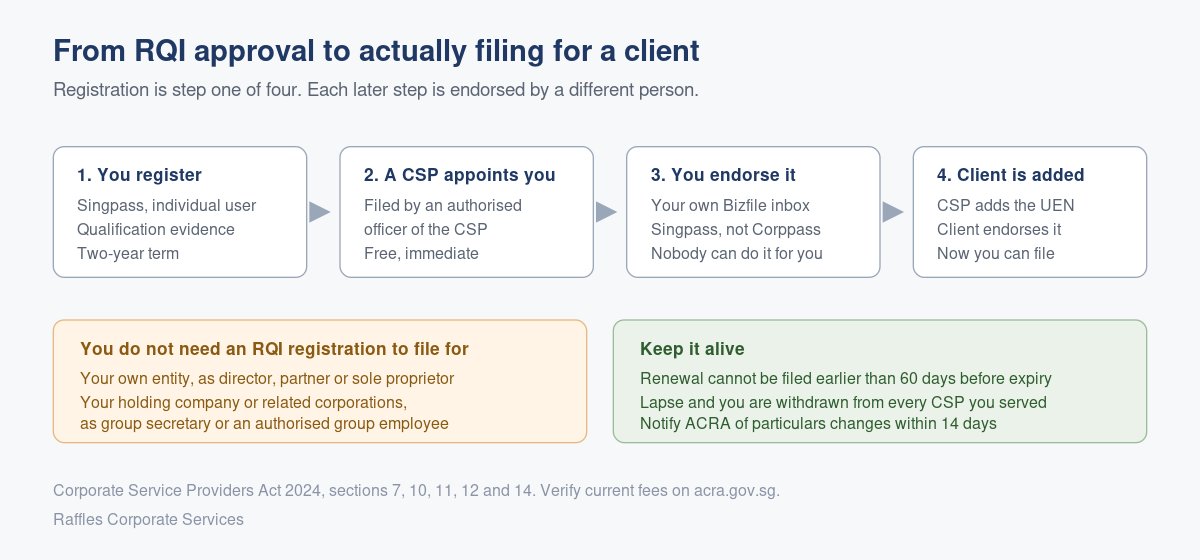
You do not need RQI registration to file for:
- Your own entity, as its director, partner, sole proprietor or other authorised representative
- Your holding company or related corporations, as the group company secretary or an authorised employee of the group
The trigger is doing the work for another person as a business. Filing your own company’s annual return is not a corporate service. Filing forty clients’ annual returns for a fee is.
The grey zone most people land in
The awkward cases are the ones that sit between the two. An accountant who prepares accounts for clients and, as an accommodation, also lodges the odd ACRA transaction for them. A lawyer whose firm incorporates companies for clients as part of a transaction. A consultant who acts as company secretary for three companies he has no shareholding in.
All three are providing corporate services to another person in the course of a business. The fact that it is a small part of your revenue does not remove it from the definition. Whether your particular arrangement crosses the line is a question worth getting a clear answer on before ACRA asks you, because the consequence under section 7 is a criminal one: a fine not exceeding $50,000 or imprisonment for a term not exceeding 2 years or both, and for a continuing offence a further fine not exceeding $2,500 for every day the offence continues after conviction.
Accounting entities sit in a special position. Section 7(2) treats an accounting entity carrying on the business of a designated activity connected with its accounting services as already registered as a CSP for that type of service, and section 15 extends similar treatment to its key appointment holders. That deemed status is not unconditional: it falls away if the deemed registration is suspended or cancelled.
Who qualifies to be an RQI
Section 11 sets the gate in the negative. The Registrar must refuse registration or renewal if the applicant is not a qualified individual or has not completed a prescribed course or training, if the Registrar is satisfied the applicant is not a fit and proper person, or if the applicant had a previous RQI registration cancelled under section 21(2) or (3) less than two years before the application date.
The detailed criteria for who counts as a “qualified individual” sit in the subsidiary legislation made under the Act. In practice, the qualifying routes fall into three families.
| Route | Who it covers | What ACRA typically wants to see |
|---|---|---|
| Public accountant | A registered public accountant | Nothing. ACRA verifies your registration directly |
| Legal | Advocate and solicitor of the Supreme Court of Singapore | A practising certificate, or proof of admission |
| Professional body membership | Members of recognised accountancy and chartered secretary bodies, including ISCA, the Association of International Accountants (Singapore Branch), the Institute of Company Accountants Singapore, and the Chartered Secretaries Institute of Singapore | Certificate of membership plus proof that membership is current, such as the latest invoice and receipt |
| Experience route | Owners, partners, directors or employees of a corporate secretarial agent with at least three years of relevant service in the past five years | Proof of the service: the CSP’s UEN, or engagement letters and invoices showing scope. Employees also need an employer letter and CPF payment records covering the period |
The experience route is the one that generates the most rejected applications, and the reason is always the same. Applicants send proof that they worked somewhere. ACRA wants proof that they provided corporate secretarial services, with the scope of service visible on the face of the document. An employment contract that says “Senior Executive” proves nothing. An engagement letter that says “company secretarial services including annual return filing and registers maintenance” proves everything.
The fit and proper test
Section 11(1)(b) lets the Registrar refuse an applicant who is not fit and proper, and section 11(2) allows the factors to be prescribed. ACRA publishes its fit and proper criteria on its own corporate service provider pages, and they look at conduct and compliance history rather than technical competence: professional misconduct, breach of fiduciary duty, serious negligence, regulatory history as an RQI or CSP, and the usual criminal and bankruptcy considerations.
Be candid in the application. Section 25 makes it an offence to provide materially false or misleading information to the Registrar, or to omit information knowing the omission will create a materially false impression, with a fine not exceeding $50,000 or imprisonment for a term not exceeding 2 years or both. A disclosed problem is a conversation. An undisclosed one is an offence.
If your earlier registration was cancelled by regulatory action, section 11(1)(c) imposes a hard two-year wait. That is not discretionary and there is no point applying early.
The process, in order
- Confirm your route and assemble the evidence first. Membership certificates, current-membership proof, practising certificate, or the engagement letters, employer letter and CPF records for the experience route. Applications sent in half-documented are the ones that stall.
- Log in to Bizfile and open the RQI registration eService. You will be logging in as an individual with Singpass, not as a business. If that distinction is new to you, our note on logging in to Bizfile as an individual user sets out when Singpass is the right credential and when Corppass is.
- Complete the personal particulars and upload the supporting documents.
- Pay. ACRA charges $200 for the two-year registration, by credit card, debit card or online banking. Confirm the current amount on ACRA’s own page before you file. The fee is non-refundable: it does not come back if the application is rejected, if you de-register early, or if ACRA cancels your registration later.
- Wait. ACRA processes most applications within 30 working days, and will tell you if it needs longer. This is a review, not a rubber stamp.
- Get appointed. Approval alone does not let you file for anyone. You must be appointed, employed or engaged by a registered CSP, or be a registered CSP yourself.
- Endorse the appointment. When a CSP appoints you, you endorse it yourself through your own Bizfile inbox. Nobody can endorse it for you.
- Wait for the client to be added. Your CSP must add the entity to its client list, and the client must endorse that, before you can file for them.
Steps 6 to 8 are where the whole thing stops feeling like a licensing exercise and starts feeling like plumbing. Our companion pieces on appointing or withdrawing RQIs and on maintaining a CSP client list cover those two links in the chain.
What goes wrong in practice
Assuming registration equals filing rights. It does not. We have watched newly registered RQIs sit for a fortnight wondering why the eService will not let them touch a client file, when the answer was that nobody had added the client to the firm’s list.
Letting the registration lapse. RQI registration runs for two years. Under section 10(2) you cannot apply to renew earlier than 60 days before expiry, which means the renewal window is genuinely narrow. Miss it and you are not merely late: you are withdrawn from every CSP you were appointed to, and you have to register from scratch, pay again, and wait out the processing time again. Put the expiry date in two calendars.
Forgetting section 12. A registered person must notify the Registrar of any change in the particulars given in the application, within 14 days of the change and in the manner ACRA specifies. Change of name, change of address, change of professional status. The fine for getting this wrong is up to $10,000, and it is the sort of thing nobody thinks about until a compliance review turns it up.
Treating AML as someone else’s job. Section 17 imposes customer due diligence obligations on the registered CSP, with a fine not exceeding $100,000 for failing to comply. In real life the RQI is the person doing the due diligence, and the RQI’s name is on the file. Our Corporate Service Providers Act 2024 compliance FAQ sets out the obligations end to end, and the ACRA Form 45 money laundering disqualification note covers the personal exposure that sits alongside it.
Underestimating nominee work. If your firm arranges for people to act as nominee directors, section 16 applies on top of everything else, and the enforcement climate has hardened considerably. Read our note on ACRA’s tougher penalties for the registers of nominee directors, nominee shareholders and controllers before you take that work on.
Frequently asked questions
Do I need to be an RQI to file my own company’s annual return?
No. RQI registration applies to providing corporate services to other people as a business. Filing for your own entity as a director, partner or sole proprietor does not require it, and neither does filing for your holding company or related corporations as the group secretary or an authorised group employee.
How long does RQI registration last, and when can I renew?
Two years. Section 10(2) of the Corporate Service Providers Act 2024 says an application for renewal cannot be made earlier than 60 days before the registration expires, so the window is short. If the registration lapses, you are withdrawn from every CSP you were appointed to and must register afresh.
Can I be an RQI without joining a CSP?
You can hold the registration, but you cannot use it. To file transactions you must be appointed, employed or engaged by a registered CSP, or be a registered CSP in your own right. Registration on its own gives you standing, not access.
What if my previous RQI registration was cancelled?
You must wait two years from the cancellation before reapplying. Section 11(1)(c) requires the Registrar to refuse an application made inside that period, so there is no discretion to exercise and no benefit in applying early.
I am a public accountant. Do I still need supporting documents?
No. ACRA verifies public accountant registration directly, so you do not upload qualification documents. You still complete the application, pay the fee and go through the fit and proper assessment like everyone else.
Does the fee come back if ACRA rejects my application?
No. The registration fee is non-refundable in every direction: rejection, early de-registration, or later cancellation by ACRA. That is a good reason to get the supporting documents right the first time rather than testing the application to see what happens.
If this is turning into a project
Getting the RQI registration is usually the easy part. Running a CSP properly afterwards, with the client list maintained, the RQI appointments endorsed, the section 12 notifications filed inside 14 days and the AML file good enough to survive a compliance review, is the part that takes real discipline.
Raffles Corporate Services is itself a registered corporate service provider, so we run this regime on ourselves every day as well as advising on it. If you are weighing up whether you need to register, or you have an application that has stalled, that is usually a short conversation.
You can reach us through Raffles Corporate Services, or read more on Singapore corporate secretarial practice at Singapore Secretary Services.
The Editorial Team, Raffles Corporate Services
Need help with corporate secretarial or compliance matters?
If you would like help with your company's corporate secretarial, governance or compliance requirements, email [email protected] or WhatsApp +65 8501 7133.
Our team can assist with corporate secretarial, accounting and tax matters. Where legal advice is needed, advisers from our associated law firms can assist.