

A registered corporate service provider must have at least one registered qualified individual appointed before it can file anything for a client, and it must tell ACRA within 14 days whenever it appoints or withdraws one. Both transactions are free and take effect immediately.
Raffles Corporate Services works with a panel of experienced Singapore law firms who offer cost-effective and efficient legal service and advice. This article is general information only and is not legal advice.
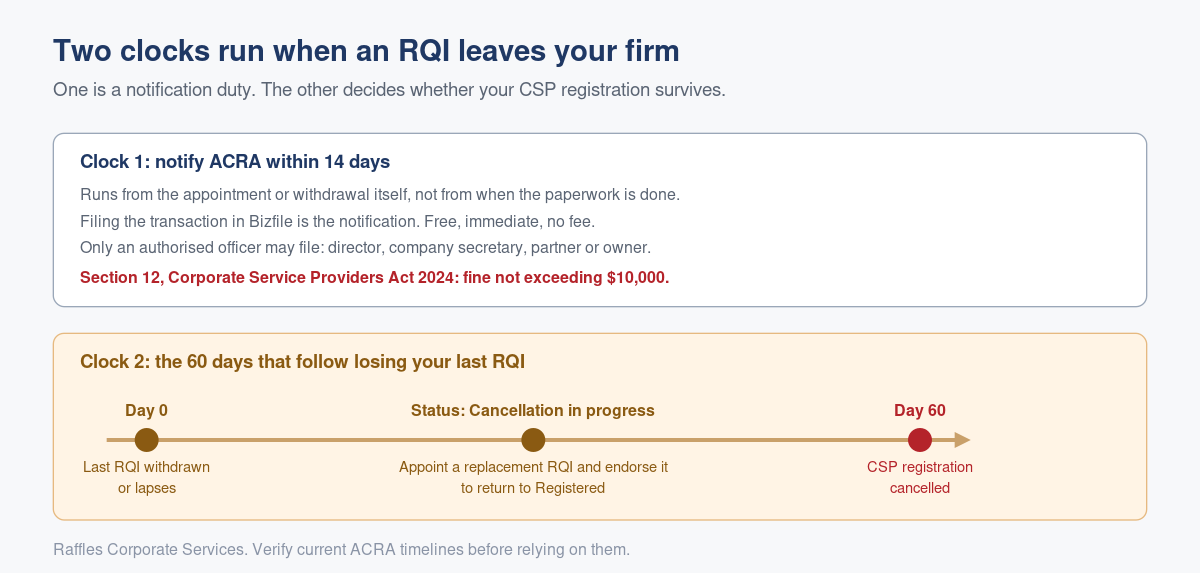
The filing itself is trivial. What is not trivial is the gap it can open. Withdraw your only RQI and your CSP registration moves to “Cancellation in progress” the moment you submit, and you have 60 days to appoint a replacement before the registration is gone.
Here is how the appointment and withdrawal mechanics actually work, who is allowed to do them, and where firms get hurt.
Why the appointment exists at all
Section 14 of the Corporate Service Providers Act 2024 requires a registered CSP to ensure that the corporate service it carries on business in is provided by one or more registered qualified individuals, or by prescribed persons under the supervision of an RQI. Section 6 requires the Registrar to keep a register of registered qualified individuals.
Put those together and the logic is clear. The firm holds the licence, but the Act insists that identified, qualified individuals stand behind the work. The appointment record is how ACRA knows which qualified individuals stand behind which firm at any given moment. That is why the notification duty is short and why the register has to be right rather than roughly right.
If you have not yet got an RQI of your own, start with our guide on registering as a registered qualified individual, which covers the qualifying routes, the evidence ACRA wants and the two-year term.
Who is allowed to file the appointment
Only an authorised officer of the CSP can appoint or withdraw an RQI. In practice that means a director, company secretary, partner or owner of the CSP firm, depending on how the firm is constituted.
An RQI cannot appoint themselves to a firm. An administrative assistant with Corppass access to Bizfile cannot do it either, however convenient that would be. The transaction is deliberately restricted to the people who carry legal responsibility for the firm.
What you need before you start
Almost nothing, which is the pleasant surprise in an otherwise demanding regime:
- The identification type of the person being appointed or withdrawn (NRIC, FIN or passport, as applicable)
- Their identification number
Bizfile retrieves the rest from the RQI register. There is no fee and no processing delay. If you need to get a member of staff into Bizfile first, our note on assigning Corppass e-Service roles safely covers who in your firm should hold what.
Appointing an RQI, step by step
- Log in to Bizfile as a Business User using Corppass. If you are not sure which credential applies, our guide to logging in to Bizfile as a business user sorts it out in two minutes.
- Select the right profile. On the profile selection page, an authorised position holder picks the CSP firm under “My Entities”. Someone coming in as an RQI picks “Corporate Service Provider” and, if they belong to more than one firm, chooses the right one from the dropdown. Getting this wrong is the single most common cause of a filing landing against the wrong entity, which is why we wrote separately on switching profiles on Bizfile.
- Open the eService for managing filing access for RQIs and CSP employees. You can reach it from the dashboard or from the “Manage” mega menu under the corporate service provider heading.
- Choose to appoint. Select the option to appoint an RQI or add an employee, and set the employee type to registered qualified individual. The distinction matters: an RQI and a CSP employee are different roles with different rights.
- Enter the identification details and retrieve the person’s information. If nothing comes back, the individual is not on the RQI register. That is the answer, not a system fault.
- Submit. The appointment is recorded immediately.
- The RQI endorses. Unless the lodger is appointing themselves, a notification goes to the appointee’s Bizfile inbox. They must log in with their own Singpass as an individual user, open the pending action, review the details and endorse.
Until that endorsement is done, the appointment is not complete. This trips up firms constantly: the office has filed the appointment, the partner has confirmed it is done, and the new RQI is still sitting outside the system because nobody told them to check their Bizfile inbox. Tell them on the day.
Withdrawing an RQI, step by step
- In the same eService, find the RQI on your list. Use the search function if the list is long: you can search by name or identification number.
- Select the delete icon next to that person.
- Enter the withdrawal date and the reason for withdrawal. The reason goes on the record. Write something accurate and neutral.
- Review the details, tick the declaration and submit.
- You receive an acknowledgement. The withdrawal is effective immediately.
Withdrawal does not need the departing RQI’s endorsement. The firm can withdraw someone unilaterally, which is correct: a person who has resigned or been dismissed should not be able to block their own removal from the register.
The 60-day clock, and why it is the whole point of this article
Here is the consequence nobody reads until it has happened to them.
If you withdraw your only RQI, your CSP’s registration status changes to “Cancellation in progress”. You then have 60 days to appoint a new RQI. Do that and the status returns to “Registered”. Fail to do it and the registration is cancelled.
| Situation | What happens to the CSP registration | What you must do |
|---|---|---|
| You appoint an additional RQI | No change, you simply have more coverage | Notify ACRA within 14 days |
| You withdraw one of several RQIs | No change, at least one remains | Notify ACRA within 14 days |
| You withdraw your only RQI | Status becomes “Cancellation in progress” | Appoint a replacement RQI within 60 days |
| You do nothing for 60 days | Registration is cancelled | Re-register as a CSP from the beginning |
| Your only RQI’s own registration lapses | They are withdrawn from your firm automatically | Same 60-day exposure, without anyone filing anything |
That last row is the dangerous one. An RQI whose personal registration expires is withdrawn from every CSP they were appointed to. Nobody at your firm files anything, nobody makes a decision, and your firm can drift into “Cancellation in progress” purely because one person missed a renewal window. Under section 10(2) of the Act, an RQI cannot even apply to renew earlier than 60 days before expiry, so the individual’s own window is narrow to begin with.
If you run a CSP with a single RQI, that person’s expiry date belongs in the firm’s compliance calendar, not just in their own.
The 14-day notification, and what it costs to miss
Section 12 of the Act requires a registered person to notify the Registrar of any change in the particulars provided in the registration or renewal application, within 14 days of the change and in the manner ACRA specifies. Contravening it is an offence carrying a fine not exceeding $10,000.
In the appointment context the good news is that the notification and the transaction are the same thing: filing the appointment or withdrawal in Bizfile is how you tell ACRA. The 14 days runs from the appointment or withdrawal itself, not from when you get round to the paperwork.
The bad news is the quieter category of change: an RQI’s change of name or residential address, a change in the firm’s own particulars, a change in professional status. Those need their own notifications and nobody is prompted to make them. A compliance review will find them.
What goes wrong in practice
The unendorsed appointment. Filed, acknowledged, and never endorsed. The firm believes it has two RQIs; the register says it has one. This surfaces at exactly the wrong moment, usually when the other RQI resigns.
The resignation nobody told compliance about. An RQI leaves, works out a notice period, and the appointment sits on the register for weeks afterwards because HR and compliance are different people. The 14-day clock started on the last day of employment, not on the day somebody remembered.
Confusing RQIs with CSP employees. They are separate roles with separate rights, filed through the same eService. Appointing your new senior executive as an RQI when they are not on the RQI register will simply fail; appointing a genuine RQI as an ordinary employee will leave them without the standing the Act requires.
Treating withdrawal as an HR formality. The withdrawal reason is a regulatory record. If someone is leaving because of a conduct problem, think about what the record should say and what else the Act may require of you, rather than typing “resigned” and closing the tab. ACRA reviews conduct and compliance history when it assesses RQI applications and renewals, and enforcement in this space has become noticeably less forgiving, as the Public Prosecutor v Zheng Jia sentencing framework illustrates.
Forgetting that appointments do not create client access. Appointing and endorsing an RQI gets them standing within your firm. It does not give them access to any particular client. The client must be on your firm’s client list and must have endorsed the arrangement. Our companion note on maintaining a CSP client list covers that second half of the chain.
Frequently asked questions
How many RQIs must a CSP appoint?
At least one. A registered CSP cannot perform transactions for clients until it has appointed an RQI, and section 14 of the Corporate Service Providers Act 2024 requires the corporate service to be provided by RQIs or by prescribed persons under an RQI’s supervision. Most firms of any size appoint more than one for continuity.
Does an RQI have to agree to be appointed?
Yes, unless they are filing the appointment themselves. The appointment generates a pending action in the RQI’s Bizfile inbox, and they must log in with their own Singpass as an individual user and endorse it. Until then the appointment is not complete and the RQI cannot file.
Can I withdraw an RQI without their consent?
Yes. Withdrawal is filed by an authorised officer of the CSP and does not require the departing RQI’s endorsement. You enter a withdrawal date and a reason, submit, and the withdrawal takes effect immediately. The reason forms part of the regulatory record.
What happens if I withdraw my only RQI?
Your CSP’s registration status changes to “Cancellation in progress” straight away. You have 60 days to appoint a replacement RQI to return to “Registered” status. If you do not, the registration is cancelled and you would have to apply as a new CSP rather than restore the old one.
Is there a fee for appointing or withdrawing an RQI?
No. Both transactions are free and processed immediately in Bizfile. The cost sits elsewhere: the individual’s own RQI registration carries a fee and a two-year term, and missing the 14-day notification duty under section 12 carries a fine of up to $10,000.
Who in my firm is allowed to file these transactions?
Only authorised officers: directors, company secretaries, partners or owners of the CSP, depending on the firm’s structure. Administrative staff with Corppass access cannot appoint or withdraw RQIs, and an RQI cannot appoint themselves to a firm they do not control.
Keeping the register honest
None of this is difficult. It is simply easy to forget, and the failure mode is disproportionate: one missed renewal by one individual can put an entire firm’s registration into a 60-day countdown that nobody is watching.
The fix is unglamorous. Keep a single list of your RQIs with their expiry dates, check it monthly, and make appointment and withdrawal part of the joiner and leaver process rather than something compliance discovers afterwards.
Raffles Corporate Services is a registered corporate service provider and runs this discipline on itself as well as advising other firms on it. If you are unsure whether your RQI register at ACRA matches the people actually doing the work, that is worth ten minutes.
You can reach us through Raffles Corporate Services, or read more on Singapore corporate secretarial practice at Singapore Secretary Services.
The Editorial Team, Raffles Corporate Services
Need help with corporate secretarial or compliance matters?
If you would like help with your company's corporate secretarial, governance or compliance requirements, email [email protected] or WhatsApp +65 8501 7133.
Our team can assist with corporate secretarial, accounting and tax matters. Where legal advice is needed, advisers from our associated law firms can assist.