

A VCC that files its annual return late pays an automatic penalty of $300 or $600, and can then face a composition sum, court prosecution and a fine of up to $10,000 per charge if the matter is not resolved.
Raffles Corporate Services works with a panel of experienced Singapore law firms who offer cost-effective and efficient legal service and advice. This article is general information only and is not legal advice.
The obligation itself is not discretionary. Section 97 of the Variable Capital Companies Act 2018 requires every VCC to file an annual return, and the deadline is fixed at seven months after the financial year end. Miss it, and the consequences do not arrive all at once. They arrive in stages, each one more expensive and more personal than the last.
Most VCCs never get past the first stage. They file a few weeks late, pay the automatic penalty, and move on. The stages that follow exist for the minority who let a late filing turn into an ignored one, and they are worth understanding before that happens to you.
What “late” costs immediately: the late lodgment penalty
The moment an annual return is filed after its due date on the VCC portal, a late lodgment penalty is applied automatically. Nobody has to review the file or make a judgement call. The system calculates it from the filing date alone.
The amount depends only on how long the default has run.
| Length of default | Late lodgment penalty |
|---|---|
| Up to three months after the deadline | $300 |
| More than three months after the deadline | $600 |
Take a VCC with a 31 December financial year end. Its annual return is due seven months later, on 31 July. If the return is filed on 20 August, the default is 20 days, well within the first band, so the penalty is $300. If the same VCC does not file until 15 November, the default has passed three months and the penalty rises to $600. The penalty does not compound daily and it does not scale further after the three-month mark. It is a flat $600 no matter how many months follow.
This penalty is separate from, and in addition to, whatever consequences follow from a late annual general meeting, since a late AGM is usually what causes a late annual return in the first place. The two breaches are assessed independently even though they share a root cause.
Beyond the penalty: how ACRA’s enforcement ladder works
Paying the late lodgment penalty settles the filing. It does not settle the fact that a statutory deadline was missed, and ACRA has separate enforcement tools for that. They apply in a fixed order, and each one exists specifically because the step before it was ignored.
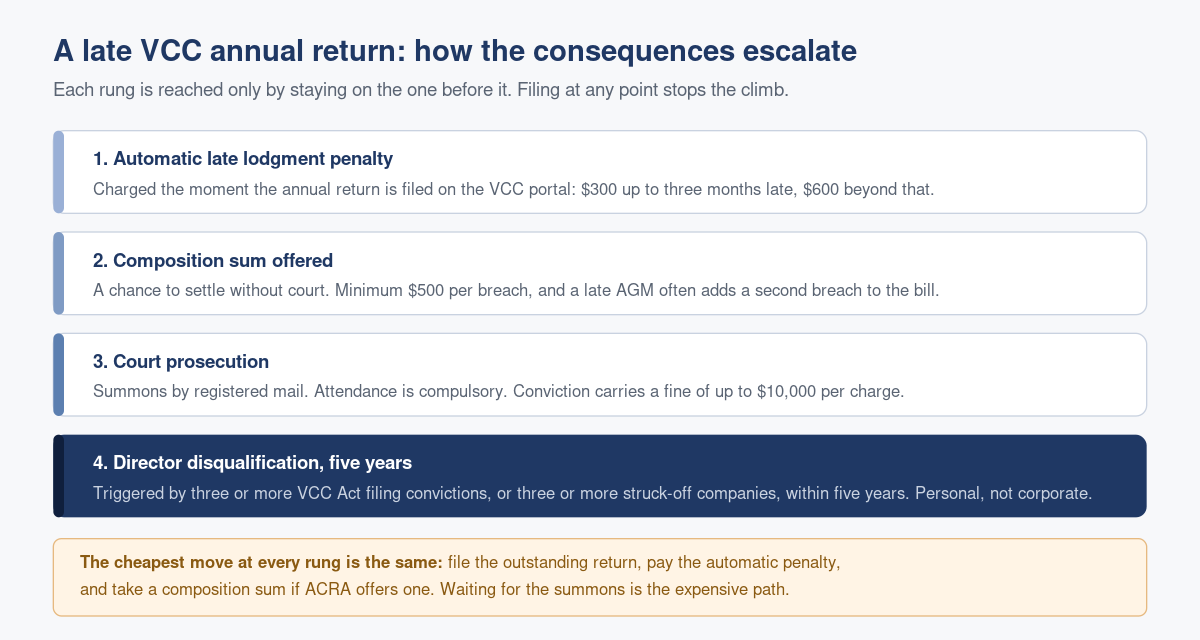
Composition sum
Before going anywhere near a courtroom, ACRA will usually offer the VCC and its directors the chance to pay a composition sum instead of facing prosecution. This is not an admission of wrongdoing recorded against you in the same way a conviction is, and it closes the matter administratively.
The minimum composition sum is $500 for each breach. Because a late AGM so often sits behind a late annual return, both breaches are frequently composed together, which means the practical minimum for a VCC facing both is at least $1,000. There is no cap stated on the higher end: the sum reflects the facts of the case.
Court prosecution
Composition is offered, not guaranteed. ACRA may prosecute in court where the VCC or its directors do not accept the composition sum, or where ACRA decides against offering one at all after a summons has already been issued.
The process runs in a fixed sequence:
- ACRA sends a summons by registered mail, addressed to the VCC’s registered office and separately to each relevant director’s residential address, stating the court date and which court to attend.
- A representative holding a letter of authority, or a director personally, must attend court. This obligation stands even while an appeal is being processed.
- At the hearing, the representative or director may accept a composition offer if one is made at that stage, plead guilty, or claim trial to dispute the charge.
- If the VCC fails to send anyone, the court can proceed in its absence. If a director individually fails to attend, the court issues a warrant for that director’s arrest.
- On conviction, the fine can reach $10,000 for each charge. A VCC with several outstanding annual returns can therefore face several charges at once.
None of these steps requires the VCC to have done anything beyond miss a deadline and then miss the chance to fix it quietly. The route from a $300 penalty to a $10,000 fine is entirely a function of how long the matter is left unattended.
The personal consequence: director disqualification
The most serious outcome does not attach to the VCC. It attaches to the individual.
ACRA will disqualify a director for five years if either of two thresholds is crossed within a five-year window: three or more convictions for filing offences under the VCC Act, or three or more companies struck off by ACRA for failing to meet their obligations. The five-year disqualification period runs from the date of conviction, and while it is in force the person cannot act as a director of, or take part in managing, any company or VCC, local or foreign.
This is why a pattern of late filing across multiple entities is far more dangerous than a single late filing at one VCC. A director who serves several vehicles and lets the same problem recur is building toward disqualification even if no single instance looked serious on its own.
What goes wrong in practice
The manager assumes the corporate secretary is tracking it, and the corporate secretary assumes the manager is. A VCC’s annual filing calendar sits at the intersection of fund operations and corporate administration. When responsibility is not assigned explicitly to one person, both sides assume the other has it covered, and the deadline passes unattended.
Directors treat the $300 penalty as the whole cost. It reads as a manageable, almost administrative figure, so a late filing does not get escalated internally. The composition sum and the disqualification exposure only become visible once ACRA has already sent a summons, by which point the options have narrowed considerably.
A summons goes to a residential address that is no longer current. Directors move, and the address ACRA holds is whatever was last filed. A director who has not kept a personal address updated risks missing the summons altogether, which does nothing to stop the court proceeding without them and does not prevent a warrant of arrest if attendance was required.
Nobody checks whether an extension of time was still available. In many cases the simplest fix, applying for more time before the deadline passes, was open and unused. Once the deadline has actually passed, that option is gone and the enforcement ladder is the only path left.
Frequently asked questions
Is the late lodgment penalty the only cost of filing a VCC annual return late?
No. The $300 or $600 penalty is charged automatically and covers the act of filing late. It does not prevent ACRA from separately offering a composition sum or pursuing prosecution if the underlying breach is not resolved, and it has no bearing on a director’s exposure to disqualification for repeated offences.
How is the composition sum calculated?
ACRA sets a minimum of $500 for each breach, so a VCC facing both a late AGM and a late annual return should expect at least $1,000 combined if both are composed. The exact figure ACRA offers reflects the facts of each case and is not published as a fixed schedule.
What happens if a VCC ignores the summons entirely?
The court can proceed with the hearing in the VCC’s absence if no representative attends. If an individual director who was summoned personally fails to attend, the court issues a warrant for that director’s arrest. Ignoring the summons does not make the matter disappear.
Can a director be disqualified after just one late annual return?
Not on that alone. Disqualification for filing offences requires three or more convictions under the VCC Act within a five-year period, or three or more companies struck off within the same window. A single late filing, resolved through the penalty or a composition sum, does not on its own meet that threshold.
Does paying the penalty stop ACRA from taking further action?
The penalty settles the automatic charge for late filing. It does not by itself resolve any related enforcement action ACRA has already decided to pursue, such as a composition offer or a prosecution already in motion, though prompt filing and payment generally puts a VCC in a far better position when ACRA is deciding what else, if anything, to do.
Where do these penalties sit in the wider law governing VCCs?
The underlying filing duty comes from section 97 of the Variable Capital Companies Act 2018. The penalty amounts, composition process and court procedure are ACRA’s administrative enforcement mechanisms for breaches of that duty, and director disqualification for repeated offences sits alongside the disqualification regime the VCC Act carries over from company law.
Getting ahead of the deadline instead of behind it
Every stage of this ladder exists to deal with VCCs that have already gone quiet on a deadline. None of it applies to a VCC that files on time, and very little of it applies to one that files a few weeks late and pays the automatic penalty without argument.
Raffles Corporate Services tracks annual filing deadlines for VCCs across our portfolio, flags a looming FYE-driven deadline well before it arrives, and steps in early if an extension of time is the better option instead of a late filing. If a VCC you are responsible for is already past its deadline, the earlier we are brought in, the more of this ladder we can help you avoid. For the related duty to keep officer and information changes current, see our guide to updating VCC information and officers, and for the broader set of duties a VCC director carries, read the legal obligations of a VCC director.
The statutory source is the Variable Capital Companies Act 2018, and ACRA’s own summary of these penalties sits on its page for penalties and enforcement action for late VCC annual return filing. For the equivalent regime that applies to ordinary Singapore companies, see ACRA’s general late lodgment penalty framework.
The Editorial Team, Raffles Corporate Services
Need help with corporate secretarial or compliance matters?
If you would like help with your company's corporate secretarial, governance or compliance requirements, email [email protected] or WhatsApp +65 8501 7133.
Our team can assist with corporate secretarial, accounting and tax matters. Where legal advice is needed, advisers from our associated law firms can assist.