

A Singapore private company has to keep six registers. Four of them sit with ACRA and update themselves when you file. Two of them, plus a third for nominee arrangements, you keep yourself, and nobody will ever remind you about them.
Raffles Corporate Services works with a panel of experienced Singapore law firms who offer cost-effective and efficient legal service and advice. This article is general information only and is not legal advice.
That split is the single most useful thing to understand about statutory registers, and it is the thing most directors get wrong. They assume the corporate secretary “has the registers”, the way a company once kept a leather-bound book at the registered office. Some of that is still true. Most of it is not.
Here is the full map: which register is which, who holds it, who can see it, and what it costs you when one of them is out of date.
What a statutory register actually is
A statutory register is a record the law requires your company to maintain of a particular class of person: who directs it, who owns it, who ultimately controls it, and who has taken security over its assets. It is not an internal document you keep for convenience. It is a legal record, and in some cases the entry in the register is what creates the legal position rather than merely describing it.
The Companies Act 1967 splits these into two very different regimes.
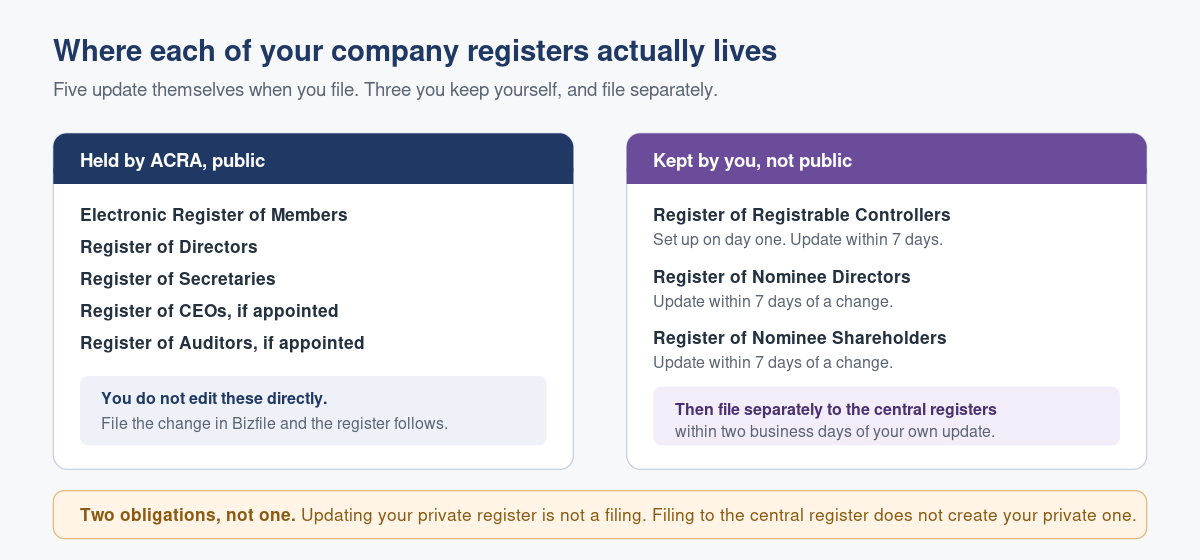
Registers held by the Registrar. Since the electronic register regime came in, the registers of members, directors, chief executive officers, secretaries and auditors are maintained by ACRA in Bizfile. Sections 196A to 196D of the Act govern the electronic register of members, and section 173 governs the register of directors, chief executive officers, secretaries and auditors. You do not update these directly. You file a transaction, and the register updates as a consequence of the filing.
Registers you keep yourself. The Register of Registrable Controllers, the Register of Nominee Directors and the Register of Nominee Shareholders are kept privately by the company, under Part 11A of the Act, sections 386AA to 386AP. The public cannot see them. Law enforcement and ACRA can. You also file a parallel copy of the controller and nominee information to ACRA’s central registers, which is a separate obligation from keeping your own.
The full list, and who can see each one
| Register | Who holds it | Visible to the public? | Updated by |
|---|---|---|---|
| Electronic Register of Members (EROM) | ACRA | Yes | Filing a share allotment, transfer or member particulars change in Bizfile |
| Electronic Register of Directors | ACRA | Yes | Filing an appointment, cessation or particulars change |
| Electronic Register of Secretaries | ACRA | Yes | Filing an appointment, cessation or particulars change |
| Electronic Register of Chief Executive Officers (if one is appointed) | ACRA | Yes | Filing an appointment, cessation or particulars change |
| Electronic Register of Auditors (if one is appointed) | ACRA | Yes | Filing an appointment, cessation or particulars change |
| Register of Registrable Controllers (RORC) | You, at your registered office or your corporate service provider’s office | No | You, by hand, plus a separate filing to the Central RORC |
| Register of Nominee Directors (ROND) | You | No | You, plus a separate filing to the Central ROND |
| Register of Nominee Shareholders (RONS) | You | No | You, plus a separate filing to the Central RONS |
The public visibility column matters more than people expect. Anyone can look up your directors and shareholders before deciding whether to trade with you, extend credit to you or hire you. That is the design. Your controllers and nominee arrangements are deliberately not public, because they exist for a different purpose: anti-money-laundering transparency to the authorities, not commercial transparency to the market.
The electronic registers are the legal record
This is worth stating plainly. For a private company, the entry in ACRA’s electronic register of members is the register of members. A spreadsheet in your finance folder showing a different shareholding is not a competing record. It is simply wrong.
The practical consequence turns up in due diligence, bank onboarding and grant applications. A buyer’s lawyer pulls the ACRA register, compares it with the share transfer documents you handed over, and finds a gap because a transfer was signed in March and never lodged. The paperwork does not fix it. The filing does.
If you have not looked at what Bizfile holds for your company recently, start with what Bizfile actually is and what you can do in it, then spend your first fifteen minutes in Bizfile checking your own entity.
The Register of Registrable Controllers, in plain terms
A registrable controller is a person or entity that owns or controls your company. For a typical Singapore SME, that means anyone holding at least 5% of the voting shares, plus anyone who exercises significant control over the company’s decisions even without holding shares.
Three obligations attach to it, and they carry three different clocks:
- Set the register up on the day the company is registered. Not when you get round to it. Day one. A company registered from 16 June 2025 files its controller information as part of the incorporation transaction in Bizfile.
- Update your own RORC within seven days of a change, with the clock starting once the controller has confirmed their details to you.
- File the update to the Central RORC within two business days of updating your own register.
You also have to send a notice to every controller at least once a year to confirm their particulars are still correct. That annual notice is the obligation companies forget most reliably, because nothing external prompts it and nothing visible breaks when you skip it.
Certain companies are exempted, typically those already subject to equivalent disclosure elsewhere, such as listed companies and their wholly owned subsidiaries. If you think you are exempt, get that confirmed rather than assumed.
Nominee directors and nominee shareholders
A nominee director sits on your board but acts for someone else, the nominator. A nominee shareholder holds shares in their own name for someone else’s benefit. Both are lawful. Both must be recorded.
Your ROND and RONS must be updated within seven days of a change, and the corresponding filing to the Central ROND and RONS is due within two business days after you update your own register.
The consequences of getting this wrong have hardened considerably. Singapore now treats nominee director arrangements that are used to obscure control as a serious matter rather than a paperwork slip, and the sentencing position has been set out by the courts. If nominee arrangements feature anywhere in your structure, read our notes on nominee shareholder arrangements and beneficial ownership disclosure and on the sentencing framework for nominee directors before you decide your register is a low priority.
Corporate service providers carry their own overlay of duties here, covered in our Corporate Service Providers Act 2024 compliance FAQ.
What goes wrong in practice
The RORC that was never created. By far the most common failure. The company incorporated, the directors assumed the corporate secretary’s incorporation pack included it, and no physical or electronic RORC exists anywhere. This surfaces during a bank account review or an ACRA inspection, at which point there is no way to backdate it honestly.
The register that exists but was never refreshed. A shareholder crossed 5% in a rights issue two years ago and the controller register still shows the old line-up. The register is not merely incomplete, it is inaccurate, which is worse.
Confusing the private register with the central filing. Updating your own RORC does not file it. Filing to the Central RORC does not create your own register. They are two obligations, with two deadlines, and both are enforceable.
Nobody owns the annual controller notice. The yearly confirmation notice to controllers falls between the corporate secretary’s scope and the finance team’s scope, so it falls on the floor.
ID changes routed to the wrong agency. Singapore citizens and permanent residents who change name, address or identification report that to ICA rather than to ACRA, and ACRA’s electronic registers for officers pick it up. The exception is the register of members, where a shareholder’s particulars still need a filing.
Late or missing filings attract late lodgement penalties, applied per transaction, so a company that has drifted on several changes does not receive one penalty. It receives several.
Frequently asked questions
Do I still need to keep a physical register of members at my office?
Not for a private Singapore company. The electronic register of members held by ACRA is the legal register. You should still keep your share transfer forms, board resolutions and share certificates, because those are the evidence behind each entry, but the register itself lives with the Registrar.
Can the public see my Register of Registrable Controllers?
No. The RORC, ROND and RONS are not public. They are available to ACRA and to law enforcement agencies on request. Everything else, including your directors, secretary and shareholders, is publicly searchable through Bizfile.
Who counts as a registrable controller in a small company?
For most SMEs, any individual or entity holding at least 5% of the voting shares, and anyone who can exercise significant influence or control over the company’s decisions even without a shareholding. Where shares are held through another company, you trace up to the individuals behind it.
Where must the RORC be physically kept?
At your registered office address, or at the office of your corporate service provider. A physical or electronic copy is acceptable. What is not acceptable is a register that exists only in the head of whoever set the company up.
What is the difference between my RORC and the Central RORC?
Your RORC is the private register your company maintains. The Central RORC is ACRA’s copy, which you file to separately. Updating one does not update the other, and each has its own deadline.
Keeping this off your desk
Registers rarely fail because someone decided not to comply. They fail because a change happened, everyone assumed someone else was filing it, and the clock ran out quietly.
The companion to this article, the 14-day update rule, sets out exactly what starts that clock and what it costs when you miss it. If you want the underlying law rather than the practice, our Companies Act 1967 deep-dive FAQ is a good place to start.
Raffles Corporate Services maintains statutory registers for several hundred Singapore companies, including the RORC, ROND and RONS that nothing else in your compliance calendar will remind you about. If you are not certain your registers are complete and current, that is a short conversation and usually a quick fix.
— The Editorial Team, Raffles Corporate Services
Need help with corporate secretarial or compliance matters?
If you would like help with your company's corporate secretarial, governance or compliance requirements, email [email protected] or WhatsApp +65 8501 7133.
Our team can assist with corporate secretarial, accounting and tax matters. Where legal advice is needed, advisers from our associated law firms can assist.