
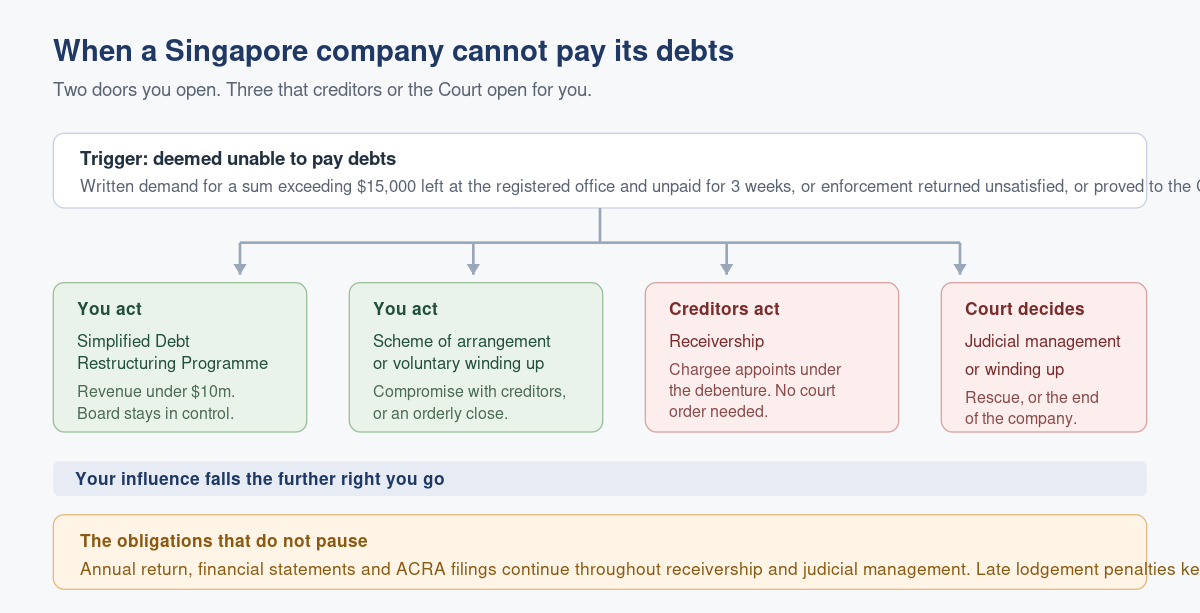
Five things can happen, and only two of them are in your hands. You can restructure, or you can wind the company up voluntarily. Your creditors can appoint a receiver, apply for judicial management, or apply to court to wind you up. Which path you end up on depends largely on how early you act.
Raffles Corporate Services works with a panel of experienced Singapore law firms who offer cost-effective and efficient legal service and advice. This article is general information only and is not legal advice.
Cash flow trouble is not, by itself, a legal event. It becomes one at a specific and quite low threshold. Once a creditor is owed more than $15,000 and serves a written demand at your registered office, you have three weeks before the law presumes you are insolvent. That presumption is the trigger for most of what follows.
The useful thing is to know which door you are standing in front of before someone else opens it for you.
When is a company legally “unable to pay its debts”?
The Insolvency, Restructuring and Dissolution Act 2018 deems a company unable to pay its debts in three situations. Any one of them is enough.
- The statutory demand route. A creditor to whom the company is indebted in a sum exceeding $15,000 then due serves a written demand at the company’s registered office requiring payment, and the company neglects for three weeks to pay, secure or compound for the sum to the creditor’s reasonable satisfaction.
- The unsatisfied enforcement route. An enforcement order or other process issued to enforce a judgment, decree or order of any court in the creditor’s favour is returned unsatisfied, in whole or in part.
- The proof route. It is simply proved to the court’s satisfaction that the company is unable to pay its debts. In deciding that, the court must take into account the company’s contingent and prospective liabilities.
Being unable to pay debts is one of the grounds on which the court may order a company to be wound up. It is also the gateway condition for judicial management, where the test is softer: the company must be, or be likely to become, unable to pay its debts.
Why the statutory demand is the moment that matters
Three weeks is not long, and the demand does not have to be dramatic. It has to be in writing, for a sum exceeding $15,000 that is then due, and left at the registered office. If your registered office is a service address and nobody is reading the post, the clock runs anyway.
You have three realistic responses inside the window: pay it, secure or compound for it to the creditor’s reasonable satisfaction, or dispute it. A genuinely disputed debt is not a proper basis for a winding up application, and there is a settled body of law on how the courts treat that, which we cover in disputed debts and winding up applications in Singapore. If the demand itself is defective or the debt is bad, the route is an application to court, set out in our guide to setting aside a statutory demand.
What you should not do is ignore it, and what you should not do is pay one pressing creditor in full while others go unpaid. Preferences granted in the run up to insolvency can be unwound later.
The five outcomes, compared
| Outcome | Who starts it | What it is for | Who ends up in control | Does the company survive? |
|---|---|---|---|---|
| Simplified Debt Restructuring Programme | The company | Fast, low cost restructuring for smaller companies | The board, with a restructuring adviser | Yes, that is the point |
| Scheme of arrangement | The company or its creditors | Binding compromise with creditors, approved by the court | The board | Usually |
| Receivership | A creditor holding a charge | Enforcing security over charged assets | A receiver appointed by the chargee | Sometimes |
| Judicial management | The company, its directors or a creditor | Rescue under court protection | A judicial manager, as an officer of the court | That is the intention |
| Winding up | The company, a creditor or the court | Orderly realisation and distribution, then dissolution | A liquidator | No |
The Simplified Debt Restructuring Programme
The SDRP sits under the Ministry of Law’s Simplified Insolvency Programme and is built for smaller companies that would be crushed by the cost of a full scheme of arrangement. Eligibility is keyed to annual revenue of less than $10 million.
It exists because the ordinary restructuring machinery was never designed for a company with eleven creditors and a single warehouse. If your numbers put you inside the threshold and the business is fundamentally viable, this is the first door to try. Details and eligibility questions go to the Ministry of Law.
Receivership
If a lender holds a charge over your assets, it does not need to persuade a court of anything. Under the security document it can appoint a receiver, who takes possession of the charged property and realises it for that lender’s benefit. Directors stay in office and keep their filing obligations, but lose control of whatever is charged.
Receivership is the fastest of the five outcomes and the one you have least influence over. It is covered in full in our guide to how a secured lender takes control through receivership.
Judicial management
Judicial management is the rescue option. The company, its directors or a creditor applies to court, and the court may make an order only if it is satisfied the company is or is likely to become unable to pay its debts, and considers the order likely to achieve one of the statutory purposes: survival of the company or its business as a going concern, approval of a compromise or arrangement, or a more advantageous realisation of assets than on a winding up.
A judicial manager must be a licensed insolvency practitioner, cannot be the company’s auditor, and must act in the interests of the creditors as a whole. They are an officer of the court whether or not the court appointed them.
The catch is the floating charge holder. Notice of the application must go to anyone entitled to appoint a receiver and manager over the whole or substantially the whole of the company’s property under a floating charge, and must also be published and sent to the Registrar of Companies. If that person opposes, the court must dismiss the application where it is satisfied that the prejudice to them would be disproportionately greater than the prejudice to unsecured creditors if it were dismissed. In practice, that means your main secured lender has a near veto. Full treatment in our article on judicial management, the moratorium and rescue.
Winding up
Winding up is the end of the company rather than a treatment for it. It can be voluntary, started by the members or the creditors, or compulsory, ordered by the court. A liquidator takes over, realises the assets, distributes according to statutory priority and the company is eventually dissolved.
Once a liquidator is in place, directors’ past conduct becomes a live subject. The liquidator can seek a public examination of officers, which we look at in public examination of company officers under the IRDA.
What goes wrong in practice
Directors keep trading and hope. Once a company is in financial difficulty, directors’ duties shift towards the interests of creditors. Continuing to incur credit you have no realistic prospect of repaying is where personal exposure starts. We examined the current Singapore position in directors’ duties when a company is financially parlous.
Nobody is reading the registered office post. The three week statutory demand clock runs from service at the registered office, not from the day a director happens to see the letter. If your registered office is an address you visit monthly, you have effectively given away most of your window.
The company pays the loudest creditor. Selective payment in the shadow of insolvency is a classic way to turn a company problem into a director problem.
The security position is never checked. Directors are often unclear which assets are charged and to whom. That single question determines whether receivership is even available to a creditor and it takes minutes to answer from the register of charges. Our guide to registering a charge explains what the register does and does not show.
Money held for a specific purpose gets mixed in. Advances made to a company for an identified purpose can in the right circumstances be held on trust and survive its insolvency, rather than falling into the pot for general creditors. That is worth knowing before you commingle it. See Quistclose trusts in Singapore.
Collections were left too late in the first place. A large share of the companies that end up here had a receivables problem, not a profitability problem. Our practical note on accounts receivable and credit control for Singapore SMEs is the boring version of this article, and the cheaper one.
Frequently asked questions
What is the minimum debt that can trigger a winding up application?
A creditor can rely on the statutory demand presumption where the company is indebted to it in a sum exceeding $15,000 that is then due. The demand must be in writing and left at the company’s registered office, and the company must neglect to pay, secure or compound for it for three weeks after service.
Can a creditor wind up my company over a debt I dispute?
Not properly. Winding up is not a debt collection tool for genuinely contested claims, and the court can restrain a petition presented as an abuse of process. But you must raise the dispute, and raise it promptly. Silence during the three week window makes the presumption of inability to pay considerably harder to displace.
Is receivership the same as liquidation?
No. A receiver enforces one creditor’s security over charged assets and owes their primary duty to that creditor. A liquidator winds up the whole company for the general body of creditors and the company is eventually dissolved. A company can be in receivership and still trading, with the directors in office.
Does judicial management stop creditors chasing us?
That is its central benefit. Judicial management places the company under court supervision with a moratorium while a judicial manager tries to rescue it. It is not automatic: the court must be satisfied of the statutory conditions, and a floating charge holder who would be disproportionately prejudiced can have the application dismissed.
Do directors still have to file with ACRA while all this is happening?
Yes, until a liquidator takes over and in some respects beyond. Receivership and judicial management do not suspend the annual return, the financial statements or the other statutory filings. Late lodgement penalties continue to accrue regardless of the company’s financial position.
Can I just close the company and walk away?
Only if it can pay its debts in full within the statutory period, which is what a members’ voluntary winding up requires. If it cannot, the route is a creditors’ winding up or one of the restructuring options, and attempting to strike the company off instead tends to end badly for the directors.
Acting early is the whole strategy
Every option that preserves the business sits at the early end of this timeline, and every option that destroys it sits at the late end. The difference between a Simplified Debt Restructuring Programme and a compulsory winding up is frequently just a few months of denial.
Raffles Corporate Services keeps the statutory and filing side of things in order while directors deal with the commercial problem: the register of charges, the ACRA lodgements that receivership and judicial management trigger, and the annual filings that do not pause because the bank has called. If you are not sure where your company stands or what is charged to whom, that is a short conversation.
You can reach us through Raffles Corporate Services, or read more on Singapore corporate secretarial practice at Singapore Secretary Services. The statutory framework is the Insolvency, Restructuring and Dissolution Act 2018, read with the Companies Act 1967.
— The Editorial Team, Raffles Corporate Services
Need help with this?
Raffles Corporate Services can handle the ACRA filings, compliance documentation and records for you, and where court proceedings or legal advice are needed, we work with a panel of experienced Singapore law firms who offer cost-effective and efficient legal service and advice.
Email: [email protected]
Call, SMS or WhatsApp: +65 8501 7133