

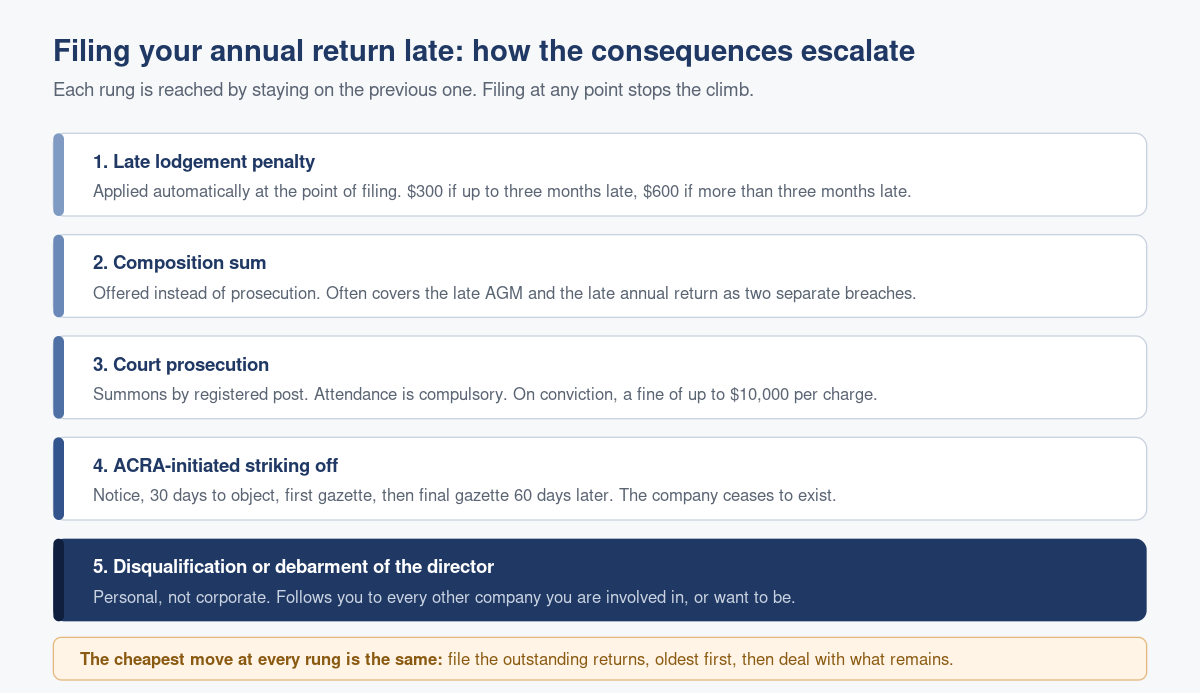
File your annual return late and ACRA charges a late lodgement penalty of $300 if you are up to three months past the deadline, or $600 if you are more than three months past it. That penalty is applied automatically by Bizfile when you file, and it applies to filing deadlines falling on or after 14 January 2022.
Raffles Corporate Services works with a panel of experienced Singapore law firms who offer cost-effective and efficient legal service and advice. This article is general information only and is not legal advice.
Most directors stop reading there, conclude that $600 is survivable, and carry on. That is the expensive misreading. The penalty is a fee for lateness. It is not the sanction for the offence.
The obligation to file sits in section 197 of the Companies Act 1967, and failing to meet it is a breach that ACRA can compound or prosecute, quite separately from the money you pay at the Bizfile checkout. Behind that sit striking off and, for repeat offenders, personal disqualification.
The late lodgement penalty
| How late the filing is | Penalty |
|---|---|
| Up to three months after the deadline | $300 |
| More than three months after the deadline | $600 |
This is the figure that applies to filing deadlines on or after 14 January 2022. It is charged on top of the ordinary $60 filing fee, it is calculated automatically when you submit, and there is no discretion applied at the counter.
Take a non-listed company with a 31 December financial year end and a filing deadline seven months later, on 31 July. Filing on 20 August is twenty days late and attracts $300. Filing on 15 November is more than three months late and attracts $600. That cliff deserves more attention than it gets: if you are already late, filing this week rather than next month may halve the penalty.
If you are still inside your deadline and the accounts are running behind, the better move is an extension of time to file the annual return, which buys up to 60 days for $200. Once the deadline has gone, that door is closed.
Composition: settling without going to court
Rather than prosecute, ACRA may offer a composition sum. Accepting it settles the breach without a court appearance and without a conviction.
The thing to understand is that a late annual return rarely arrives alone. The annual return declares your AGM details, so a company that held its AGM late has usually committed two breaches, not one, and a composition offer may cover both at the same time. In ACRA’s own published illustration of a company with a 31 December financial year end that ran about a month late on both its AGM and its annual return, the composition sum was at least $500 for each breach.
That is the figure worth carrying around. Not $300 or $600, but the realistic total once compounding is added to the late lodgement penalty and the filing fee.
Prosecution in court
ACRA may take the company and its directors to court where the composition is not accepted, where there have been multiple or repeated late filings, or where ACRA decides compounding is not appropriate.
How the process runs
Summons. ACRA sends a summons by registered post to the company’s registered office or to the director’s residential address. It states the court, the date and the time. This is the point at which a stale registered address stops being a paperwork nuisance and becomes a serious problem, because non-receipt is not a defence.
Attendance. A director, or a representative carrying a letter of authority, must attend. This holds even where an appeal is being processed. If the company sends nobody, the court may hear the matter in its absence. If a director personally fails to turn up, a warrant may be issued for their arrest.
Outcome. On conviction, the fine can be up to $10,000 per charge, and a default penalty may also apply. Per charge matters. Several years of unfiled returns are several charges.
Striking off, and losing the company altogether
ACRA can strike a company off the register under section 344(1) of the Companies Act 1967 where there is reasonable cause to believe the company is not carrying on business or is not in operation. Years of unfiled annual returns are the classic evidence of exactly that.
This is not the voluntary striking off a company applies for when it has finished trading. It is done to you, and it runs on a fixed timetable:
- ACRA issues a Striking Off Notice to the company, its directors, secretaries and shareholders.
- You have 30 days from the date of that notice to object. During this period the company’s status is still “Live”.
- If nobody objects, or an objection is disallowed inside that window, ACRA publishes the company in the First Gazette Notification and the status becomes “Gazetted to be Struck Off”. You can still object at this stage.
- If there is still no objection 60 days after the first gazette, ACRA publishes the Final Gazette Notification, the status becomes “Struck off”, and the company no longer legally exists.
A struck off company cannot hold a bank account, cannot sue, and cannot own the assets it used to own. Bringing it back requires a court restoration, and the work does not end when the order is made: the statutory records have to be rebuilt too. Our note on restoring statutory registers and records after a court restoration covers what that involves.
The part that follows the director home
Everything above is corporate. This part is personal.
Under sections 155 and 155A of the Companies Act 1967, ACRA disqualifies a director who is convicted of three or more filing offences within five years, and that disqualification runs for five years. A director who has three or more companies struck off by ACRA within five years is also disqualified: three years for a first occurrence, five years for a repeat.
While disqualified, you cannot act as a director of, or take part in the management of, any local or foreign company.
Separately, a director can be debarred for failing to meet key obligations, including failing to lodge required documents for a continuous period of three months or more. A debarred person cannot take on new appointments as a director or company secretary.
If you sit on several boards, that arithmetic is worth taking seriously. A dormant company you have forgotten about, left unfiled for years, is a live contributor to a personal disqualification count. The wider picture on directors’ obligations under the Act is in our Companies Act 1967 deep-dive FAQ.
What goes wrong in practice
The dormant company nobody closed. A venture wound down in 2021, the bank account was emptied, and everyone moved on without striking the company off properly. The annual returns kept falling due. Five years later a director discovers the problem when a new appointment is blocked.
The registered address that stopped working. The company moved, the address was never updated, the summons went to the old office, nobody attended court, and the matter escalated from a fixable filing default to a warrant.
Filing one year and thinking it is done. Where several years are outstanding, all of them must be filed, oldest first, and each late year carries its own penalty. You cannot jump to the current year.
Waiting for the accounts to be perfect. A company that is already four months late, holding out for a tidier set of accounts, is choosing $600 over $300 and adding to the breach count in the meantime.
If you are not certain which deadline applied to you in the first place, check annual return deadlines and requirements, then work through how to file the annual return on Bizfile.
Appealing a penalty or a summons
A director can appeal to have a penalty reduced or a summons reviewed. You submit ACRA’s Late Lodgment Appeal Form with supporting documents attached.
Review takes about four weeks, longer at peak times or where ACRA needs to come back to you with questions, and each case is assessed on its own facts. One rule matters more than any other: an appeal in progress does not excuse you from attending a scheduled court date. Turn up anyway.
Appeals succeed on evidence of something genuinely outside the company’s control. They do not succeed on the basis that the penalty feels high, or that the company was busy.
Frequently asked questions
How much is the late filing penalty for an annual return in Singapore?
For deadlines on or after 14 January 2022, the late lodgement penalty is $300 if you file up to three months after the deadline and $600 if you file more than three months after it. This is charged on top of the ordinary $60 annual return filing fee, and Bizfile applies it automatically when you submit.
Is the late lodgement penalty the only consequence of filing late?
No. The penalty settles the lateness of the lodgement, not the breach of the filing obligation itself. ACRA may separately offer a composition sum, prosecute the company and its directors in court, strike the company off the register, or disqualify directors with a pattern of filing defaults.
Can a director be personally fined for the company’s late annual return?
Yes. Prosecution can be brought against the company and its directors, and on conviction the fine can be up to $10,000 per charge, with a default penalty also possible. Directors convicted of three or more filing offences within five years are disqualified from directorship for five years.
What happens if my company has not filed annual returns for several years?
File all of the outstanding returns through Bizfile, starting with the oldest, before dealing with anything else. Each year carries its own penalty. Continued non-filing is a common trigger for ACRA-initiated striking off, which begins with a notice giving you 30 days to object.
Can I appeal a late lodgement penalty?
Yes. Directors can submit ACRA’s Late Lodgment Appeal Form with supporting documents to ask for a penalty to be reduced or a summons reviewed. Reviews take roughly four weeks and each case is judged on its merits. You must still attend any scheduled court date while the appeal is pending.
My company received a striking off notice. What do I do?
Object within 30 days of the notice date, through Bizfile, and bring the outstanding filings up to date at the same time. The company’s status remains “Live” during that window. Objections are still possible after the first gazette notification, but the position gets harder, and once the final gazette is published the company no longer exists.
Getting off the ladder
If your company is late, the single most useful thing you can do today is file. Every rung on the escalation ladder is reached by staying on the one below it, and filing is what stops the climb.
If the reason you have not filed is that the accounts are unfinished, or the register does not match reality, or nobody has Corppass access any more, those are all fixable, and they are fixable faster than most directors expect. Raffles Corporate Services regularly takes on companies with several years of outstanding returns, works out the filing order, reconstructs what needs reconstructing and gets them current. We will also tell you plainly when an appeal is worth making and when it is not.
You can reach us through Raffles Corporate Services, or read more on Singapore corporate secretarial practice at Singapore Secretary Services.
— The Editorial Team, Raffles Corporate Services
Need help with corporate secretarial or compliance matters?
If you would like help with your company's corporate secretarial, governance or compliance requirements, email [email protected] or WhatsApp +65 8501 7133.
Our team can assist with corporate secretarial, accounting and tax matters. Where legal advice is needed, advisers from our associated law firms can assist.