

There are five prescribed notices behind a register of registrable controllers, not one. Each has a different trigger, a different recipient and a different consequence if you skip it. Companies that treat the RORC as a spreadsheet to be filled in are usually missing four of the five.
Raffles Corporate Services works with a panel of experienced Singapore law firms who offer cost-effective and efficient legal service and advice. This article is general information only and is not legal advice.
The notices matter because the Companies Act 1967 does not ask you to know who your controllers are. It asks you to take reasonable steps to find out, and it defines part of what reasonable steps means by reference to notices you must send. If you never sent a notice, you have not taken the steps, whatever the register says.
ACRA publishes the templates. This article explains the system they sit inside.
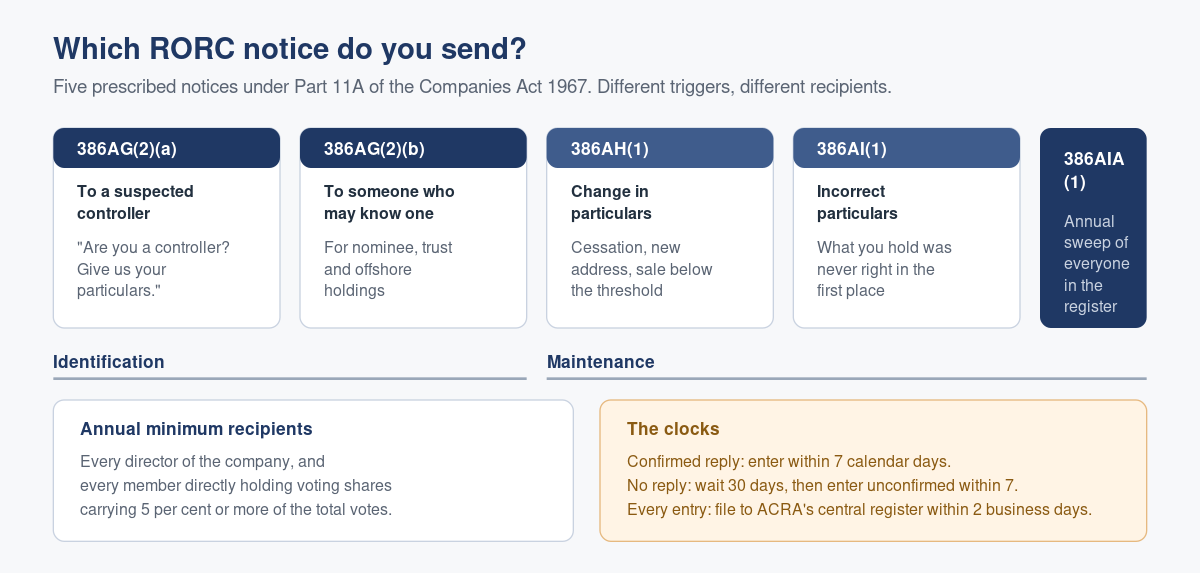
The five notices, mapped
Each notice is tied to a provision of Part 11A of the Companies Act 1967. Limited liability partnerships have a parallel set under the Limited Liability Partnerships Act 2005.
| Notice | Companies Act provision | LLP equivalent | Who receives it | What triggers it |
|---|---|---|---|---|
| Notice to a suspected controller | Section 386AG(2)(a) | Section 48(2)(a) | Anyone you know or reasonably believe is a registrable controller | Setting up the register, and annually thereafter |
| Notice to someone who may know a controller | Section 386AG(2)(b) | Section 48(2)(b) | Anyone you know or reasonably believe knows, or is likely to know, who a controller is | Same, where the controller is not directly identifiable |
| Notice of change in particulars | Section 386AH(1) | Section 49(1) | The controller concerned | You know or reasonably believe a relevant change has occurred |
| Notice of incorrect particulars | Section 386AI(1) | Section 50(1) | The controller concerned | You know or reasonably believe the particulars you hold are wrong |
| Annual confirmation notice | Section 386AIA(1) | Section 50A(1) | Every controller already in the register | Once every calendar year |
Notice one and two: finding out who the controllers are
The first two notices do the identification work, and they pair up.
The 386AG(2)(a) notice goes to a person or entity you think is a controller. It asks them to confirm whether they are, and to supply their particulars.
The 386AG(2)(b) notice goes to a person you think knows who the controller is, or is likely to know. This is the notice for the situation where the shares are held by a nominee, a trustee or an offshore vehicle and the name behind it is not visible to you.
The annual minimum
Taking reasonable steps is not a one-off. As a minimum, a company should be sending these notices every year to:
- Each director of the company. Every one, not just the executive ones.
- Each member who directly holds voting shares carrying at least 5 per cent of the total votes in the company.
That 5 per cent figure is well below the 25 per cent controller threshold, and deliberately so: a 5 per cent shareholder may be the person who knows who the real controller is.
You do not have to send a notice to someone who has already given you accurate information. If a controller has already confirmed their particulars and nothing has changed, the notice would be an empty exercise. But document why you decided not to send it, because that decision is exactly what an inspection will question.
Notices three and four: keeping it current
The 386AH(1) notice deals with change. A relevant change is either someone ceasing to be a registrable controller, or any other change that makes the particulars in your register incorrect or incomplete. New residential address, new passport, a company that has moved its registered office, a controller who has sold down below the threshold.
The 386AI(1) notice deals with error: particulars in the register that were never right in the first place.
The trigger for both is knowledge or reasonable grounds for belief. Credible information counts. If a newspaper report, a bank query or a law enforcement approach tells you that what you hold is out of date, that is reasonable grounds and the notice should go out.
Notice five: the annual confirmation
This is the newest of the five and the one most companies have not yet built into their calendar. Every calendar year, a company must give notice to every registrable controller whose particulars appear in the register, asking whether any change has occurred and whether any of the particulars are incorrect.
Note the difference from notices three and four. Those are triggered by suspicion. This one is triggered by the calendar, whether or not you suspect anything. It is a positive annual sweep.
What a valid reply now has to contain
The reply is not just an email saying “yes, that’s me”. The particulars or new particulars provided must be accompanied by:
- a statement by the controller that the information given is true and accurate; and
- the controller’s signature, with the date of signature immediately below that statement.
This is a meaningful change. A reply without the declaration and dated signature does not “confirm” the particulars, which means your clock does not start and, strictly, you are in the not-confirmed position described below.
The clocks that start when you send
This is where companies lose control of the process, so here they are in one place.
| Event | Deadline |
|---|---|
| Particulars confirmed by the controller | Enter or update the register within 7 calendar days |
| No reply to a notice | Wait 30 days from the date the notice was sent, then enter the particulars you hold, with a note that they are unconfirmed, within a further 7 calendar days |
| Company concludes it has no identifiable registrable controller | Enter the note and the particulars of each director with executive control and each CEO within 2 business days |
| Any entry or update made in the register | File it to ACRA’s central register within 2 business days |
The “no reply” rule surprises people. Silence from a controller does not excuse you. You enter what you have, flagged as unconfirmed, and you keep the evidence of the notice you sent.
How to send them, and what to keep
Notices can be sent electronically or on paper. There is no requirement for registered post, and the notice does not need to be signed by a director or the company secretary.
That makes sending them easy and proving you sent them hard, which is the wrong way round. Keep:
- a dated copy of every notice sent, and to whom;
- the reply, with its signed and dated true-and-accurate declaration;
- the identity documents behind each entry (NRIC for citizens and permanent residents, passport plus address verification for foreign individuals, certificate of registration plus address verification for foreign entities); and
- a short file note wherever you decided a notice was unnecessary.
The Registrar, ACRA officers and public agencies including the Police, the Commercial Affairs Department, CPIB and IRAS can require the register and any document relating to it. The documents are half the compliance.
What goes wrong in practice
Only the first notice is ever sent. The company identifies its controllers at incorporation, files, and never touches the process again. The annual confirmation notice alone makes that indefensible.
The 5 per cent list is never refreshed. Shareholdings move. The list of members who must receive an annual notice moves with them, and nobody rebuilds it.
Replies come back as WhatsApp messages. No declaration, no signature, no date. The information may be perfectly true, but it has not been confirmed in the way the Regulations require.
The two-business-day filing to the central register is missed. Companies update the register diligently and forget that ACRA holds a central register too, which must mirror it within two business days of every entry or update. The internal register being right is not the end of the obligation.
Nobody notices the register is separate from everything else. The controller register is not the register of members, is not the register of nominee directors, and is not the register of nominee shareholders. Four different tests, four different registers. Our piece on registrable controllers in practice works through the structures where the answers diverge.
Frequently asked questions
Do we have to use ACRA’s exact templates?
The forms of notice are prescribed in the Regulations, and ACRA publishes templates that follow them. Using the published templates is the safe route. If you produce your own, it must contain everything the prescribed form requires, which in practice means the templates are simpler.
Can we email the notices?
Yes. Notices may be sent electronically or in hard copy, registered post is not required, and no director or secretary signature is needed on the notice itself. Keep proof of sending.
What if a controller refuses to reply?
Wait 30 days from the date you sent the notice, then enter the particulars you already hold into the register with a note recording that the controller has not confirmed them. You have 7 calendar days after that 30-day period to make the entry.
We are an exempt company. Do the notices still matter?
If your company is exempt from keeping a register, you do not send these notices for your own register. But the exemption does not remove a controller’s duty to provide information to other companies. If your exempt company is a controller of a non-exempt company, it must respond to that company’s notice.
Are there separate notices for LLPs?
Yes. The Limited Liability Partnerships Act 2005 contains a parallel set of prescribed notices, and ACRA publishes those templates alongside the Companies Act ones. The structure is the same: identification, change, correction and annual confirmation.
Who can see the register once we have built it?
Not the public and not your auditors. Companies must decline requests for access, including from their own members. The register goes to the Registrar and to public agencies on request, and nowhere else.
Running the notice cycle without thinking about it
Five notices, three clocks and an annual sweep is not difficult. It is just easy to drop, because nothing external reminds you until ACRA or a bank asks.
Raffles Corporate Services runs this cycle for Singapore companies as a standing item: the annual notices go out, the replies are collected in the form the Regulations require, the register is updated inside seven days and the central register is filed inside two business days. If you are not certain when your company last sent a controller notice, that is usually the answer.
Further reading: ACRA’s page for the RORC form of notice templates, the Companies Act 1967 on Singapore Statutes Online, our Companies Act 1967 deep-dive FAQ, and the Corporate Service Providers Act 2024 compliance FAQ if you keep registers on behalf of clients.
— The Editorial Team, Raffles Corporate Services
Need help with corporate secretarial or compliance matters?
If you would like help with your company's corporate secretarial, governance or compliance requirements, email [email protected] or WhatsApp +65 8501 7133.
Our team can assist with corporate secretarial, accounting and tax matters. Where legal advice is needed, advisers from our associated law firms can assist.