
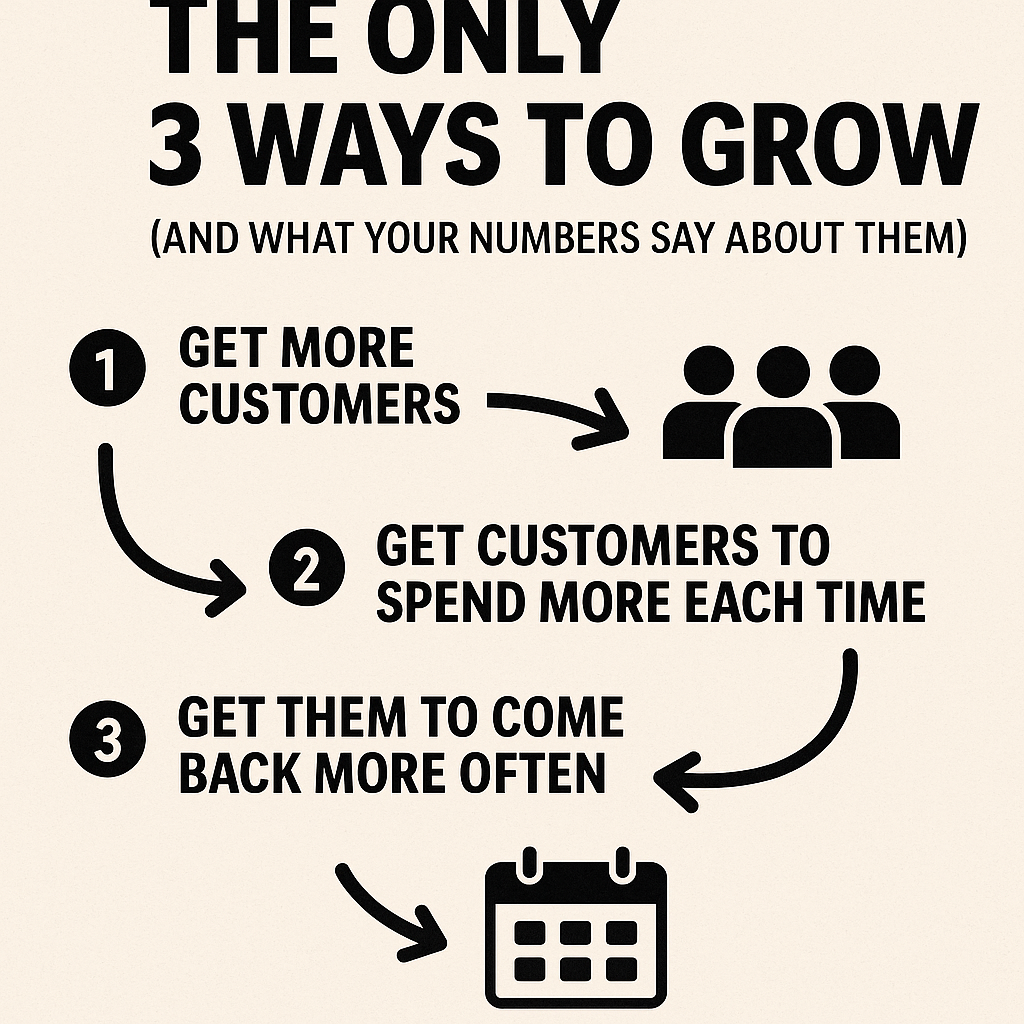
Most business owners I meet want growth — more sales, more profit, more cash. But growth often feels messy and complicated.
Raffles Corporate Services works with a panel of experienced Singapore law firms who offer cost-effective and efficient legal service and advice. This article is general information only and is not legal advice.
The truth? There are really only three levers to pull. This idea comes from Jay Abraham, a legendary business strategist. And the beauty is, your numbers already show you how you’re doing in each area.
Let’s break it down.
1. Get More Customers
One of my clients runs a small neighbourhood bakery. The nature of the business meant their customer catchment was limited — mostly people living or working within 2km of the shop. Sales plateaued after a few years.
With some strategic planning, they decided to pivot: instead of competing head-to-head with every other bakery nearby, they started making sugar-free, diabetic-friendly bakes that were still delicious.
Suddenly, their customer base wasn’t just the neighbourhood. Orders started coming in from across the island. People weren’t buying because it was convenient — they were buying because the product solved a very specific need. Within a year, the bakery doubled its sales as the number of customers grew beyond its immediate catchment.
Numbers to watch: total sales revenue, and if possible, customer count (or estimate it by dividing sales by average spend).
Questions to ask yourself:
-
Am I spending more on marketing than the lifetime value of the customer I acquire?
-
Do I know where new customers are coming from (referrals, ads, partnerships)?
2. Get Customers to Spend More Each Time
Recently I went to McDonald’s drive-through for dinner. The aim: to get McNuggets, nothing else. At the counter, the staff offered me the chance to purchase a time-limited promotion: McDonald’s Singapore had teamed up with legendary lifestyle brand tokidoki to release a limited-edition charm collection, reimagining beloved McDonaldland characters with a quirky flair. The cost? $7.90 a piece.
As if buying one wasn’t enough, the sales person leaned in and asked, “Do you want to get the full set?” Suddenly I wasn’t just buying dinner — I was buying collectibles. I ended up paying $8.40 for the 6-piece McNugget meal, plus $7.90 × 2 for two keychains I never intended to buy in the first place.
In other words, McDonald’s turned a simple $8.40 dinner into a $24.20 bill. That’s a 188% increase in spending from the same customer (me), all without acquiring anyone new.
That’s the power of this lever: you don’t need to bring in more customers if you can persuade existing ones to spend more per visit.
Numbers to watch: average transaction value (Sales ÷ Number of Transactions), and gross profit margins (are your upsells profitable?).
Questions to ask yourself:
-
What’s the simplest “add-on” I can offer today?
-
Am I pricing my services based on value, or just cost + markup?
3. Get Them to Come Back More Often
Another client of mine is a home-based business owner who works as a personal trainer and also provides meal prep for clients. Initially, the meal prep side was run on-demand — clients would place orders whenever they felt like it. Sales were unpredictable, last-minute cancellations were common, and inventory planning was a nightmare.
With a small tweak, we shifted the model to subscriptions. Clients committed to a meal plan for a fixed number of months. This simple change transformed the business. Revenue became more predictable, inventory was easier to manage, and clients stayed consistent with their meal plans. The trainer didn’t just sell more — he built loyalty and stability into the business.
Numbers to watch: invoices per customer, repeat purchase data, or subscription commitments.
Questions to ask yourself:
-
Do I know who my repeat customers are?
-
Can I create a simple system (loyalty program, retainer, subscription) to encourage return?
The Overlooked Point
These three levers don’t work in isolation. If you increase average spend but neglect repeat visits, customers might churn faster. If you grow repeat purchases but margins are thin, cash flow may still suffer.
Smart growth means balancing all three levers, not maxing out just one.
Takeaway
Your numbers aren’t just history — they’re a growth dashboard. Break down “sales” into these three levers, and suddenly the path forward becomes clearer.
Action step: Pull out your last 6 months’ sales data. Can you roughly split growth (or decline) into one of the three levers? That’s where you should focus next.
How Raffles Corporate Services can help
If you would like to enquire about our corporate secretarial, accounting or tax services, email [email protected] or WhatsApp +65 8501 7133.
Our team and tax advisers can assist with your business requirements. Where legal advice is needed, advisers from our associated law firms can assist.