

If your company issued shares that were not paid for in full, and a shareholder has since paid some or all of the balance, you file a notice to update paid-up share capital in Bizfile. It is free, it takes effect immediately, and it is the only way ACRA’s record catches up with your bank statement.
Raffles Corporate Services works with a panel of experienced Singapore law firms who offer cost-effective and efficient legal service and advice. This article is general information only and is not legal advice.
Most Singapore private companies never need this filing, because most issue shares fully paid on day one. If that is you, you can stop reading and go to the alteration of share capital guide instead.
But partly paid shares are more common than people assume, particularly in companies that were set up quickly with a large nominal capital and a small cheque, or in joint ventures where one party’s contribution was staged.
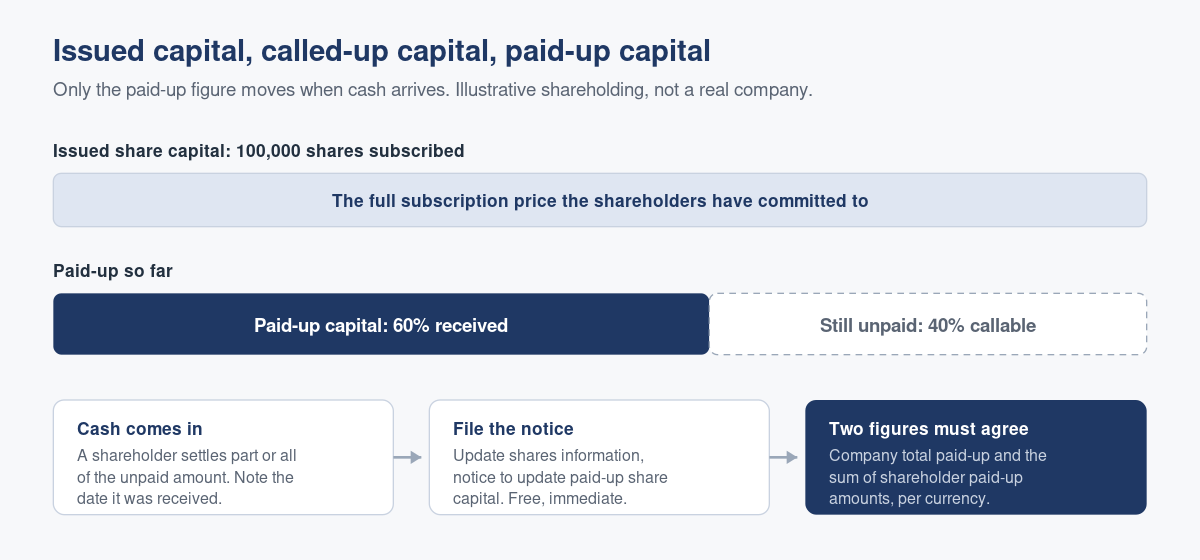
What “paid-up” actually means
There are three figures in play and they are routinely confused, including in board papers.
| Figure | What it means | Does the Bizfile notice change it? |
|---|---|---|
| Issued share capital | The shares the company has actually issued, at the price the subscribers agreed to pay | No. That changes on allotment, transfer, alteration or reduction |
| Called-up capital | The portion of the issue price the company has formally demanded from shareholders | No. That is an internal board act, recorded in the minutes |
| Paid-up capital | The portion of the issue price that has actually been received | Yes. This is precisely what the notice updates |
| Unpaid capital | The balance still owing on issued shares, which remains a liability of the shareholder | Indirectly. It falls as paid-up capital rises |
The distinction matters commercially. Unpaid capital is not a theoretical figure. It is money the company can call on, and a shareholder holding partly paid shares carries a real obligation to pay the rest. Liquidators are fond of that fact. So are banks assessing what cushion sits behind a facility.
If the accounting side of this is the part that is fuzzy, our note on the accounting treatment of share capital, share premium and reserves explains how these amounts sit in the financial statements.
When this filing applies, and when it does not
Use the notice to update paid-up share capital when:
- A shareholder pays part or all of the outstanding amount on shares already issued
- The company calls up a previously uncalled amount and the money is received
- The total paid-up figure for a particular currency needs to move as a result
Do not use it when:
- You are issuing new shares. That is a return of allotment, a different filing with different information requirements
- You are capitalising reserves into new shares, which is a bonus issue followed by an allotment filing
- You are reducing capital. That has its own statutory process and its own risks, set out in our guide to reducing share capital by solvency statement or court order
- You are consolidating, subdividing, converting to stock or cancelling unissued shares, all of which are alterations under Section 71 of the Companies Act 1967
Only local companies with partially paid-up shares can file this notice. If every share on the register is fully paid, the eService has nothing to do.
It is also not the filing for a change in a shareholder’s own particulars, such as a new address or a change of name. That has its own route, covered in our guide to updating shareholder information with ACRA. ACRA gathers all of these under shares and updating share information, which is worth bookmarking if you file more than occasionally.
What to have in front of you before you start
Two things, and both are more precise than people expect:
- The date the paid-up amount changed. Use the date the company received the money, which you can evidence from the bank statement, not the date somebody noticed or the date you are filing.
- The updated paid-up amount for each affected shareholder, per currency. Not the amount paid this time. The new cumulative paid-up figure for that shareholder in that currency.
That second point is where the mistakes live. The form asks for a state, not a movement. If a shareholder had paid $30,000 and has now paid a further $20,000, the figure you enter is $50,000.
The steps, in order
You will need Corppass access to the entity as a business user. If that is not yet set up, deal with it first, because nothing below will work without it.
- Log in to Bizfile through Corppass and confirm the entity name on the top menu bar is the company you intend to file for.
- From the menu, open the Update shares information eService. Scroll to the list of share eServices at the foot of the introduction page and select the notice to update paid-up share capital, then start. If you saved a draft earlier, continue with that instead.
- Check the entity details on the first screen, enter the date of change, and continue.
- If the company-level total paid-up share capital is changing, update it: choose the currency, enter the new paid-up amount and save. Add a second currency if the company has capital denominated in more than one.
- Move to the shareholding details and update the individual or corporate shareholder amounts. Select the shareholder, choose the currency, enter their new paid-up amount and save. If the shares are held on trust, the trust name can be recorded here too.
- Repeat for each shareholder affected, and for each currency where a shareholder holds capital in more than one.
- Review every figure on the confirmation page, tick the declaration and submit.
Fee: nil. Effect: immediate. You will get an on-screen acknowledgement and a notification in your Bizfile inbox confirming the updated share information, which is the document to file in the company’s records.
A note on multiple currencies
A Singapore company may have share capital in more than one currency, and the eService handles each currency as its own line. The totals do not get converted and netted. If you have SGD and USD capital, you update each separately at company level and again at shareholder level. Mixing them up produces a register that looks arithmetically wrong to anyone reading it later.
What goes wrong in practice
The company total and the shareholder totals do not agree. This is the most frequent failure. Someone updates the headline paid-up figure but forgets one shareholder, or updates the shareholders and skips the company total. The record then says one thing at entity level and another at member level, and the first person to notice is usually an auditor or a bank.
The movement is entered instead of the cumulative balance. The paid-up figure drops instead of rising, and unpicking it means a second filing or a notice of error.
The date of change is the filing date. Money received in February, filed in November, dated November. The company’s own accounts will say February. Now two official records disagree about when the capital was paid, which is exactly the kind of small inconsistency that becomes a long email chain during due diligence.
Calls are made informally. A director asks a shareholder to “put in the rest of the money” without a board resolution making the call. The payment arrives, the filing goes in, and there is no minute anywhere authorising it. The filing is not wrong, but the corporate record is thin in a place where it should not be.
Nothing is filed at all. The money came in, the bookkeeper credited share capital, and nobody told ACRA. The public record then understates the company’s paid-up capital, which matters whenever paid-up capital is used as a qualification threshold, including for certain licences and certain immigration and tender assessments. If a counterparty checks the register and sees a lower figure than you told them, you have a credibility problem before you have a compliance one.
The wrong eService is used entirely. Issuing new shares and paying up existing ones feel similar and are not. If you are unsure which one your transaction is, our Companies Act 1967 deep-dive FAQ is a reasonable place to start, and a corporate secretary is a better one.
Frequently asked questions
Does it cost anything to update paid-up share capital?
No. There is no filing fee for the notice to update paid-up share capital, and the update takes effect immediately on submission. You will receive a confirmation in your Bizfile inbox. Keep that with the bank evidence of the payment and the board minute recording the call.
What date should I enter as the date of change?
The date the company actually received the payment, evidenced by the bank record. Not the date you file, and not the date the board resolved to make the call. Using the filing date creates a mismatch between ACRA’s record and your financial statements that someone will eventually query.
Do I file this when I issue new shares?
No. New shares are notified through a return of allotment, which captures the number of shares, the consideration and the allottees. The paid-up capital notice is only for updating the amount paid on shares that have already been issued but were not fully paid.
My shareholder has paid in a different currency. Can I record that?
Yes. Share capital can be denominated in more than one currency, and the eService lets you update each currency separately, both at company level and for each shareholder. Do not convert one currency into another to make the totals tidy. Record each line as it stands.
Who can file the notice?
An authorised officer of the company with the right Corppass e-service assignment, or a registered corporate service provider acting for the company. The responsibility for the accuracy of the figures stays with the company’s directors regardless of who presses submit.
What happens if a shareholder never pays the balance?
The unpaid amount remains a debt owed to the company and can be called up while the company is solvent, and will very likely be called up by a liquidator if it is not. Partly paid shares are a live obligation, not a formality, and shareholders should be told that in writing when the shares are issued.
Getting the capital record right
Paid-up capital is one of the few numbers about your company that strangers read before they meet you. Banks read it. Landlords read it. Government assessors read it. It is worth being accurate, and it costs nothing to file.
Raffles Corporate Services files share transactions for Singapore companies, keeps the entity-level and member-level figures in step, and reconciles the register against the accounts before year end. If you suspect your paid-up capital on the public record is not what your accounts say, that is a quick check and usually a quick fix.
You can reach us through Raffles Corporate Services, or read more on Singapore corporate secretarial practice at Singapore Secretary Services.
— The Editorial Team, Raffles Corporate Services
Need help with corporate secretarial or compliance matters?
If you would like help with your company's corporate secretarial, governance or compliance requirements, email [email protected] or WhatsApp +65 8501 7133.
Our team can assist with corporate secretarial, accounting and tax matters. Where legal advice is needed, advisers from our associated law firms can assist.