
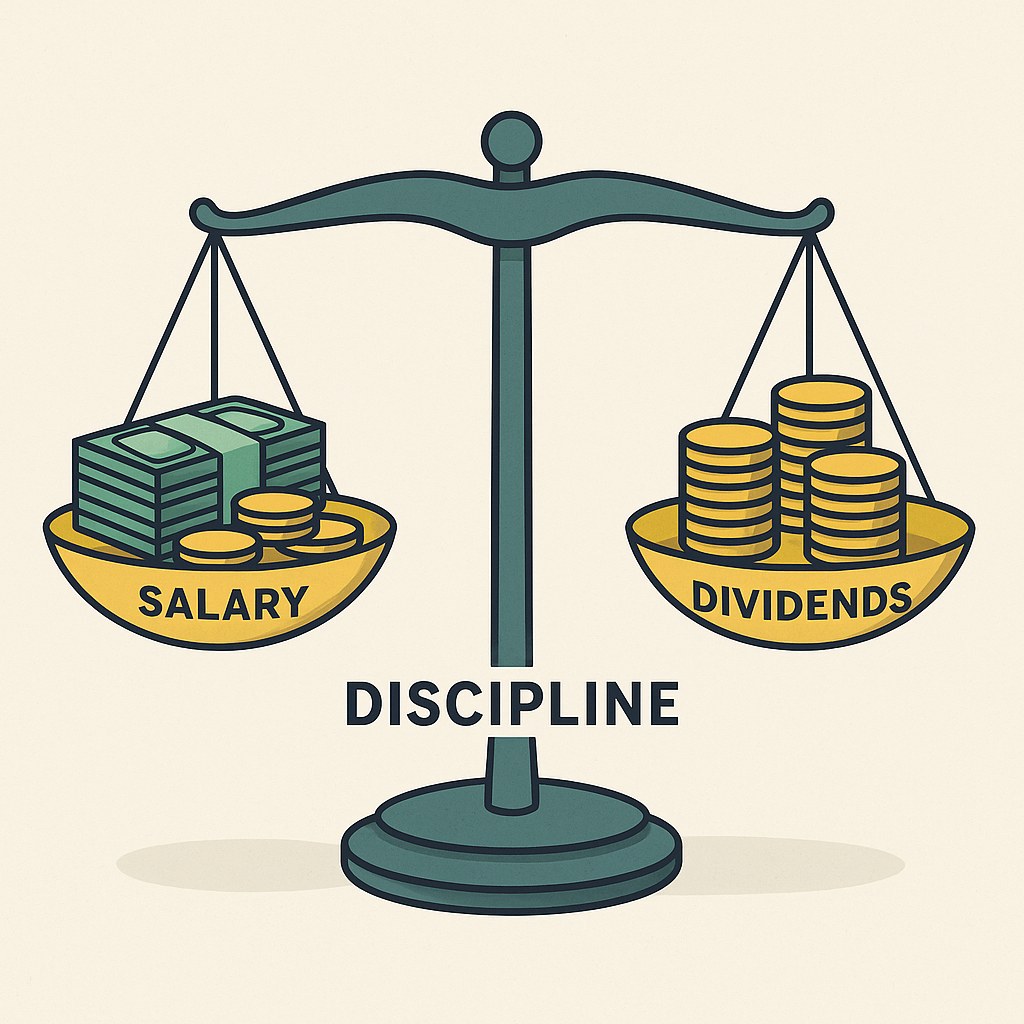
Deep Dive: Paying Yourself Right — Salary, Dividends, and Discipline
Most SME owners I meet have the same blind spot: they don’t have a clear system for paying themselves. Some skip salary altogether. Others withdraw cash whenever they need it and later call it “dividends.”
Raffles Corporate Services works with a panel of experienced Singapore law firms who offer cost-effective and efficient legal service and advice. This article is general information only and is not legal advice.
On the surface, it works. But beneath that, it creates blind spots — overstated profits, compliance risks, and weaker financials when you most need credibility (e.g., loans, investors).
Here’s how to think about owner pay in Singapore, and why a disciplined approach matters more than you think.
1. The hidden cost of “no salary”
If you don’t book an owner salary, your P&L looks better than reality.
-
Profit is overstated. Example: you show $100,000 profit. But if a fair owner salary is $120,000, you’re really running at a $20,000 loss.
-
Break-even is understated. You’ll think your business can sustain lower prices or higher overhead than it really can.
-
External parties adjust for it anyway. Bankers and investors normalise for owner pay. Better that you do it first — it shows discipline.
👉 Action: Set a modest, recurring salary so your accounts reflect the true cost of running the business.
2. “Just call it a dividend” — the trap
I see this often: owners withdraw cash at random and, to avoid personal income tax, later coin it as “dividend.”
The problem:
-
Dividends must come from profits. If the company wasn’t profitable, it’s not a dividend.
-
It needs a proper resolution. Without minutes, vouchers, and registers, it can be reclassified.
-
Other risks. It might end up booked as a director’s loan (and if interest-free, the benefit is taxable). Or it could be deemed remuneration, and taxed as employment income.
👉 Action: If you want to pay a dividend, do it properly — check profits, pass a resolution, issue documents. Anything else is just a messy withdrawal waiting to be untangled.
3. The three buckets of owner pay
Think of your paycheck in three distinct forms:
-
Salary → predictable, CPF applies, deductible for the company. Great for personal bills and retirement.
-
Director’s fees → taxable to you, CPF generally not payable, must be shareholder-approved. Useful if you don’t want fixed monthly salary.
-
Dividends → paid from after-tax profits, tax-exempt to most shareholders in Singapore. Not a company expense, no CPF.
Each has a role. The danger is when you blur the lines.
4. A simple “Owner Pay Stack”
Here’s a structure I recommend:
-
Base salary — small, steady, for bills + CPF.
-
Top-up with dividends — only when there are real profits and cash buffer intact.
-
Leave the rest as retained earnings — strengthens your balance sheet, signals resilience.
Write it down as an Owner Pay Policy. It can be one page, but it keeps you and your accountant on the same track.
5. Other risks to watch
-
Director loans snowball. Random drawings often end up booked here — creating taxable perks and clean-up headaches.
-
CPF blind spot. Skipping salary skips CPF. That’s your retirement at stake.
-
Minority fairness. If you have co-shareholders, undocumented withdrawals look like leakage. Proper dividends keep things transparent.
-
Bankability. Clean, disciplined owner pay makes financials stronger and borrowing easier.
6. If you’re already in a tangle
-
Map out 12 months of withdrawals.
-
Reclassify correctly (salary, dividend, loan).
-
Paper it properly (board minutes, vouchers, agreements).
-
Put a policy in place going forward.
It’s better to fix it now than wait for IRAS — or your banker — to ask awkward questions.
Pro Tip: Don’t Game the System with Low Salary + High Dividends
This one’s especially for professionals — doctors, dentists, consultants — who set up companies mainly as a tax vehicle.
A common tactic is to:
-
Pay themselves an unusually low salary (or none at all), and
-
Take most of the company’s profits as dividends (since dividends in Singapore are tax-exempt).
On paper, it reduces personal tax. But here’s the risk:
-
IRAS may see through it. If the arrangement has no real commercial substance, they may reclassify part of the dividends as employment income.
-
Why? Because if you are the business (i.e., the company has no other employees generating the income), then paying yourself below-market wages while calling the rest “dividends” looks like tax avoidance.
👉 Action: If you’re essentially the main breadwinner of the company, pay yourself a fair market salary first. Dividends should be a reward for ownership and risk-taking, not a substitute for proper remuneration.
Zooming Out — Why This Matters Beyond Just Your Pay
When you systemise how you pay yourself, three things happen:
-
Your numbers tell the truth. You stop running a business that looks profitable only on paper.
-
You become future-proof. Whether it’s IRAS tightening rules, CPF rates creeping up, or lenders scrutinising accounts, you’re already a step ahead.
-
You lead by example. Your employees and partners see discipline at the top, and it cascades through the company.
Too many SME owners treat their company like a personal wallet. That works in the short term, but over time it holds back growth. The ones who scale are the ones who treat themselves like proper employees and shareholders — with structures, not shortcuts.
✅ Final Takeaway
Paying yourself is not just about money in your pocket. It’s about the story your financials tell, the discipline you build, and the options you unlock for the future.
So: salary for truth, dividends for reward, buffers for growth. Get that right, and your business — and your life — runs smoother.
👉 Not sure if your owner pay is structured right? This is one of the most common issues I help SME clients fix. Get it right once, and your financials (and sleep) will thank you.
Need help with this?
Raffles Corporate Services can handle the ACRA filings, compliance documentation and records for you, and where court proceedings or legal advice are needed, we work with a panel of experienced Singapore law firms who offer cost-effective and efficient legal service and advice.
Email: [email protected]
Call, SMS or WhatsApp: +65 8501 7133