

The Business Names Registration Act 2014 is the statute that decides whether you must register your business with ACRA at all, what name you are allowed to trade under, and what happens when you stop. It is short, it is readable, and almost nobody running a sole proprietorship has ever opened it.
Raffles Corporate Services works with a panel of experienced Singapore law firms who offer cost-effective and efficient legal service and advice. This article is general information only and is not legal advice.
It came into force on 3 January 2016, replacing the old Business Registration Act. The headline change was the exemption: an individual trading under nothing but their own full name no longer has to register. That single rule is the reason so many small operators are confused about whether they are inside the system or outside it.
The Act does not govern companies, limited liability partnerships or registered foreign companies trading under their own registered names. Those are exempt by name. What it governs is the layer beneath: sole proprietors, general partnerships, and anyone trading under a name that is not their own.
What follows is a map of the Act, not a summary of it.
The shape of the Act
The Act is published free on Singapore Statutes Online, and its subsidiary legislation sits alongside it. There are three Parts and forty-five sections, which makes it one of the more approachable pieces of Singapore corporate legislation.
| Part | Sections | What lives there |
|---|---|---|
| Part 1, Preliminary | 1 to 4 | Definitions, the Registrar, and the list of people who do not have to register at all |
| Part 2, Registration | 5 to 31 | The whole life cycle: registering, naming, renewing, changing, ceasing, restoring |
| Part 3, Miscellaneous | 32 to 45 | Inspection, bankrupts, offences, composition, regulations |
Two definitions in section 2 do a great deal of quiet work. “Business” includes every form of trade, commerce and profession and any other activity carried on for the purposes of gain, but expressly excludes any office, employment or occupation. And a person who has a place of business in Singapore is treated as carrying on business in Singapore. The second one catches people who assume a foreign base keeps them outside the Act.
Who actually has to register?
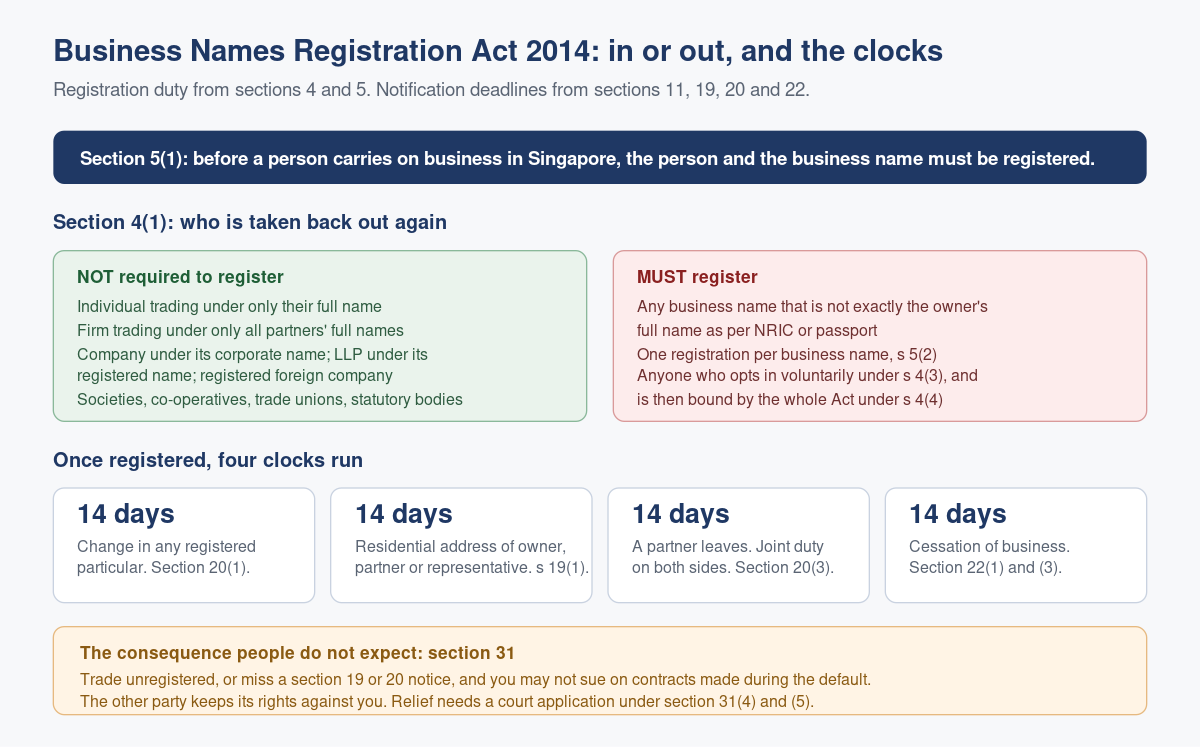
Section 5(1) states the rule in one line: before a person carries on business in Singapore, the person and the person’s business name must be registered. Section 5(2) adds that if you trade under more than one business name, each name needs its own separate registration.
Then section 4(1) removes a long list of people from that obligation. The ones that matter to a small operator:
- An individual proprietor carrying on business under only their full name. No registration required.
- A firm of two or more individuals carrying on business under only the full names of all the individuals. Same.
- Certain regulated professions where practice is restricted by written law to people holding prescribed qualifications whose names are on a statutory register, subject to regulations that can switch the exemption off.
- Companies trading under their corporate name, LLPs under their registered name, and registered foreign companies under their registered name. They are already registered elsewhere.
- Societies, co-operatives, trade unions, mutual benefit organisations and statutory bodies.
The word doing the work in the first two is only. “Full name” is defined in section 2 as the name on your latest identity card, or, if you are not registered under the National Registration Act 1965, the name on your latest passport. Trading as “Tan Wei Ming” is exempt. Trading as “Tan Wei Ming Design” is not. Add a single descriptive word and you are inside the Act.
Section 4(3) allows most exempt persons to register voluntarily anyway, and section 4(4) is the sting: once you choose to register, you must comply with the whole Act for as long as you stay registered. Voluntary registration is not a free badge. It is an opt-in to a compliance regime.
Who lodges the application
Section 6 sets out the particulars: the business name, the general nature of the business, the principal place of business, and the full name, identification, nationality, residential address and contact address of each individual proprietor or partner. It also defines who is an “appropriate person” to lodge. Since 9 June 2025, that list includes a registered corporate service provider authorised by and acting for the applicant, a change made by the Corporate Service Providers Act 2024.
The name rules, which are stricter than people expect
Registration does not give you ownership of the name. Section 10 says so directly, and section 15(3) adds that registering a name does not authorise its use if that use is prohibited under some other law. A registered business name is not a trade mark and gives you no defence to an infringement claim.
Section 17 is where names get refused. The Registrar must refuse a name that is undesirable, identical to another registered business name or to the name of a corporation or limited partnership, identical to a name already reserved, or of a kind the Minister has directed the Registrar not to accept.
Section 17(2) adds waiting periods before a dead entity’s name can be reused. These are worth knowing before you fall in love with a name:
| Previous holder of the name | Waiting period before reuse |
|---|---|
| A business registration cancelled or ceased under the Act | At least 1 year after cancellation or cessation |
| A company dissolved following winding up | At least 2 years after dissolution |
| A company dissolved after being struck off | At least 6 years after dissolution |
| A foreign company whose dissolution was notified to the Registrar | At least 2 years after dissolution |
| An LLP dissolved after winding up, or after striking off | At least 2 years, or 6 years respectively |
| A limited partnership cancelled or dissolved | At least 1 year |
Section 16 lets you reserve a proposed name before you commit. The Registrar may approve only if the application is made in good faith and the name would be registrable. An approved reservation runs for 60 days from the date you are notified, extendable by a further 60 days on a good faith application.
The provision people never see coming is section 17(4). Even after your name is registered, the Registrar may direct you to change it, including where your name so nearly resembles an existing corporate or business name as to be likely to be mistaken for it, or where a court has restrained its use by an injunction under the Trade Marks Act 1998. You then have six weeks to comply unless the Registrar allows longer. Under section 17(6), any member of the public can apply for such a direction, and on the “nearly resembles” ground they must do so within 12 months of your registration. Under section 17(8), failing to comply with the direction is a ground for cancelling your registration. There is an appeal to the Minister under section 17(9), within 30 days, and the Minister’s decision is final.
Our guide to changing a company name in Singapore covers the parallel process on the companies side.
The clocks you are running
Almost every enforcement problem under this Act comes from one of four deadlines.
- Change in registered particulars: 14 days. Section 20(1) requires notice within 14 days after the change, or such further period as the Registrar allows on application. Section 20(2) carves out two things that have their own routes: a change of residential address and a change of business name.
- Change of residential address: 14 days. Section 19(1) applies to a registered individual proprietor, a partner of a registered firm, and an authorised representative. Section 19(2) gives a useful shortcut: if you reported the change under section 10 of the National Registration Act 1965, you are taken to have told the Registrar as well.
- A partner leaving: 14 days. Section 20(3) requires both the departing partner and the continuing partners to lodge notice of the cessation. It is a joint obligation, which is exactly why it gets missed after an acrimonious split.
- Ceasing business: 14 days. Section 22(1) requires notice within 14 days after you stop trading under the registered name. Section 22(3) makes failure an offence carrying a fine not exceeding $5,000. Section 22(2) lets the Registrar accept advance notice of a future cessation date, which is the cleaner way to do it.
ACRA’s published late lodgement penalty for filings due on or after 9 December 2024 is $50 where the default is within three months and $200 where it runs beyond three months. Our note on ACRA late lodgement penalties sets that alongside the company scale.
Renewal, cancellation and getting back in
Section 8(3) makes a registration valid for a period the Registrar specifies and renewable on payment of the prescribed fee. ACRA offers one-year and three-year terms to eligible registrants.
If you let it expire, section 14 applies. The Registrar gives written notice that the registration may be cancelled unless renewed within a stated period of at least 30 days. Section 14(4) is the part people misread: you remain registered after expiry until the registration is actually cancelled. Expiry is not the same event as cancellation.
Section 12 gives the Registrar a general cancellation power, including where the business is being used for an unlawful purpose or for purposes prejudicial to public peace, welfare or good order, where it would be contrary to national security or interest for the registration to continue, or where a required authorised representative has not been appointed. Since 26 February 2024 it also reaches a registrant whom the CPF Board has notified as having failed to comply with its contribution obligations. Cancellation requires notice and at least 30 days to make written representations, with an appeal to the Minister under section 12(4).
Section 23 is the dormancy sweep: if the Registrar has reasonable cause to believe you are not actually carrying on business under the name, you get a notice and at least 30 days to object.
Section 24 is the way back. You may apply to restore a registration cancelled under section 12(2), 14 or 23, or ceased under section 22, within 12 months, or longer in special circumstances. On payment of outstanding renewal fees and any prescribed late renewal penalty the Registrar may restore it, and the registration is then treated as if it had never been cancelled. Section 24(5) keeps the sting: restoration does not stop you being prosecuted for having traded unregistered in the meantime. The company-side equivalent is covered in our guide to restoring a struck off company.
The overseas proprietor trap
Section 11 requires an authorised representative where an individual proprietor, all the partners of a firm, or all the officers of a registered foreign company do not reside in Singapore. The representative must be a natural person, at least 18, of full legal capacity, and ordinarily resident in Singapore.
Three timings sit inside that section. If nobody resides here at the point of registration, the representative must be in place at registration or by the date trading starts. If the last Singapore-resident proprietor, partner or officer leaves, you have 30 days. Notice of the appointment and the representative’s consent must be lodged within 14 days of the appointment, and notice that a representative has ceased within 14 days of that event.
The consequence is personal. Under section 11(5) and (6) the authorised representative is personally responsible for discharging all the obligations attaching to the business, and on default is subject to the same liabilities and penalties as the proprietor. Failing to comply with the appointment or notification requirements is an offence under section 11(12) carrying a fine not exceeding $1,000.
What goes wrong in practice
You cannot sue on your own contracts. This is the provision that costs real money, and it is the one nobody knows about. Under section 31, a person required to be registered who trades unregistered, or trades after their registration was cancelled or ceased and not restored, or who fails to lodge a notice required by section 19(1) or 20(1) or (3), may not enforce by action any right arising out of a contract relating to that business, where the contract was made during the default period. Your customer can still sue you. Section 31(6) preserves the other party’s rights, and section 31(7) lets you defend and counterclaim, but you cannot bring the claim yourself. Relief is available under section 31(4) and (5), where the court is satisfied the default was accidental, due to inadvertence or some other sufficient reason, or that it is just and equitable to grant relief. That is a court application you did not budget for, to recover a debt you should simply have been able to sue on.
Trading unregistered, or under the wrong name. Section 35(1) makes it an offence to carry on business without being registered, to trade under a business name different from your registered one, or to trade after the registration has been cancelled or has ceased. It also covers making a materially false statement to the Registrar. The maximum is a fine not exceeding $10,000 or imprisonment for a term not exceeding two years, or both. Section 35(3) puts the late-notice offences under sections 19 and 20 on a lower tier: a fine not exceeding $5,000 or imprisonment up to 12 months, or both. Section 37 provides for composition of offences, which is how most of these are actually resolved.
An undischarged bankrupt in the business. Section 34 makes it an offence for an undischarged bankrupt, adjudicated by a Singapore court or a foreign court, to carry on a business required to be registered, or to take part directly or indirectly in the management of such a business, without the permission of the General Division of the High Court or the written permission of the Official Assignee. The maximum is a fine not exceeding $10,000 or imprisonment up to two years, or both. The words “directly or indirectly” are doing real work: an informal management role counts.
Frequently asked questions
Do I need to register if I trade under my own name?
No. Section 4(1)(a) exempts an individual proprietor carrying on business under only their full name, meaning the name on your identity card or passport. Add anything to it, such as a trade descriptor or a second word, and the exemption falls away and you must register under section 5. A partnership of individuals is exempt only if it trades under the full names of all the partners.
What happens if I forget to tell ACRA that a partner has left?
Section 20(3) requires both the departing partner and the continuing partners to lodge notice within 14 days. Missing it attracts a late lodgement penalty and is an offence under section 35(3). More seriously, section 31 may stop the business enforcing contracts made while it was in breach, until a court grants relief.
Can I get my business registration back after it was cancelled?
Usually, yes. Section 24 allows an application to restore a registration cancelled under section 12(2), 14 or 23, or ceased under section 22, within 12 months, or a longer period the Registrar allows in special circumstances. You pay the outstanding renewal fees and any prescribed late renewal penalty. Once restored, the registration is treated as never having been cancelled.
Does registering a business name protect it?
No. Section 10 states that registration does not confer ownership, and section 15(3) confirms it does not authorise use of the name if some other law prohibits it. Name protection is a trade mark question. Under section 17(4) the Registrar can even direct you to change a registered name if a court restrains its use by injunction under the Trade Marks Act 1998.
Does the Act apply to an online business with no shop?
Yes, on the same terms as any other business. Section 2 defines “business” broadly as any activity carried on for gain, and treats a person with a place of business in Singapore as carrying on business here. The exemptions in section 4 apply to online sellers as they do to anyone else, so an individual trading online under only their own full name is outside the registration requirement. Our guide to setting up an online business in Singapore covers the wider licensing picture.
Is a sole proprietorship the right structure at all?
That is a separate question, and the answer usually turns on liability rather than on filing burden. A sole proprietorship gives you no separate legal personality, so business debts are your debts. Our note on ACRA fees for a sole proprietorship or partnership sets out what the structure costs to keep alive.
Where this usually lands
Most breaches of this Act are not deliberate. They are a partner who left in March and a notice nobody filed, or a registration that quietly expired while the business carried on trading. The Act is unforgiving about that in one specific way, through section 31, and forgiving in another, through restoration under section 24 and composition under section 37.
Raffles Corporate Services registers and maintains business names, renews registrations before they lapse, files partner and particulars changes inside the 14-day window, and handles cessations and restorations. If you are not certain your registration is current, or whether you needed one in the first place, that is a short conversation.
Related reading: common offences for sole proprietorships and partnerships, closing a sole proprietorship or partnership, and, for the companies side of the same registry, the Companies Act 1967. You can also read more on Singapore corporate secretarial practice at Singapore Secretary Services.
— The Editorial Team, Raffles Corporate Services
Need help with corporate secretarial or compliance matters?
If you would like help with your company's corporate secretarial, governance or compliance requirements, email [email protected] or WhatsApp +65 8501 7133.
Our team can assist with corporate secretarial, accounting and tax matters. Where legal advice is needed, advisers from our associated law firms can assist.