
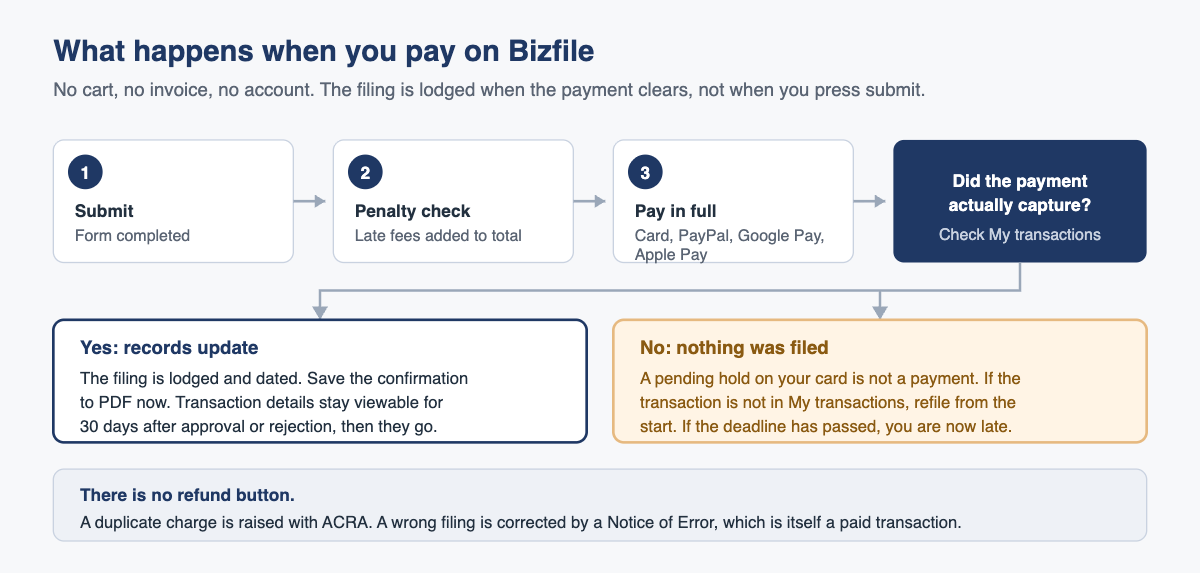
You pay for each Bizfile transaction the moment you submit it. There is no shopping cart, no invoice, no monthly account with ACRA. Card, PayPal, Google Pay or Apple Pay, and PayNow for certain renewals. Payment clears, then your record updates.
Raffles Corporate Services works with a panel of experienced Singapore law firms who offer cost-effective and efficient legal service and advice. This article is general information only and is not legal advice.
That last sentence is the one that catches people out. The filing is not lodged when you press submit. It is lodged when the money goes through. If the payment fails at that final step, you have a completed form and no filing, and if the deadline was that day, you are now late.
This piece covers the payment methods, what the fees actually are, what happens when a payment drops out mid-transaction, whether you can get money back, and how to pull a receipt before the window closes on you.
How payment works on Bizfile now
Bizfile removed the “add to cart” function that existed in the old BizFile+ system. The reason ACRA gives is data accuracy: draft transactions sitting in a cart could overwrite earlier filings, so a company could end up with the wrong information showing in its records. Immediate payment means each transaction is completed and recorded in one pass.
The practical sequence is short:
- You complete and submit the transaction.
- Bizfile checks whether any late lodgement penalties are due on that filing and adds them to the amount payable.
- You choose a payment method and pay the total in full.
- Your records update once the payment succeeds.
There is no step where you can park the transaction and pay later. There is also no way to batch five filings into one payment, which matters if you are filing for several entities in an afternoon: that is five separate payments, five separate card charges, and a profile switch between each one, as our note on switching profiles on Bizfile explains.
Payment methods
| What you are paying for | Methods accepted |
|---|---|
| Most transactions and purchases of business information | Credit card, debit card, PayPal, Google Pay, Apple Pay |
| Renewal of a sole proprietorship, partnership or limited partnership registration | The above, plus PayNow |
Payment records from the old BizFile+ system carried across to Bizfile, so saved payment details did not have to be re-entered.
What ACRA actually charges
Business owners tend to treat ACRA fees as rounding errors, and individually they are. In aggregate over a year, for a company that changes address, appoints a director, allots shares and files its annual return, they are a real line item that belongs in your budget rather than in a surprise.
The published fees for the key company transactions are these:
| Transaction | Fee |
|---|---|
| Apply for a new business entity name | S$15 |
| Register a new business entity | S$300 |
| File an annual return | S$60 |
| Apply for an extension of time to file accounts or hold an AGM | S$200 |
| Apply for exemption from financial statement requirements | S$200 |
| File a Notice of Error via general lodgement | S$60 |
| Register a new charge | S$60 |
| Convert company type via general lodgement | S$40 |
| Register an amalgamation of business entities | S$400 |
Two notes on that table. First, an amalgamation that produces a new company attracts the S$300 company registration fee on top of the S$400. Second, the fee is only half the picture: if the filing is late, the penalty is collected in the same payment. For a company, a late lodgement penalty is S$50 where the default is within three months and S$200 where it runs longer, and it applies per late filing rather than per visit to the portal. Two director changes filed six months late is S$400 in penalties, not S$200.
Late annual returns sit on a separate and steeper scale: S$300 where the return is up to three months late and S$600 beyond that. The full current schedules are on ACRA’s service and transaction fees page and its late lodgement penalties page, and they are worth checking rather than assuming, because they change.
What happens if the payment fails halfway through
This is the failure mode nobody plans for, and it has a simple rule underneath it: no payment, no filing.
If the card is declined, the 3-D Secure challenge times out, your browser session drops, or you close the tab while the bank’s authentication page is loading, the transaction does not complete. Bizfile will not hold the submission open for you and pay it later. From ACRA’s side, nothing was lodged.
What confuses people is what they see on their card. Many card issuers place a temporary authorisation hold the instant a payment is attempted, and that hold shows up in a banking app as a pending amount even though the merchant never captured it. So a director looks at his phone, sees S$60 pending, concludes the annual return was filed, and does nothing further. The hold falls off a few days later. The annual return was never filed. He finds out when the late lodgement penalty appears on the next attempt.
Do this instead:
- Do not assume the filing went through because money looks like it left. A pending authorisation is not a completed payment.
- Log back in to Bizfile and check My transactions. If the submission is not sitting there with a status, it did not happen.
- Retry the transaction from the beginning. You will be asked to complete the form again.
- If a second attempt fails with a different card, the problem is usually the issuer, not Bizfile. Overseas-issued cards and cards with tight online spending controls are the common culprits.
- If the money was actually captured and the transaction still shows nothing on Bizfile, stop retrying and raise it with ACRA before you pay twice.
The single most useful habit here is to confirm the outcome in your transaction history rather than in your inbox or your banking app. Our companion piece on using your Bizfile transaction history as an audit trail sets out how to read the statuses and what each one means.
Can you get a refund?
Start by separating three situations that feel identical to the person holding the card and are completely different in how they get fixed.
You were charged twice for the same filing. This is a payment problem, and it is the one ACRA will look at. Gather the transaction reference, the date, the amount and the card statement line, then raise it through the Bizfile feedback and enquiry form or the ACRA hotline on 6248 6028, available Monday to Friday between 8.30am and 6pm.
The payment failed and you were charged anyway. Usually this is an authorisation hold that will reverse itself. Give it a few working days before treating it as a real charge. If it settles rather than reversing, treat it as the case above.
You filed the wrong thing, or filed correct information incorrectly. This is not a refund question at all. The route is a Notice of Error, which is itself a paid transaction at S$60 via general lodgement. You are buying a correction, not recovering the original fee. Note also that a Notice of Error is for errors, not for changing your mind: if the underlying facts changed, that is a fresh filing.
There is no self-service refund button in Bizfile, and no facility to cancel a submitted transaction and take the money back. Treat every fee as spent at the moment you press pay, and put the effort into getting the form right before that point rather than after it.
Getting the receipt into your accounts before it disappears
Here is the trap that quietly costs bookkeepers hours.
Bizfile transaction details are available for 30 days after the transaction is approved or rejected. After that, if you want the record, you buy the relevant extract. Thirty days is shorter than most SME bookkeeping cycles. A company that reconciles quarterly will routinely find, at quarter end, that the detail behind three ACRA card charges is no longer retrievable from the portal.
Build the habit at the point of payment instead:
- Save or print the confirmation page to PDF the moment the payment succeeds. Do not navigate away first.
- Keep the confirmation email ACRA sends to the registered email address.
- Name the file so it reconciles: entity name, transaction type, date, amount.
- File it against the card or PayPal line in your accounting system in the same session, not at month end.
On the accounting treatment, ACRA filing fees are ordinary compliance expenses of running the company and sit naturally in a professional fees or statutory filing fees account. Company registration costs incurred before trading begins are pre-incorporation or pre-operating costs and deserve their own treatment rather than being buried in general expenses. Late lodgement penalties should be coded to a separate account rather than mixed in with the fees, because penalties are not incurred in producing income and are generally not deductible. Keeping them visible also makes the annual cost of late filing painfully obvious, which is the point.
If your bookkeeping is currently a shoebox of card charges reconciled in arrears, our note on when to move from DIY bookkeeping to professional support is the honest version of that conversation, and reconciling bank accounts properly covers the discipline that catches a duplicate ACRA charge in the same month it happens rather than a year later.
What goes wrong, and what it costs
Filing on the deadline day itself. If the payment fails at 11.40pm on the due date, you are late. There is no grace for a declined card. Filing two or three days early costs nothing and removes the entire category of risk.
Corporate cards with online transaction blocks. Plenty of company cards are configured to decline unfamiliar online merchants. The person filing discovers this at the worst moment. Test the card on a S$15 name application before you rely on it for an annual return.
Assuming the corporate secretary paid. When filings are shared between an internal finance person and an external provider, both sometimes assume the other completed the payment step. Nobody did. The fix is one named owner per filing.
Nobody notices the penalty line. Bizfile shows the exact penalty amount at the point of payment. If the person clicking through is not the person who cares about cost, an extra S$200 sails past unremarked, several times a year. Someone should be reading the total.
The email confirmation goes to a former secretary. If the registered email address is stale, the payment confirmation and everything after it lands in an inbox nobody reads. That problem is bigger than receipts, and we have covered it in the ACRA alerts companies miss.
Frequently asked questions
Can I pay for several Bizfile filings in one transaction?
No. Bizfile removed the cart function, so each transaction is paid for individually at the point of submission. If you are filing for several entities, expect a separate payment and a separate card charge for each one.
Does the transaction go through if I close the browser after paying?
If the payment was captured and Bizfile confirmed it, yes. If you closed the tab during the bank authentication step, probably not. Log back in and check My transactions before retrying, so you do not pay twice for the same filing.
Can I use PayNow to pay ACRA?
Only for renewals of sole proprietorship, partnership and limited partnership registrations. Every other transaction is paid by credit card, debit card, PayPal, Google Pay or Apple Pay.
How long do I have to download the receipt for my accounts?
Bizfile transaction details are available for 30 days after approval or rejection. After that you would need to purchase the relevant extract. Save the confirmation to PDF at the point of payment rather than relying on retrieving it later.
Are ACRA late lodgement penalties tax deductible?
Statutory penalties are not incurred in the production of income and are generally not deductible. Code them to a separate expense account from your ordinary filing fees, and confirm the treatment for your specific circumstances with your tax adviser.
I filed the wrong information. Can I cancel and get my fee back?
No. The correction route is a Notice of Error, which is a separate paid transaction at S$60 via general lodgement. You are paying to correct the record, not recovering what you already spent.
Paying once, filing on time
Nearly every expensive ACRA payment we see started as a cheap one. A S$60 annual return becomes S$360 because a card declined on the deadline. A S$50 penalty becomes S$400 because four changes drifted past three months together. The fee schedule is not the problem. The calendar is.
That is the part Raffles Corporate Services takes off your desk: we track the deadlines, file inside the windows, keep the confirmations where your accountant can find them, and tell you what a filing will cost before you commit to it rather than after. If you are not sure whether your last few Bizfile transactions actually completed, that is a short check and worth doing.
You can reach us through Raffles Corporate Services, or read more on Singapore corporate secretarial practice at Singapore Secretary Services.
The Editorial Team, Raffles Corporate Services
Need help with this?
Raffles Corporate Services can handle the ACRA filings, compliance documentation and records for you, and where court proceedings or legal advice are needed, we work with a panel of experienced Singapore law firms who offer cost-effective and efficient legal service and advice.
Email: [email protected]
Call, SMS or WhatsApp: +65 8501 7133