
Registering a Singapore company is two transactions on Bizfile, not one. First you reserve the name for $15. Then, within 120 days, you file the incorporation itself for $300. Most approvals land within minutes of payment.
The filing is the easy part. What takes the time, and what causes almost every delay we see, is everything that has to be settled before you open the form: the company type, the financial year end, who the officers are, how the shares are split, and whether you are adopting a model constitution or your own.
Those are permanent decisions typed into a web form in an afternoon. This article is the map of the whole sequence, so you know what is coming and in what order. Each of the individual decisions gets its own article in this series.
What you are actually applying for
Section 19 of the Companies Act 1967 sets out the mechanics. You submit the proposed company’s constitution and the prescribed information, you furnish the Registrar with the last day of the proposed company’s first financial year, you pay the fee, and somebody, either a registered qualified individual or a person named in the constitution as a director or secretary, declares that the Act’s formation requirements have been met and that the identities of the subscribers and officers have been verified.
The Registrar then registers the constitution and issues a notice of incorporation. Section 19(5) gives that notice its effect: from the date stated on it, the subscribers and everyone who later becomes a member are a body corporate, able immediately to exercise all the functions of an incorporated company, to sue and be sued, with perpetual succession.
So the output is a legal person and a UEN, not a certificate in a frame. Everything that follows, the bank account, the lease, the employment contracts, the licences, belongs to that person rather than to you. Our note on what incorporation gains you and what it costs covers whether you should be doing this at all.
Step one: reserve the name
Name reservation is a separate application with its own $15 fee, and it has to happen first. You cannot register a company against a name you have not reserved.
Three things about it catch people out.
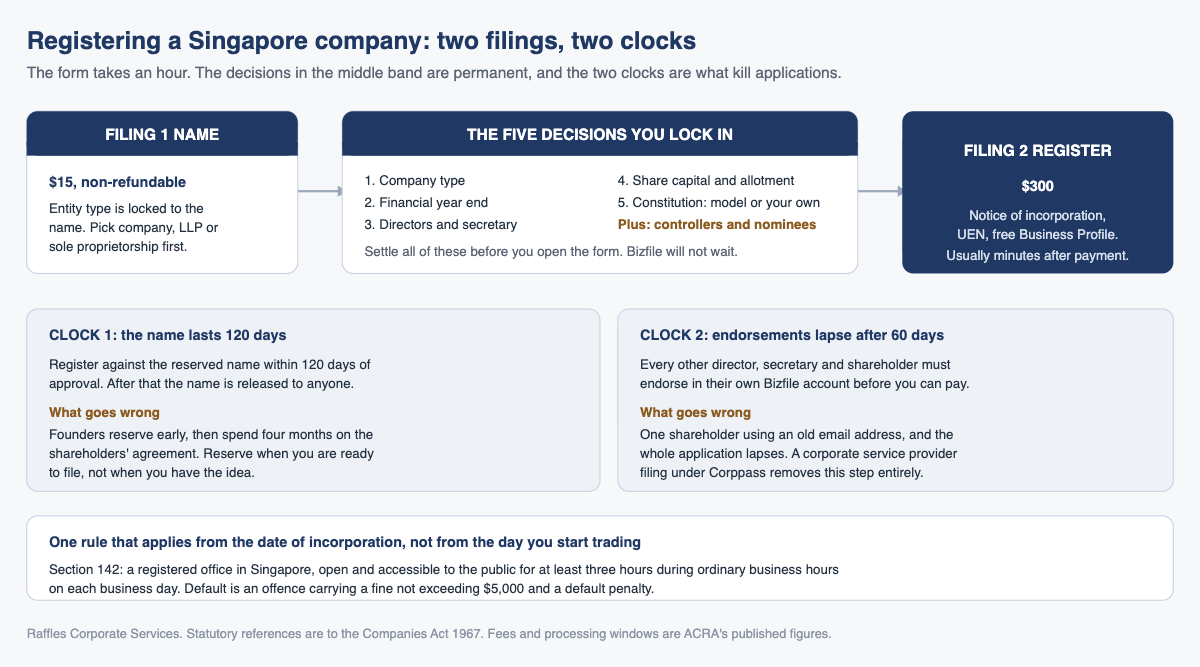
The reservation lasts 120 days. After that the name is released and anybody can take it. If your funding round, your work pass or your landlord negotiation slips past four months, you reserve again and pay again.
The entity type is locked to the name. You choose the structure when you apply for the name, and you must register that same structure. Decide between a company, an LLP and a sole proprietorship or partnership before you reserve, not after.
Approval is not exclusivity. An ACRA name registration is not a trade mark. It stops another entity registering the identical name; it does not stop a competitor using your brand. If the name matters commercially, apply separately through IPOS. The same goes for the domain, which is first come, first served.
Most names clear within a few working days. Names touching a regulated activity, finance, education, healthcare, media and several others, are routed to a referral authority, which adds up to 15 working days at the name stage and considerably more at the registration stage.
Step two: settle the five decisions before you open the form
Bizfile will ask for all of these, in this order, and it will not let you save and think about it later without losing your place. Each one is covered properly elsewhere in this series.
Company type. Private company limited by shares, exempt private company, public company, or company limited by guarantee. For almost every trading business the answer is a private company limited by shares, but the distinctions genuinely change what you must file and who you can bring in as a shareholder. See choosing a company type.
Financial year end. You furnish the last day of the first financial year at incorporation, under section 19(1)(b). That single date sets your annual general meeting deadline, your annual return deadline and the shape of your first tax year, for the life of the company. See choosing your company’s financial year end.
Officers. At least one director ordinarily resident in Singapore, a natural person aged 18 or over and of full legal capacity, under section 145. At least one company secretary, a natural person whose principal or only place of residence is in Singapore, under section 171. Where a company has a sole director, that person cannot also be the secretary.
Share capital and allotment. Currency, class of shares, number of shares, issued and paid-up amounts, and how each shareholder’s holding is made up. The minimum is one issued share. Shares can be paid in cash, otherwise than in cash, partly in each, or issued for no consideration.
Constitution. Upload your own, or adopt ACRA’s model constitution. The model is free and adequate for a straightforward single-class company. It is not adequate once you have investors, multiple share classes, drag-along and tag-along rights, or anything you would want a shareholders’ agreement for.
You will also be asked to declare whether the company is exempt from maintaining the Register of Registrable Controllers and the Registers of Nominee Directors and Nominee Shareholders, and, if not exempt, to provide those details at the point of incorporation. Most owner-managed companies are not exempt. Our Register of Registrable Controllers guide explains who counts as a controller.
The registered office, and the rule nobody reads
Section 142 requires a company to have a registered office in Singapore from the date of incorporation, to which all communications and notices may be addressed, and which is open and accessible to the public for not less than three hours during ordinary business hours on each business day. Default is an offence carrying a fine not exceeding $5,000 and a default penalty.
It does not have to be where you trade: your registered office can be in Raffles Place while the workshop is in Tuas. It does have to be a real, accessible Singapore address where legal papers can be served, which is why a residential address used casually as a registered office is a problem rather than a saving.
Step three: file, endorse, pay
| Stage | What happens | Fee | Typical timing |
|---|---|---|---|
| Name application | Reserve the name and the entity type, select the SSIC code | $15, non-refundable | Usually the same day; up to 15 working days if referred |
| Name held | You have 120 days to register against it | none | 120 days, then released |
| Incorporation filing | Company details, officers, controllers, share capital, allotment, constitution | $300 at payment stage | Filing itself takes under an hour once decisions are made |
| Endorsement | Every other position holder endorses in their own Bizfile account | none | Up to 60 days, then the application lapses |
| Payment | Payment notification arrives in your Bizfile inbox once endorsements are complete | $300 | Immediate |
| Outcome | Notice of incorporation, UEN, free Business Profile download | none | Usually minutes after payment; complex cases up to 15 working days, referrals 14 to 60 days |
Two procedural points do real damage when they are missed.
Only the person who reserved the name can file the incorporation, and that person must be appointed as a director or secretary of the new company. You cannot have an assistant reserve the name and a director file the registration. If you are engaging a corporate service provider, they handle both under Corppass and the endorsement step falls away entirely.
Everyone else has to endorse. After submission, every other position holder, each director, secretary and shareholder, logs in to Bizfile with their own Singpass and endorses the registration. The window is 60 days. One shareholder travelling, or using an email address they no longer check, and the whole application lapses. You start again, and the name clock does not restart with it.
What goes wrong, and what it costs
The name expires before the company exists. A 120-day reservation feels generous until the shareholders’ agreement takes three rounds. The name is released, someone else may take it, and you pay the fee again. Reserve the name when you are ready to incorporate, not when you first have the idea.
The endorsement window runs out. This is the most common wasted filing we see. The founder submits, tells the co-founders “you’ll get an email”, and nobody chases. Sixty days later the application is gone. Bizfile notifications go to the email address and mobile number keyed for each position holder, so those need to be right at the point of filing rather than corrected later.
The financial year end gets typed without a thought. A date chosen carelessly can produce a first financial period of seventeen months, which then has to be split across two Years of Assessment for tax, which quietly consumes one of the three years of start-up tax exemption. Section 198(2) caps the first financial year at 18 months without the Registrar’s approval, and that is a long way from a sensible answer.
The registered office is a mailbox nobody opens. ACRA’s notices, the annual return reminder, a statutory demand, a writ: all of it goes to the registered office and the officers’ registered addresses. Companies that end up with late lodgement penalties usually did not decide to file late. They simply never saw the reminder.
Nobody appoints the secretary. The office cannot be left vacant indefinitely, the sole director cannot fill it, and it is not a formality: the secretary is the person who actually keeps the filings on time.
If incorporating from scratch feels heavy, it is worth knowing the alternative is rarely better. Our note on buying a shelf company rather than incorporating fresh sets out when a ready-made entity genuinely helps and when it just imports somebody else’s history.
Frequently asked questions
How long does it take to register a company in Singapore?
Most incorporations are approved within minutes of payment. The delays come earlier: the name application can take up to 15 working days if it is referred to another agency, and the endorsement step waits on every other officer and shareholder. Plan for a week end to end, and longer for regulated activities.
How much does it cost to register a company with ACRA?
$315 in ACRA fees: $15 for the name application and $300 for the incorporation. The name fee is non-refundable even if the name is rejected. That is the government cost only, and it excludes a company secretary, a registered office, a constitution drafted for your situation, or professional fees.
Can a foreigner register a Singapore company?
A foreigner can own one hundred per cent of a Singapore company, but must engage a registered corporate service provider to file the registration and must have at least one director ordinarily resident in Singapore. Owning the company and being able to sign for it are two separate questions.
Do I need a company secretary from day one?
Every company must have at least one secretary, who must be a natural person whose principal or only place of residence is in Singapore. Where the company has a sole director, that director cannot also be the secretary. Appoint someone who understands the filing calendar rather than the nearest willing name.
What do I get when the registration is approved?
A notice of incorporation, a Unique Entity Number, and a link to download a free copy of the company’s Business Profile. Banks, landlords and government agencies will ask for the UEN and the Business Profile, not a certificate. Certified hard copies are a separate paid product.
Getting the decisions right before the form opens
Incorporation is cheap and fast. Unpicking a decision made badly at incorporation is neither. Share splits agreed on a handshake, a model constitution adopted for a company that was always going to raise money, a financial year end chosen because it was the default: each costs multiples of the original $315 to correct two years later.
Raffles Corporate Services incorporates Singapore companies as a registered corporate service provider, so we file the name and the registration under Corppass, the endorsement chase disappears, and the five decisions get made deliberately rather than at the keyboard. We then keep the calendar running afterwards, which is the part that determines whether the company stays clean.
You can reach us through Raffles Corporate Services, or read more on Singapore corporate secretarial practice at Singapore Secretary Services.
— The Editorial Team, Raffles Corporate Services