

Registering an LLP costs $100 and is filed on Bizfile once the name is approved, but you do not pay at the point of submission. Every other partner and manager must endorse the registration first, and they have 60 days to do it.
Raffles Corporate Services works with a panel of experienced Singapore law firms who offer cost-effective and efficient legal service and advice. This article is general information only and is not legal advice.
That single difference is why LLP registrations take longer than people plan for. A sole proprietorship is submitted and paid in one sitting. An LLP is submitted, waits on other people, then gets a payment notification, then completes.
The other difference is that you are registering a body corporate, not a firm. Section 4 of the Limited Liability Partnerships Act 2005 makes an LLP a body corporate with legal personality separate from that of its partners, and with perpetual succession. That brings obligations a general partnership never has, several of which start at registration. If you have not settled on the structure yet, read what an LLP actually is and who it suits first.
What has to be true before you file
Five things, and four of them are statutory.
An approved name. Reserve it first, as a separate application, for the LLP entity type specifically. Under section 23 of the Act, an approved reservation runs for 60 days from the date you are notified of approval, extendable by a further 60 days on a good faith application. Section 22 requires the name to carry either the words “limited liability partnership” or the acronym “LLP”.
At least two partners. Section 18 allows any two or more persons associated for carrying on a lawful business with a view to profit to register an LLP. Section 28(1) requires an LLP to have at least two partners at all times. Partners may be individuals or bodies corporate, and there is no maximum.
At least one qualifying manager. Section 29(1) requires at least one manager who is a natural person, at least 18 years of age and otherwise of full legal capacity, and ordinarily resident in Singapore. A manager is anyone concerned in or taking part in the management of the LLP, whether or not they are a partner.
A registered office in Singapore. Section 32 requires a registered office within Singapore to which all communications and notices may be addressed, and documents may be served on the LLP by leaving them there or sending them by registered post. ACRA additionally requires it to be open and accessible to the public during normal business hours on each business day. It does not have to be where you work: the registered office can be in the city while the operation runs out of an industrial estate.
A decided position on controllers. You will be asked at registration whether the LLP is exempt from maintaining a Register of Registrable Controllers from the date of registration. Do not work that out mid-application.
Who is allowed to file
Only the person who reserved the business name can submit the registration, and for an LLP that person must be a partner or a manager of the proposed LLP. Foreigners without Singpass cannot file and must engage a registered corporate service provider. Our Corporate Service Providers Act 2024 FAQ covers what a CSP is now obliged to do before it acts for you.
There is a practical consequence to using a CSP that people are usually pleased to discover: where a CSP files the registration, the 60-day endorsement round is not required. If your partners are spread across time zones and unlikely to act promptly, that alone can be the deciding factor.
What to prepare
Section 19(1) sets out the particulars that go into the registration statement. In practice you want all of this open before you start.
| What you need | Detail that matters |
|---|---|
| Approved name and its eService number | Use it to retrieve the reservation rather than re-keying |
| Singpass, or Corppass if a CSP is filing | Individual partners and managers use Singpass |
| General nature of the proposed business | A statutory particular, not a marketing description |
| Proposed registered office | Singapore address, publicly accessible during business hours |
| LLP email address | Where ACRA will correspond |
| Each individual partner and manager | Full name, identification, nationality, date of birth, residential address and contact address |
| Each corporate partner or manager | Corporate name, place of incorporation or registration, registration number, registered office |
| Controller position | Whether exempt, and if not, whether you can identify your registrable controllers |
| Controller details | Particulars of each registrable controller, or of the individuals with executive control if controllers cannot be identified |
Residential address versus contact address
Every individual partner and manager gives both. The residential address is where ACRA sends official letters. The contact address is what appears in ACRA’s public records: it must sit in the same jurisdiction as the residential address, must be a place where the person can receive post, and cannot be a P.O. Box.
There is no fee for registering a contact address that differs from the residential address. Use it. Once a home address has been published against a person’s name, it does not un-publish.
The controllers step, done properly
Halfway through the application you will be asked to state whether the LLP is exempt from maintaining a Register of Registrable Controllers. There are three routes through, and each has a different set of follow-on fields.
- Exempt. You confirm the exemption and select the category it falls under.
- Not exempt, controllers identifiable. You confirm the LLP is not exempt, confirm you can identify its controllers, and add each individual or corporate registrable controller.
- Not exempt, controllers not identifiable. You confirm you cannot identify the controllers, tick the accompanying declaration, and instead provide the details of the individuals with executive control.
Members of the public cannot view or purchase controller information. That does not make it optional: the register carries its own maintenance obligations and its own penalties, and it is one of the most commonly neglected items in small entities. Our Register of Registrable Controllers guide sets out the ongoing obligation, and if any partner is holding their interest for someone else, read nominee arrangements and beneficial ownership disclosure before you answer.
The steps, in order
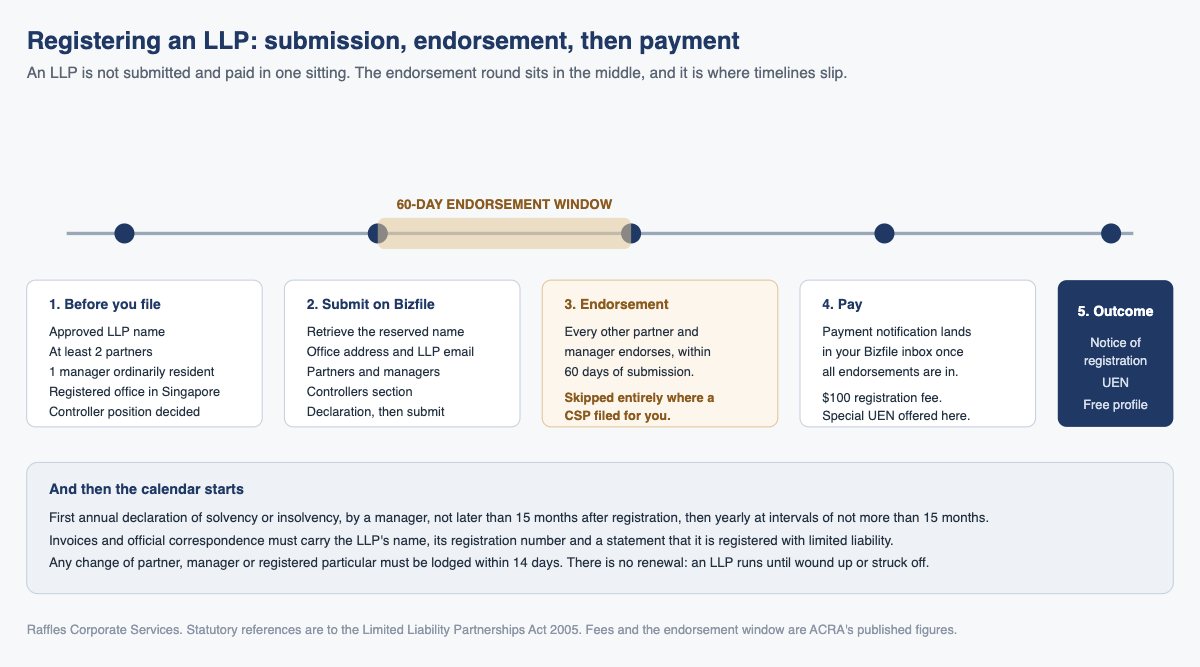
- Reserve the name for an LLP, including the words “limited liability partnership” or “LLP”.
- Line up at least two partners, at least one manager who is ordinarily resident in Singapore, and a registered office address you are entitled to use.
- Log in to Bizfile. Partners and managers use Singpass as individual users. A CSP uses Corppass and its own dashboard.
- Open the registration eService for a new business entity and retrieve the approved name using its eService number.
- Enter the registered office address and the LLP email address.
- Add each partner and manager as a position holder, individual or corporate, with identification, residential address and contact address.
- Complete the controllers section by the route that applies to you.
- Review every field, read the declaration, tick it and submit.
- Wait for endorsements. Every other position holder must endorse the registration within 60 days. This step is skipped where a CSP filed.
- When all endorsements are in, a payment notification arrives in your Bizfile inbox. Pay the $100 registration fee. A special unique entity number can be selected during the payment process.
- Check your Bizfile inbox for the outcome.
What it costs and how long it takes
| Item | Amount or period |
|---|---|
| Registration fee | $100 |
| Name application | Charged separately when you reserve the name |
| Payment methods | Credit card, debit card or online banking |
| Endorsement window | 60 days from submission, unless a CSP filed |
| Straightforward applications | Usually approved shortly after payment |
| Complex applications | Up to 15 working days |
| Applications needing another authority’s approval | 14 to 60 days |
Note what is absent: unlike a sole proprietorship, there is no registration period to choose and no renewal cycle. An LLP continues until it is wound up or struck off. That is a genuine advantage over a registered business name, and also why the compliance obligations are heavier. Our note on paying ACRA on Bizfile covers receipts and failed payments.
The calendar that starts the day you are registered
Approval brings the notice of successful registration, the UEN, and a link to download a free copy of the Business Profile. Download it and check every particular against what you intended to file.
Then four obligations begin, and one has a clock that started on registration day.
The annual declaration. Section 30 requires one of the managers to lodge a declaration with the Registrar as to whether, in that manager’s opinion, the LLP appears able to pay its debts as they fall due in the normal course of business. The first is due not later than 15 months after registration, and thereafter once in every calendar year at intervals of not more than 15 months. Failure to lodge is an offence attracting a fine of up to $5,000, and it opens the door to striking off. A manager who declares solvency without reasonable grounds commits a separate offence.
Accounting records. Section 31 requires records sufficient to explain the transactions and financial position, and to enable true and fair profit and loss accounts and balance sheets to be prepared.
Name and limited liability on your paperwork. Section 33 requires invoices and official correspondence to bear the LLP’s name and registration number, and a statement that it is registered with limited liability. Failure carries a fine of up to $1,000, plus a daily default fine. Get this into your invoice template on day one.
Changes within 14 days. Section 34 gives 14 days to lodge a new partner, a new manager, a cessation, or any other change in the registered particulars. An individual partner or manager who moves house has 14 days to lodge the new residential address, although a change reported under the National Registration Act 1965 counts as compliance.
Section 29(3) is the line every manager should read once: a manager is answerable for what sections 30, 33 and 34 require, and is personally liable for penalties imposed on the LLP for contravening those sections unless the court is satisfied they should not be.
Turn on ACRA’s alerts so the annual declaration reminder reaches someone who will act on it.
What goes wrong in practice
The endorsement window quietly expires. The application sits waiting on a partner who is travelling, or whose Singpass has not been used in two years, or who did not realise anything was required of them. Sixty days passes and the work is wasted. Tell every partner, before you submit, that an endorsement request is coming.
The only manager is not ordinarily resident. An LLP with no qualifying manager is in breach of section 29(1), and the offence lands on the LLP and every partner, with a fine of up to $5,000 and a daily default fine. This usually happens later, when the one local manager resigns and nobody appoints a replacement.
Partner numbers drop below two and stay there. Section 28(2) is the provision to fear. If an LLP carries on business with fewer than two partners for more than two years, a person who was a partner when an obligation was incurred, and who knew the LLP had been running short-handed for more than two years, becomes personally liable jointly and severally with the LLP for that obligation. The limited liability that was the whole point of the structure switches off for that person.
The controllers question is answered carelessly. Ticking “exempt” because it is the shortest route through the form creates a registration record that is wrong from day one.
The registered office is nominal. An address nobody monitors means registrar correspondence, statutory notices and served documents arrive somewhere no one reads. Service is effective whether or not you saw it.
Frequently asked questions
How long does it take to register an LLP in Singapore?
If a CSP files, approval usually follows shortly after payment. If partners file it themselves, add however long the endorsement round takes: every other partner and manager has 60 days to endorse, and payment is only requested once all endorsements are in.
Does an LLP need a company secretary?
No. An LLP needs at least one manager who is a natural person, at least 18, of full legal capacity and ordinarily resident in Singapore. That manager carries personal responsibility for the annual declaration, the invoice requirements and the filing of changes.
Can a company be a partner in an LLP?
Yes. Section 11 of the Limited Liability Partnerships Act 2005 allows any individual or body corporate to be a partner. You provide the corporate name, place of incorporation or registration, registration number and registered office instead of personal particulars.
When is the first annual declaration due?
Not later than 15 months after the LLP is registered, and after that once in every calendar year at intervals of not more than 15 months. It is a manager’s declaration as to whether the LLP appears able to pay its debts as they fall due.
Do LLPs have to renew their registration?
No. Unlike a sole proprietorship or partnership, an LLP has no expiry date and no renewal fee. It continues until it is wound up or struck off. What replaces the renewal is the annual declaration, and that one is not optional.
What has to appear on an LLP’s invoices?
The LLP’s name, its registration number, and a statement that it is registered with limited liability. Section 33 makes omission an offence with a fine of up to $1,000 plus a daily default fine, so build it into the template rather than adding it later.
Getting the registration and the first year right
Most LLP problems are not registration problems. They are second-year problems: a declaration nobody lodged, a manager who left without a replacement, an invoice template that never carried the limited liability statement, a partner who departed and was never filed.
Raffles Corporate Services registers LLPs, acts as filing agent so the endorsement round can be skipped, maintains registered office and controller records, and lodges the annual declaration on time every year. If you have an LLP that has drifted, or partners in several countries and no appetite for chasing endorsements, that is a short conversation.
You can reach us through Raffles Corporate Services, or read more on Singapore corporate secretarial practice at Singapore Secretary Services.
— The Editorial Team, Raffles Corporate Services
Need help with corporate secretarial or compliance matters?
If you would like help with your company's corporate secretarial, governance or compliance requirements, email [email protected] or WhatsApp +65 8501 7133.
Our team can assist with corporate secretarial, accounting and tax matters. Where legal advice is needed, advisers from our associated law firms can assist.