
Your UEN is issued and you can start trading, but you are not finished. Within the first day you can apply for Corppass, within 60 days your free Business Profile expires, and your registration itself lasts only one or three years before it must be renewed.
That last point is the one that catches people. A sole proprietorship or a partnership is not a permanent thing you set up once. It is a registration with an expiry date, and the renewal is gated on something most owners have never thought about: whether they are up to date on their CPF MediSave contributions.
Here is the full sequence, in the order it actually matters.
The first week: what has a deadline and what does not
| Task | When | What happens if you skip it |
|---|---|---|
| Apply for Corppass | From one day after your UEN is issued | You cannot transact with ACRA, IRAS, CPF or most agencies online |
| Download your free Business Profile | Within 60 days of issue | The free copy expires and you have to buy one |
| Check whether you need a licence or permit | Before you start operations | Operating without a required licence is an offence under that licensing regime |
| Open a corporate bank account | Any time after registration | No hard deadline, but mixing business and personal money makes your tax position painful |
| Apply for a CPF Submission Number | Before your first payroll run | You cannot make CPF contributions for staff |
| Register a Data Protection Officer | Before you start collecting personal data | Appointing a DPO is a requirement under the Personal Data Protection Act 2012 |
Corppass is the gate to everything else
Corppass is the single login for government-to-business transactions, and you can apply one day after your UEN is issued. Everything downstream depends on it: renewing your registration, filing tax, paying CPF, applying for grants. Set it up on day two, not on the day you need it. Our guides to logging in to Bizfile as a business user and to who should have Bizfile access explain how to assign the ACRA e-service to the right people, which is the step new owners most often miss.
The 60-day Business Profile window
ACRA issues one free Business Profile when you register. It sits in your Bizfile inbox behind a link, and the free copy expires 60 days after issue. Banks, landlords and suppliers ask for it constantly, so download it now.
Licences before operations, not after
Registration with ACRA tells you the name is yours. It tells you nothing about whether you may do the thing you registered to do. Food, education, employment agency work, money-changing, travel, private security and healthcare all need a sector licence first.
Run your SSIC through the GoBusiness licence e-advisers before your first customer. If you move goods across the border, you also need a Customs account before applying for trade permits.
Your tax position is different from a company’s
A sole proprietorship is not a separate taxpayer. Its profits are your income, taxed at your personal income tax rates. A partnership is not a separate taxpayer either: profits are divided and each partner is taxed on their share, at personal rates if the partner is an individual and at corporate rates if the partner is a company.
There is no corporate tax return for the business as an entity, no exempt amount, and no separation between the business’s losses and your own tax position.
GST registration
You must register for GST if your taxable turnover has exceeded $1 million in a calendar year, or if you expect it to exceed $1 million in the next twelve months. For a sole proprietor, taxable turnover is measured across all of your sole proprietorship businesses plus your income from trade, work and other jobs. For a partnership, it is measured across all partnerships with the same group of partners.
People with two or three small trading names under one NRIC discover this the hard way. The threshold is not per business name.
GST-registered businesses are separately being brought onto the InvoiceNow network in phases under the GST InvoiceNow Requirement. New voluntary registrants came into scope from 01 April 2026 and new compulsory registrants from 01 April 2028, with existing registrants phased in by size after that. Build it into your software choice now.
MediSave: the obligation that can cancel your business
As a self-employed person you are required to contribute to your CPF MediSave Account. If you or any of your partners have annual net trade income above $6,000, you must have made arrangements with the CPF Board either to pay your MediSave contributions in full or to pay them by monthly instalments.
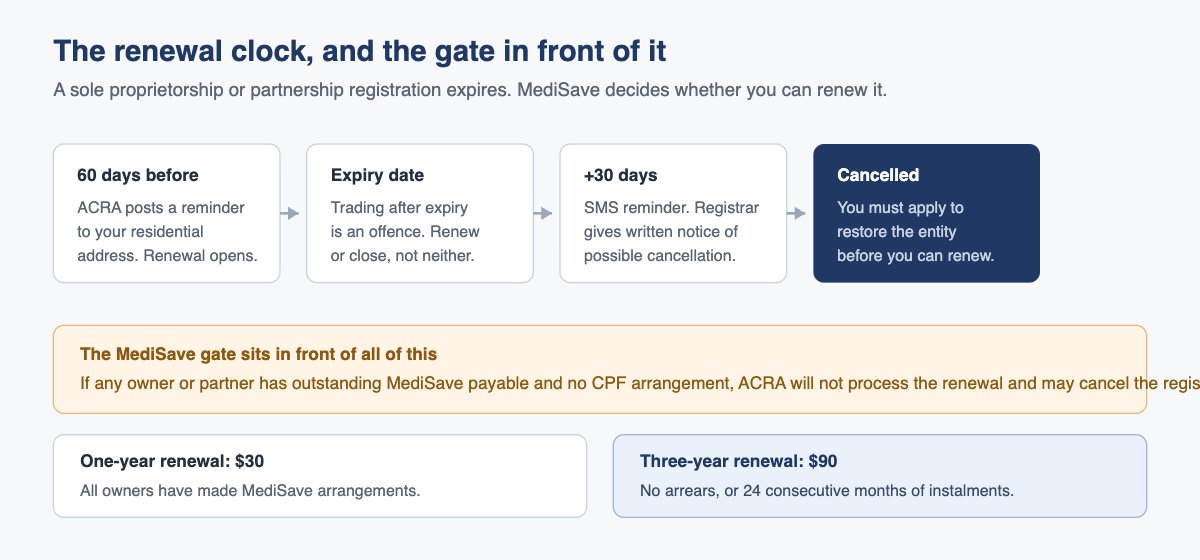
The consequence is unusually direct for a tax-adjacent obligation. If there is outstanding MediSave payable and no arrangement in place:
- ACRA will not process your renewal, and
- your business registration may be cancelled early, with a notice sent to all owners or partners.
In a partnership this is collective. One partner’s unpaid MediSave can stop the whole firm’s renewal.
Check your position on the CPF Board’s self-employment dashboard and fix it well before renewal season, because there is a timing trap: if you set up a GIRO instalment arrangement, ACRA’s system needs to see that payment has actually started. You must wait for your first successful GIRO deduction before the renewal will go through. Our guide to CPF MediSave contributions for self-employed persons walks through how the liability is calculated.
Renewal: one year or three
Under section 8(3) of the Business Names Registration Act 2014, a registration is valid for the period the Registrar specifies and is renewable on payment of the prescribed fee. In practice you choose a one-year or a three-year term.
| One-year renewal | Three-year renewal | |
|---|---|---|
| Fee | $30 | $90 |
| Who qualifies | All owners must have made MediSave arrangements with the CPF Board | All owners must have no outstanding MediSave payable, or be on a CPF instalment plan with at least 24 consecutive months of contributions made |
| Approval | Immediate | Immediate |
The renewal timeline, in order
- ACRA sends a renewal reminder letter to your residential address 60 days before expiry.
- You may renew from 60 days before expiry, and not earlier. The system will not let you.
- If you have not renewed within 30 days of the expiry date, ACRA sends an SMS reminder.
- If the registration expires, the Registrar gives written notice that the registration may be cancelled unless it is renewed within a stated period, which under section 14 of the Act must be at least 30 days.
- Your registration may be cancelled around 60 days after the expiry date.
- Once cancelled, you must apply to restore the business before you can renew it.
Note step 1. The reminder goes to your residential address, not your business address. If you have moved and not updated ACRA, you will not get it.
Note also what happens between expiry and cancellation. The Act provides that a person and their business name continue to be registered after expiry unless and until the registration is cancelled. That is not permission to keep trading. It is an offence to carry on business after your registration has expired, and if you no longer want the business, closing it properly before expiry is cheaper than letting it lapse.
The 14-day rule you will actually use
Section 20(1) of the Business Names Registration Act 2014 requires you to notify ACRA within 14 days of any change in your registered particulars: your principal place of business, the nature of the business, and the particulars of owners, partners and authorised representatives.
Two useful carve-outs. A change in the residential address of an individual proprietor, individual partner or authorised representative is not treated as a change of particulars for this purpose, and a change of registered business name goes through a separate process. Citizens and permanent residents who report an address change to the Immigration and Checkpoints Authority are treated as having told the Registrar.
Miss the 14 days and you are into late lodgement penalties, charged per late transaction, so a firm that lets several changes drift accumulates a surprising bill.
One more has real teeth: you must trade under your registered business name. Carrying on business under any other name, or under a name whose registration has been cancelled or ceased, is an offence under the Act.
What goes wrong
The reminder goes to an old address. Owners move house, never update ACRA, and the 60-day renewal letter goes to a flat they left three years ago. The first they hear of it is the SMS after expiry, or a bank refusing a facility because the UEN shows as cancelled.
MediSave quietly blocks the renewal. The owner logs in to renew on the last day, is refused, sets up a GIRO arrangement that afternoon, then discovers the first deduction will not run until the 25th. The registration expires in the gap.
One partner’s arrears stop everybody. Every partner has to be square with the CPF Board. The one who has been ignoring letters for two years is a problem for all of them.
Nobody registered a Data Protection Officer. It sits on nobody’s list, and it applies to every organisation that handles personal data, not just large ones. Register your DPO with the PDPC and put the contact details somewhere a customer can find them.
The free Business Profile expired. Sixty days pass, the bank asks for a profile, and you pay for something you were given.
Frequently asked questions
How often must I renew my sole proprietorship registration in Singapore?
Every one or three years, depending on the term you choose. The fee is $30 for a one-year renewal and $90 for a three-year renewal. You can renew from 60 days before expiry and not earlier, and ACRA sends a reminder letter to your residential address 60 days ahead.
Why can I not renew my business registration?
The most common reason is outstanding MediSave payable with the CPF Board. ACRA will not process a renewal where any owner or partner has unpaid MediSave and no arrangement in place. If you have just set up a GIRO instalment, you must wait until the first deduction has actually gone through before the renewal will be accepted.
Do I need a three-year renewal or is one year fine?
One year is fine. The three-year renewal is cheaper per year and saves an annual task, but it requires either no outstanding MediSave payable or an instalment plan you have been paying for at least 24 consecutive months. If you do not qualify, the option will not appear.
Is my sole proprietorship taxed separately from me?
No. A sole proprietorship is not a separate taxpayer. Its profits are your income and are taxed at your personal income tax rates. A partnership works the same way: profits are allocated to the partners, and each partner is taxed at their own personal or corporate rate.
What happens if my registration is cancelled for non-renewal?
You must apply to restore the business entity before you can renew it, and you should not be trading in the meantime. Carrying on business after your registration has expired is an offence. If you have stopped trading anyway, closing the business properly is the better route.
The part worth outsourcing
Most sole proprietors and partnerships do not have a compliance problem. They have a calendar problem. The renewal is every one or three years, the MediSave gate is invisible until it blocks you, and the 14-day window opens and closes without anyone noticing.
Raffles Corporate Services tracks renewal dates, files changes inside the 14 days, and flags the MediSave position before it becomes a refusal rather than after. If you are not sure when your registration expires, that is a two-minute check on our side.
You can reach us through Raffles Corporate Services, or read more on Singapore corporate secretarial practice at Singapore Secretary Services.
— The Editorial Team, Raffles Corporate Services