
When a director, secretary, partner or manager leaves office, the entity must tell ACRA within 14 days. The filing costs nothing. If the entity will not file, the individual can notify ACRA directly.
That last sentence is the part most people do not know exists, and it is the reason this transaction matters. Resignations go wrong far more often than appointments do. Somebody hands in a letter, the relationship sours, nobody opens Bizfile, and six months later the person who thought they had left is still sitting in ACRA’s register as a serving officer of a company they no longer have anything to do with.
Here is who is supposed to file, what evidence you need, how the self-notification route works, and the one cessation ACRA will simply refuse to accept.
What a notice of cessation is, and what it is not
A notice of cessation is the filing that removes a person from ACRA’s register of directors, chief executive officers, secretaries or auditors for a particular entity, and records the date on which they stopped holding that position.
It is a record of something that has already happened. It does not end anyone’s appointment, and it does not make a resignation effective. The resignation is effective when it is effective under the Companies Act 1967 and the company’s constitution. The filing simply tells the Registrar so that the public record catches up.
Two consequences follow, and they pull in opposite directions. Filing late does not move the cessation date: if a director resigned on 03 March 2026 and the company files on 03 September 2026, the register shows 03 March 2026 and the filing is six months late. And not filing at all does not keep the person in office. They have left. But the world, including banks, auditors and anyone buying a company search, will read the register and conclude otherwise.
Who has to file it, and by when
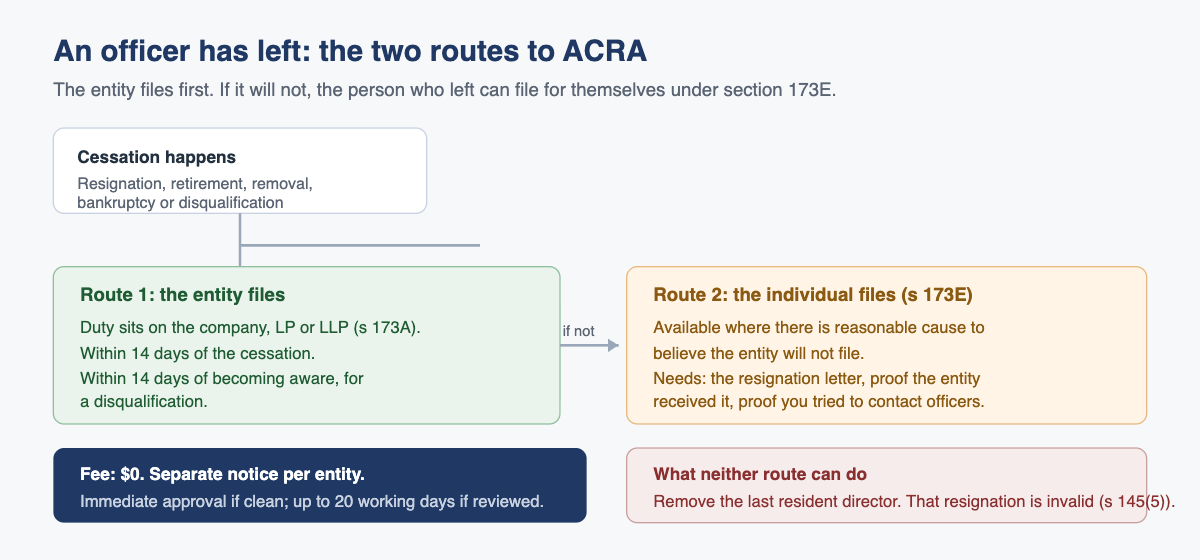
The primary duty sits on the entity, not on the person leaving. Section 173A of the Companies Act 1967 requires a company to notify the Registrar within 14 days after a change in the appointment of any director, chief executive officer, secretary or auditor. Where the change is a disqualification, the 14 days runs from the date the company becomes aware that the person has ceased to be qualified.
Default is an offence. Under section 173H, the company and every officer in default are each liable on conviction to a fine not exceeding $5,000, and also to a default penalty. Before that stage, ACRA charges late lodgement penalties per late transaction, so an entity carrying several unfiled changes accumulates a bill rather than a single charge.
| Situation | Who files | Deadline |
|---|---|---|
| Director, secretary, CEO or auditor resigns, retires or is removed | The entity | 14 days from cessation |
| Director becomes disqualified | The director tells the company, then the entity files | Director: as soon as practicable, and no later than 14 days. Entity: 14 days from becoming aware |
| Entity will not or cannot file | The individual who left, using the notice of cessation eService | As soon as the individual has reasonable cause to believe the entity will not file |
| Position holder of an LP or LLP ceases | The entity, or the individual on the same self-notification basis | 14 days |
The fee for the notice of cessation eService is $0. ACRA’s published position is that applications meeting the requirements may be approved immediately, and that applications needing further review are processed within 20 working days.
What you need before you open the eService
Supporting documents are required for every application. What ACRA expects depends on why the position ended, and the gap between what people have and what ACRA wants is where most of these filings stall.
| Cessation reason | What to have ready |
|---|---|
| Resignation | The resignation letter, evidence that the entity actually received it, evidence that you tried to contact the entity’s officers, and any other supporting documents |
| Bankruptcy | The bankruptcy number, the date of adjudication, the cessation date, and copies of the bankruptcy documents |
| Disqualification | The disqualification order number, the date of disqualification, the date of conviction, the cessation date, the court or related documents, and the letter and date of release from prison where that applies |
The second line of the resignation row does the heavy lifting. A resignation letter on its own proves that you wrote a letter. It does not prove that the company received it. Evidence of receipt means an acknowledgement from the board, a signed receipt, a registered post record, or an email trail showing delivery to an officer of the company.
The step people skip
Evidence of an attempt to contact the entity’s officers is a separate requirement from evidence of receipt. Filing a cessation for yourself is a route of last resort, not a shortcut: ACRA expects you to have approached the company first and given it the chance to file. In practice that means one dated, written approach to the directors or the company secretary asking them to file the cessation, sent to an address you can prove, and kept.
The filing, in order
For your own cessation, you file as an individual through Singpass. For someone else’s, you file under the entity’s or a corporate service provider’s profile through Corppass. If the Corppass side is unfamiliar, our note on logging in to Bizfile as an individual covers the difference between the two doors.
- Log in to Bizfile. Choose Individual User and Singpass if you are filing for yourself, or Business User and Corppass if you are filing for another position holder, then select the correct profile.
- Open the notice of cessation or resignation of position holder eService.
- Check the entity name and UEN. If you hold positions in more than one entity, this is the screen where the wrong one gets picked.
- Select the position to be ceased. If you hold two positions in the same entity, select each separately.
- Enter the date of cessation and choose the cessation reason. The fields that appear next change with the reason.
- Upload the supporting documents and save. Repeat for each further position.
- Review, tick the declaration, and submit.
File a separate notice for every entity: a director resigning from four companies on the same day files four notices, not one.
After submission the status is visible under Transaction Status Enquiry, and ACRA will email you if you gave an email address. Keep the submission record. Our note on using your Bizfile transaction history as an audit trail explains why that record is worth more than the confirmation screen.
When the company will not file: the self-notification route
Section 173E of the Companies Act 1967 is the provision that gets a stranded officer out.
A director who has resigned and given the company notice of the resignation, or who has been removed or has retired, may give the notice to the Registrar themselves if they have reasonable cause to believe the company will not. A secretary in the same position has the same right. A director who becomes disqualified must notify the company within 14 days, and may also notify the Registrar directly on the same basis.
“Reasonable cause to believe the company will not” is the test, and it is a factual one. An unanswered letter, an abandoned registered office, directors who have stopped responding, or a board that has told you it does not intend to file: each supports the belief. Impatience does not.
Where the underlying problem is an entity abandoned by its beneficial owners, the cessation filing is only the first move, and our note on the trapped nominee director’s exit covers what comes after.
The cessation ACRA will not accept
You cannot use this transaction to leave an entity below the minimum number of position holders the law requires it to have.
For a local company, section 145(5) of the Companies Act 1967 says that a director must not resign or vacate office unless at least one director who is ordinarily resident in Singapore remains, and that any purported resignation in breach of that is invalid. The last resident director of a local company therefore cannot resign through this transaction, and the system will not let the filing through.
That is not an administrative inconvenience. The resignation has no legal effect at all: the person remains a director, with every duty and exposure that carries, until a replacement is appointed. Getting another qualifying director in place is a members’ decision, not the departing director’s. We set the constraint out in full in how a director leaves office in Singapore.
The narrow exception is that section 145(5) does not apply where a director is required to leave by reason of disqualification, removal or revocation of appointment under the disqualification provisions of the Act. Disqualification overrides the resident director floor, which is why a company whose only resident director becomes disqualified has a problem to solve within days, not months.
What goes wrong in practice
The verbal resignation. Someone tells the board they are stepping down, everyone nods, and nothing is written. Months later there is no letter, no receipt and no minute, and nothing that satisfies ACRA’s evidence requirement. Write the letter, deliver it in a way you can prove, and keep the proof.
Filing the cessation and stopping there. Removing a director does not update the company’s own statutory registers, change the bank mandate, cancel their Corppass access, or release them from anything they signed.
Assuming the 14 days runs from the filing decision. It runs from the cessation. A resignation effective 01 April 2026 that nobody notices until the annual return is prepared in November is seven months late.
Disqualification handled as though it were resignation. A disqualified director has an obligation to tell the company, on a 14-day clock of their own, and the company has a separate obligation once it becomes aware. Two duties, two clocks, two sets of consequences. See director disqualification in Singapore. Where the entity’s records and ACRA’s have drifted apart over years, fixing it is no longer a single filing, and our note on restoring statutory registers and records covers that repair.
Frequently asked questions
How much does it cost to file a notice of cessation?
Nothing. ACRA charges no fee for the notice of cessation or resignation of position holder eService. The cost of getting it wrong is the late lodgement penalty on the transaction, which applies per late filing, and potential prosecution of the entity and its officers in default.
I resigned months ago and the company never filed. What do I do?
Write to the directors or company secretary asking them to file, keep proof of sending, and give them a reasonable chance to act. If they do not, file the notice of cessation yourself through Bizfile using Singpass, attaching your resignation letter, proof the company received it, and proof of your attempt to contact the officers.
Can I resign if I am the only director?
Not if you are the only director ordinarily resident in Singapore. Section 145(5) of the Companies Act 1967 makes any such resignation invalid, and Bizfile will block the transaction. You remain a director until the members appoint a qualifying replacement.
How long does ACRA take to process it?
Applications that meet the requirements may be approved immediately. Applications requiring further review are processed within 20 working days, and ACRA will say if it needs longer. You can check progress in Bizfile under Transaction Status Enquiry. File a separate notice for each entity you are leaving.
Does filing the cessation end my liability for what happened while I was in office?
No. It updates the register from the cessation date forward. Anything you did, approved or failed to do while you were an officer stays with you, and the filing is evidence of when your tenure ended rather than a release from it.
Closing the loop properly
The companies that get into trouble here are rarely the ones acting in bad faith. They are the ones where a departure was agreed in the room and nobody owned the paperwork afterwards.
Raffles Corporate Services files cessations inside the 14-day window, builds the evidence pack at the time the resignation happens rather than reconstructing it a year later, and checks the resident director position before anyone signs a resignation letter. If you have left a Singapore entity and the register still shows you as an officer, that is fixable, and the sooner it is fixed the less it costs.
You can reach us through Raffles Corporate Services, or read more on Singapore corporate secretarial practice at Singapore Secretary Services.
— The Editorial Team, Raffles Corporate Services