

The company must notify ACRA within 14 days. That is not the only duty: a disqualified director must tell the company within 14 days, every officer must give the company the information it needs to file, and an officer the company ignores can notify the Registrar directly. Default is an offence carrying a fine of up to $5,000 plus a daily default penalty.
Raffles Corporate Services works with a panel of experienced Singapore law firms who offer cost-effective and efficient legal service and advice. This article is general information only and is not legal advice.
Most companies think of this as one filing. It is better understood as a chain of notifications, each with its own trigger, its own clock, and its own person who can be prosecuted.
This article is about who owes what to whom. For the mechanics of the transaction, the supporting documents and the screens, read filing a notice of cessation. For the grounds and durations, read director disqualification in Singapore.
Three notifications, not one
| Who notifies | Who they notify | Trigger | Window | Provision |
|---|---|---|---|---|
| Director, CEO, secretary or auditor | Their own company | Any change to the information ACRA holds about them, including a cessation | As soon as practicable, and no later than 14 days | Section 173B(1)(b) |
| A director who becomes disqualified | Their own company | The disqualification | As soon as practicable, and no later than 14 days | Section 173E(1)(a) |
| The company | The Registrar | A change in the appointment of an officer | 14 days after the change | Section 173A(1)(b) |
| The company | The Registrar | Becoming aware that a director has ceased to be qualified | 14 days after becoming aware | Section 173A(1)(d) |
| The individual who left, or who was disqualified | The Registrar | Reasonable cause to believe the company will not file | No fixed deadline; a right, not a duty | Section 173E(1)(b) and (2) |
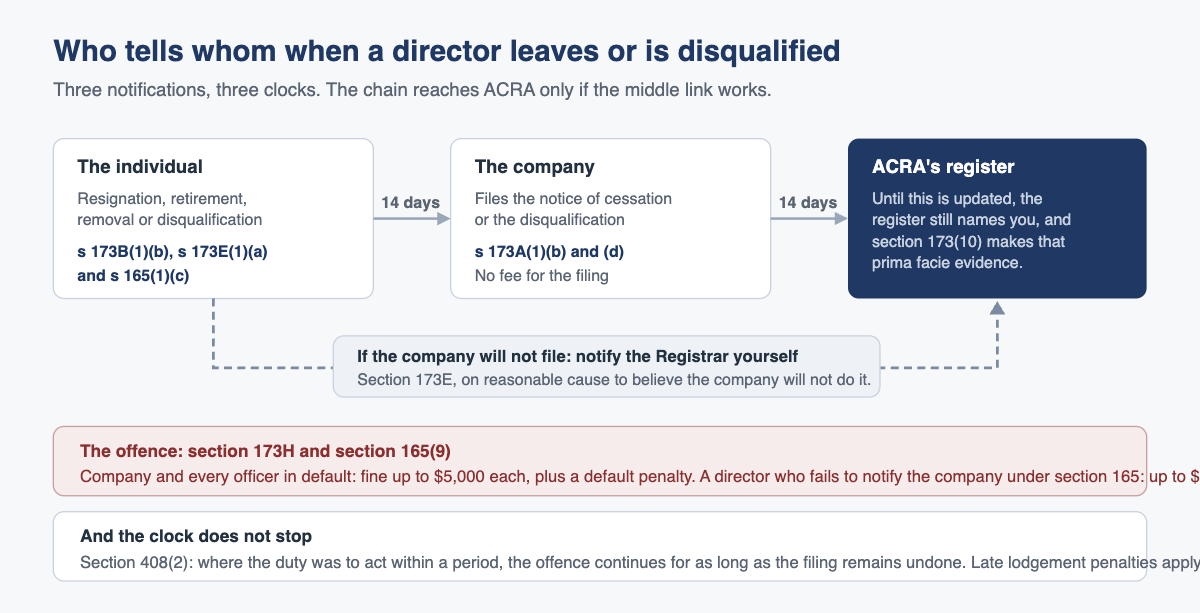
Read the table downwards and you can see why so many cessations go unfiled. The chain starts with the person leaving and reaches ACRA only if the company acts on what it is told. When the relationship has broken down, which is precisely when people resign, the middle link fails.
The company’s duty, and the date the clock starts
Section 173A of the Companies Act 1967 requires a company to notify the Registrar within 14 days after a change in the appointment of any director, chief executive officer, secretary or auditor, and within 14 days after any change in the information the register is required to contain.
For a straightforward resignation, retirement or removal, the 14 days runs from the date the officer actually ceased to hold office. Not the date the board discussed it, and not the date the corporate secretary was instructed. That effective date is the subject of our companion article on when a director can resign.
Disqualification is handled separately, and the difference is deliberate. Section 173A(1)(d) requires the company to notify the Registrar within 14 days after it becomes aware that a person has ceased to be qualified to act as a director, whether under sections 148(1), 154(1), 155(1), 155A(1), 155C(1) or 155D(1), or by a disqualification order made by the Court under section 149, 149A or 154(2). The notice must state the fact, the provision it arose under, and the date it took effect.
“Becomes aware” is the trigger, and it recognises reality: most statutory disqualifications happen automatically, with no letter to the company. A company cannot file what it does not know. What it cannot do is arrange not to know.
The individual’s duty to speak first
Two provisions sit on the person rather than the company.
Section 173B(1)(b) requires a director, chief executive officer, secretary or auditor to give the company any information it needs to comply with its own filing duty, as soon as practicable and no later than 14 days after the change. That covers a resignation, a change of address, a change of name and anything else the register records.
Section 173E(1)(a) is newer and narrower. A director who becomes disqualified must notify the company as soon as practicable and no later than 14 days after the disqualification, and the provision says expressly that this operates without affecting section 165(1)(c).
That reference matters, because section 165 carries a much heavier penalty than the filing provisions do. Section 165(1)(c) requires every director and chief executive officer to give the company written notice of such events and matters affecting themselves as the company needs in order to comply with section 173A. Under section 165(9), a director who fails to comply is liable on conviction to a fine not exceeding $15,000 or to imprisonment for a term not exceeding three years, and to a further fine of $1,000 for every day the offence continues after conviction.
The disqualified director who says nothing is therefore not simply being unhelpful. They are exposed under a provision that contemplates imprisonment.
When the company will not file: notifying ACRA yourself
Section 173E gives the stranded officer a way through, and it is a right rather than an obligation.
A director who has resigned and given the company notice of it, or who has been removed or has retired, may give the section 173A notice to the Registrar personally if they have reasonable cause to believe the company will not. Section 173E(3) gives a secretary the same right, section 173E(1)(b) extends it to a disqualified director, and section 173E(4) covers the officer whose residential or contact address has changed and whose company will not update it.
The test is factual and it is evidenced: an unanswered written request to the board, a registered office that no longer responds, a secretary who has also resigned, or a company that has said outright it will not file. Frustration at a slow corporate secretary is not the same thing, and ACRA expects to see that you approached the company first.
The offence, and who actually gets prosecuted
| Failure | Who is liable | Exposure |
|---|---|---|
| Company does not notify the Registrar within 14 days (section 173A(1)) | The company and every officer of the company who is in default | Fine not exceeding $5,000 each, and a default penalty, under section 173H(1) |
| Officer does not give the company the information it needs (section 173B) | The director, CEO, secretary or auditor | Fine not exceeding $5,000, and a default penalty, under section 173H(2) |
| Director does not give the company written notice under section 165(1) | The director or chief executive officer | Fine not exceeding $15,000 or imprisonment up to three years, plus $1,000 per day of continuation, under section 165(9) |
| Late filing, before any prosecution | The entity, administratively | ACRA’s late lodgement penalties, charged per late transaction |
Two features of that table repay attention.
“Officer who is in default” has a definition
Section 408(3) defines an officer in default as one who knowingly and wilfully is guilty of the offence, or who authorises or permits its commission. It is not automatic liability for everyone whose name appears on the register. It is aimed at the officer who knew and let it happen, which in a small company is usually the person who was told about the resignation and did nothing.
The default penalty accrues daily
Section 408(1) makes a person already convicted or dealt with for an offence guilty of a further offence if it continues, with an additional penalty for each day of up to the amount specified as the default penalty or, where none is specified, up to $200 a day. Section 408(2) then deems an offence of not doing something within a period to continue for as long as it remains undone, even though the period has elapsed.
In plain terms, the 14 days expiring does not close the matter, and the exposure grows until the filing is made. Late lodgement penalties sit on top as an administrative charge on the transaction.
What non-notification costs you even if nobody prosecutes
Prosecution is the tail risk. The everyday cost of an unfiled cessation is that the register keeps saying you are there.
Under section 173(10) of the Companies Act 1967, a certificate of the Registrar stating that a person was named as a director, chief executive officer, secretary or auditor at a given time is received as prima facie evidence of that fact until a notification of change is given. Under section 173(14), documents required to be served on such an officer are sufficiently served if sent to the residential address or contact address in the Registrar’s register. None of that stops because you have resigned. It stops when the notification is lodged.
So banks, counterparties, insurers, grant administrators and investors run a Business Profile and see your name, the company’s regulatory correspondence keeps reaching you, and any due diligence on you personally turns up a directorship you say you left and cannot evidence. Section 173F lets the Registrar amend the register on the Registrar’s own initiative where there is reasonable cause to believe a director has been disqualified or has died, but that is a discretion, not a substitute for filing. Where the drift has run for years and the entity’s own registers no longer match ACRA’s, the repair is larger than a single transaction: see restoring statutory registers and records.
What goes wrong in practice
Everyone assumes the corporate secretary already knows. The board discusses a resignation, nobody sends the instruction, and the 14 days passes while three people each believe a fourth is handling it. Put the instruction in writing on the day.
Disqualification treated as the company’s problem alone. It is two duties on two clocks: the director tells the company, the company tells ACRA. A director who stays quiet is exposed under section 165(9), the heaviest penalty in this area by a wide margin.
Waiting for the annual return to tidy things up. The annual return is not a cessation filing, and reaching it with unfiled changes simply documents the lateness.
Self-notifying without evidence of having asked the company first. The right under section 173E depends on reasonable cause to believe the company will not file. Build that record before you use the route, and remember that each entity is a separate notification.
Not checking the register a week later. A submitted transaction is not an approved one, and ACRA’s published position is that applications requiring further review are processed within 20 working days. Officers and members can pull the register of directors free of charge under section 12(2C), so verification costs nothing.
Frequently asked questions
How long does a company have to tell ACRA that a director has resigned?
Fourteen days. Section 173A(1)(b) of the Companies Act 1967 requires notice to the Registrar within 14 days after the change in appointment, running from the effective date of the resignation rather than from the date the company decides to file. Late filings attract ACRA’s late lodgement penalties per transaction.
What is the penalty for not telling ACRA about a director’s cessation?
Under section 173H(1), the company and every officer in default are each liable on conviction to a fine not exceeding $5,000 and also to a default penalty. Section 408 allows that default penalty to accrue daily while the filing remains outstanding, and administrative late lodgement penalties apply separately.
Does a disqualified director have to tell the company?
Yes. Section 173E(1)(a) requires notice to the company as soon as practicable and no later than 14 days after the disqualification. Section 165(1)(c) imposes a parallel written notice duty, and failure to comply with it carries a fine of up to $15,000 or imprisonment of up to three years under section 165(9).
Can I notify ACRA myself if my company refuses to file my resignation?
Yes, if you have reasonable cause to believe the company will not do it. Section 173E(2) allows a director who has resigned, been removed or retired to give the notice to the Registrar directly. Keep evidence that the company received your resignation and that you asked it to file.
Am I still a director if the cessation was never filed?
No, if the resignation was legally effective. But ACRA’s register will continue to name you, and under section 173(10) that record is prima facie evidence of the position until the notification is lodged. In practice you will be treated as a serving officer by anyone who looks you up.
Closing the chain properly
The reliable version of this is unglamorous: a written resignation with evidence of receipt, an instruction to file issued the same day, a filing made well inside the 14 days, and a register check a week later.
Raffles Corporate Services runs that chain for the companies we act for, and also for individuals who need to get themselves off a register a company will not touch. If you are carrying unfiled changes from previous years, the earlier they are regularised the smaller the bill.
You can reach us through Raffles Corporate Services, or read more on Singapore corporate secretarial practice at Singapore Secretary Services.
— The Editorial Team, Raffles Corporate Services
Need help with corporate secretarial or compliance matters?
If you would like help with your company's corporate secretarial, governance or compliance requirements, email [email protected] or WhatsApp +65 8501 7133.
Our team can assist with corporate secretarial, accounting and tax matters. Where legal advice is needed, advisers from our associated law firms can assist.