

A Singapore director can resign once two conditions are satisfied: the resignation complies with the company’s constitution, and at least one director ordinarily resident in Singapore remains in office afterwards. If the second condition fails, the resignation is not delayed. It is invalid.
Raffles Corporate Services works with a panel of experienced Singapore law firms who offer cost-effective and efficient legal service and advice. This article is general information only and is not legal advice.
That distinction is the whole article. Most people treat a resignation as a letter: write it, send it, you are out. In Singapore company law the letter is only the trigger. Whether it works, and from what moment, depends on the constitution, on who is left on the board, and on when the company received the notice.
For the wider picture of the four routes out of a board, including retirement, removal and automatic vacation of office, read how a director leaves office in Singapore alongside this one.
The two conditions, side by side
| Condition | Where it comes from | What satisfies it | What happens if it fails |
|---|---|---|---|
| The resignation follows the constitution | Section 145(4A) of the Companies Act 1967 applies only “unless the constitution otherwise provides” | Written notice given to the company in whatever form, period and manner the constitution requires | The notice may not take effect on the date you intended, or may not be effective at all until the constitutional requirement is met |
| At least one ordinarily resident director remains | Section 145(5) of the Companies Act 1967 | Another director who is ordinarily resident in Singapore is in office at the moment your resignation would take effect | The purported resignation is invalid. You remain a director with every duty that carries |
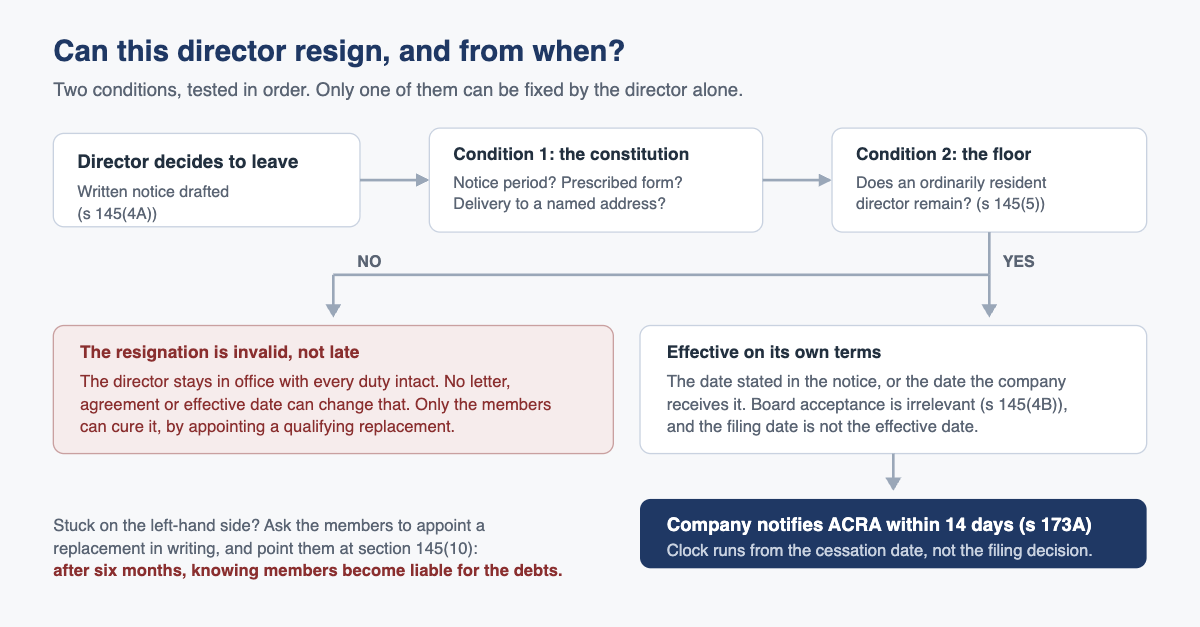
The two are not equal in weight. A constitutional defect is curable: reissue the notice properly and lose a few days. A breach of the resident director floor is not curable by anything the departing director can do alone.
Condition one: what the constitution does to your notice
Section 145(4A) of the Companies Act 1967 says that, unless the constitution otherwise provides, a director may resign by giving the company written notice of resignation. Section 145(4B) adds that the resignation is not conditional upon the company accepting it. No board approval, no resolution, no negotiation: the notice is the act.
The opening words of section 145(4A) are what you have to check. Because it applies only where the constitution is silent, a constitution can impose a notice period, prescribe a form, require delivery to a particular person or address, or state that the resignation takes effect only at the next board meeting. Those provisions are lawful and they bind you.
What to look for before you sign anything
Read the directors’ clauses and answer four questions:
- Is a minimum notice period specified? One month is the most common variation we see.
- Must the notice go to the registered office, to the secretary, or to the board?
- Does the constitution say when the resignation takes effect, as opposed to when notice is given?
- Does it list events that vacate office automatically, and is one of them about to happen anyway?
If the company adopted the model constitution without amendment, the answers are usually straightforward. If it has a tailored constitution drafted around a shareholders’ agreement, assume nothing: see model constitution versus tailored constitution.
Condition two: somebody ordinarily resident has to be left behind
Section 145(1) requires every company to have at least one director ordinarily resident in Singapore, and section 145(5) protects that requirement with unusual force. Despite anything in the Act, in the constitution, or in any agreement with the company, a director must not resign or vacate office unless at least one director ordinarily resident in Singapore remains, and any purported resignation or vacation of office in breach of that subsection is invalid.
Three words do the damage. “Despite” means you cannot contract around it. “Any agreement” means a service agreement, a shareholders’ agreement or a nominee director agreement promising you an exit does not deliver one. “Invalid” means the resignation has no legal effect at all: you are not a former director whose paperwork is outstanding, you are a serving director who wrote a letter.
The Act does not define “ordinarily resident in Singapore”. In practice the test is whether Singapore is the person’s usual place of residence, which is why citizens, permanent residents and foreign nationals living here on a valid pass with a local residential address are the people who normally satisfy it. A local address attached to someone who lives abroad does not.
The exception, and why it does not help volunteers
Section 145(6) disapplies the resident director floor where a director is required to resign or vacate office by reason of disqualification, removal or revocation of appointment under the disqualification provisions of the Act, including sections 148, 149, 149A, 154, 155, 155A and 155C, or under the equivalent provisions in the financial services legislation listed there.
The logic is consistent. The floor stops a director walking away and stranding the company. It does not stop the law removing someone who is no longer fit to serve. A company whose only resident director becomes bankrupt therefore loses that director immediately, and is in breach of section 145(1) until the members appoint a replacement. The grounds and durations are set out in director disqualification in Singapore.
Giving notice to the company: what counts, and when
“Giving the company” written notice is a delivery test, not a drafting test. A perfect letter that never arrives achieves nothing; a scrappy one that provably arrives achieves everything. Use registered post to the registered office, hand delivery against a signed receipt, or email to the secretary and the board asking for written acknowledgement. A message to one director’s personal account is not enough.
Ask for that acknowledgement even though section 145(4B) means you do not need it. It is not consent, it is proof of receipt, and proof of receipt is what ACRA will want if the company later refuses to file your cessation: see filing a notice of cessation.
When the resignation actually takes effect
| Scenario | Effective date | Why it matters |
|---|---|---|
| Notice states a future date, and the constitution permits it | The stated date | Your duties run until that date, not until the letter is signed |
| Notice states no date | The date the company receives it | Receipt, not posting, and not the date on the letterhead |
| Constitution imposes a notice period | The end of that period | A one-month clause makes 01 March 2026 notice effective on 01 April 2026 |
| Board refuses to accept the resignation | Unaffected | Section 145(4B) removes acceptance from the equation |
| No ordinarily resident director would remain | Never | Section 145(5) makes it invalid, so there is no effective date |
| The company files the cessation late | The original effective date | The filing records the event; it does not create it |
The last row is the one that costs money. Section 173A of the Companies Act 1967 gives the company 14 days after the change in appointment to notify the Registrar, running from the cessation and not from the day someone remembers. A resignation effective 03 February 2026 filed in September 2026 is seven months late, and ACRA’s late lodgement penalties are charged per late transaction. Note too that a cessation cannot be filed before it happens, and that a resignation which has taken effect cannot simply be withdrawn: returning to the board means a fresh appointment and a fresh consent to act.
The trapped director problem, and the order you fix it in
Section 145(5) produces a common predicament: the sole resident director of a company whose beneficial owners have lost interest, who wants out and legally cannot get out. A stronger letter does not help, and neither does resigning “with immediate effect”. Work through it in this order:
- Confirm the board composition from ACRA’s register, not from memory. If another ordinarily resident director is already in office, condition two is satisfied and you can resign today.
- Ask the members, in writing, to appoint a qualifying replacement. Appointment is a members’ or board decision depending on the constitution, and it is not yours to make. Put a deadline on the request and keep the correspondence.
- Make the consequences explicit to the members. Under section 145(10), if a company carries on business without at least one ordinarily resident director for more than six months, a member who knows it is doing so becomes liable for all the debts contracted during that period and may be sued for them. That is personal exposure for shareholders, and it concentrates minds faster than anything else here.
- Consider the Registrar’s power to intervene. Section 145(7) allows the Registrar, on the Registrar’s own motion or on any person’s application, to direct the members to appoint an ordinarily resident director, and section 145(8) makes each member in default of that direction liable to a fine not exceeding $2,000 with a further fine of up to $1,000 for each day the offence continues after conviction. Section 145(9) allows the Court to order the appointment.
- Deal with the entity itself if it is genuinely abandoned. Where there are no operations and nobody willing to run it, the exit runs through the entity rather than the board seat: see the trapped nominee director’s exit.
Throughout all of it you are still a director, and the duties in section 157 continue to apply. Directors in this position sometimes stop attending to the company on the basis that they have resigned, which is the worst available response: it adds neglect to a directorship they have not left.
What goes wrong in practice
Resigning first and looking for a successor afterwards. The sequence is replacement, then resignation. Reversed, it produces a director who believes they have left and a register that says otherwise.
Treating a signed and dated letter as the end of the matter. Nobody delivered it, nobody filed the cessation, and the 14-day clock ran out months ago. The letter is evidence of intention, not of departure.
Assuming the nominee director agreement controls the exit. Section 145(5) applies despite any agreement with the company, so a contractual right to resign on notice is unenforceable against the statutory floor.
Forgetting everything attached to the seat. Bank mandates, guarantees, Corppass assignments, CPF and IRAS authorisations and any shareholding survive the resignation and need their own decisions. The joining checklist works in reverse: see our practical checklist for a new director.
Frequently asked questions
Can the sole director of a Singapore company resign?
Not if they are the only director ordinarily resident in Singapore. Section 145(5) of the Companies Act 1967 makes any such resignation invalid, so the person remains in office with full duties. The members must appoint a qualifying replacement first, and only then can the outgoing director leave.
Does a director need board approval to resign?
No. Section 145(4B) states that a director’s resignation is not conditional upon the company’s acceptance. Once written notice is given to the company in the manner the constitution requires, the resignation takes effect on its terms. The board cannot refuse it, although the resident director rule can still invalidate it.
When does a director’s resignation take effect in Singapore?
On the date stated in the notice, or on the date the company receives the notice if none is stated, subject to any notice period in the constitution. The date ACRA is notified is not the effective date. The company’s 14-day filing deadline runs from the effective date.
How much notice must a Singapore director give before resigning?
None under the Companies Act 1967. Section 145(4A) requires only written notice to the company, and section 145(4B) means the company does not have to accept it. A notice period applies only where the constitution or the director’s service agreement imposes one, so read both documents before giving notice.
What happens if my resignation is invalid under section 145(5)?
You remain a director in law and on ACRA’s register. Your statutory duties continue, you can still be prosecuted for the company’s compliance failures, and you remain exposed to claims arising from the period after you thought you had left. The only cure is the appointment of an ordinarily resident replacement.
Getting out cleanly
A resignation that works is a short sequence: read the constitution, check who is left on the board, secure the replacement if you are the floor, deliver the notice provably, then file the cessation inside 14 days and verify it on the register.
Raffles Corporate Services runs that sequence for both sides of the table. If you are the only resident director of a company you no longer want to be part of, speak to us before you sign a letter that may have no legal effect.
You can reach us through Raffles Corporate Services, or read more on Singapore corporate secretarial practice at Singapore Secretary Services.
— The Editorial Team, Raffles Corporate Services
Need help with corporate secretarial or compliance matters?
If you would like help with your company's corporate secretarial, governance or compliance requirements, email [email protected] or WhatsApp +65 8501 7133.
Our team can assist with corporate secretarial, accounting and tax matters. Where legal advice is needed, advisers from our associated law firms can assist.