
Every share transaction in a Singapore private company runs through the same five steps, in the same order: authority, resolution, documents, lodgement, register. Allotments, transfers, conversions, redemptions and capital alterations differ only in the detail inside each step.
That is more useful to know than any individual procedure, because transactions almost never fail on the detail. They fail on the order. The resolution is passed before the authority exists. The filing goes in before the stamp duty is paid. The parties treat the signing as the end when it is the middle.
This article sets out the five steps and what sits inside each. The individual transactions are covered in depth elsewhere, and the map of all of them is in our overview of shares and share filings in Singapore, so what follows is the skeleton rather than the walkthrough.
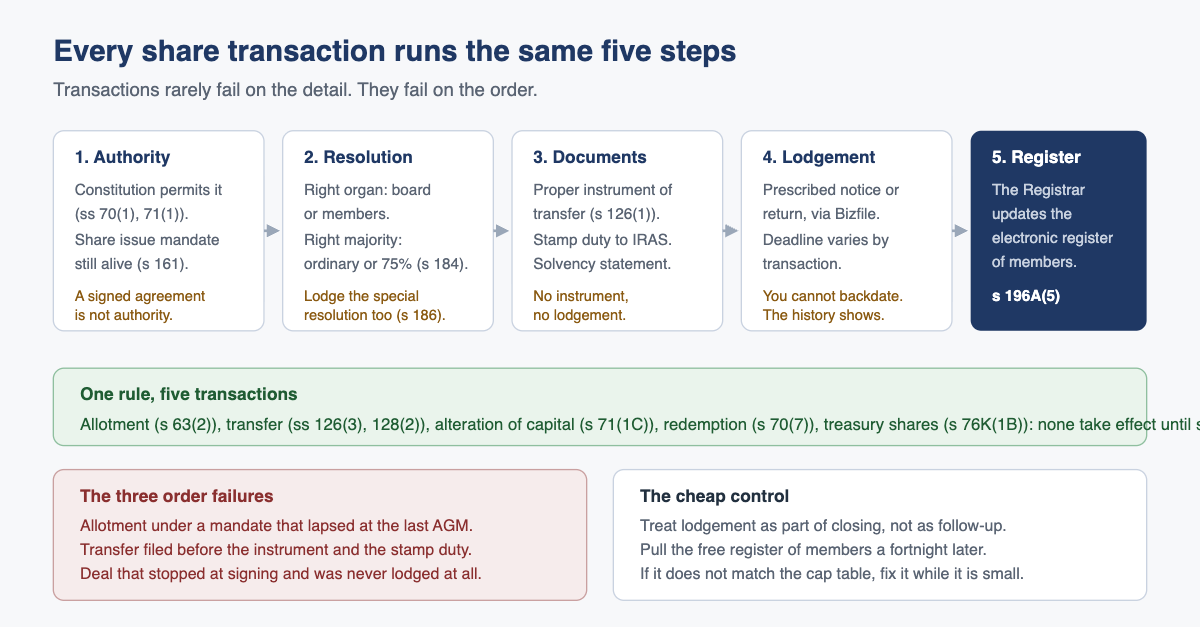
The five steps, in strict order
- Authority. Establish that the company is permitted to do this at all, and that whoever is deciding has the power to decide it. Authority lives in the constitution, in the Companies Act 1967, and sometimes in a standing members’ mandate.
- Resolution. Pass the correct resolution, by the correct organ (board or members), by the correct majority, with the correct notice, and date it correctly.
- Documents. Produce the instruments the transaction actually needs: an instrument of transfer, a solvency statement, a stamp duty payment, a share certificate.
- Lodgement. File the prescribed notice or return with ACRA through Bizfile, within the applicable deadline.
- Register. The Registrar updates the electronic register of members, and at that moment the transaction takes legal effect.
Skipping a step is survivable. Reversing two of them usually is not, because the earlier step cannot be validly performed with knowledge of the later one already in place.
Step 1: Authority, which is not the same as agreement
The commonest single mistake in share work is treating a signed agreement as authority. It is not. Authority is the company’s power to do the thing, and the decision-maker’s power to decide it. Three places to look, every time.
The constitution. Several transactions are unavailable unless the constitution permits them. Redeemable preference shares may only be issued if the constitution so authorises, and may only be redeemed on the terms it provides, under section 70(1). Altering share capital under section 71(1) requires constitutional authority. A buy-back needs express permission. The constitution may also require directors’ approval before a transfer is registered, or give existing members pre-emption rights that must be offered and declined first.
The members’ mandate to issue shares. Under section 161(1), directors must not, despite anything in the constitution, exercise any power of the company to issue shares without prior approval in general meeting. What people miss is section 161(3): that approval continues only until the conclusion of the next annual general meeting, or the date by which it was required to be held, whichever is earlier. A mandate given at the 2025 AGM does not authorise an allotment after the 2026 AGM.
The Act itself. Some steps turn on statutory facts rather than permissions: redeemable preference shares must be fully paid before redemption, a redemption out of capital needs a solvency statement from all the directors, and treasury shares are capped at 10% of the class under section 76I.
Step 2: The resolution, and the part everyone forgets to file
Once authority exists, somebody has to decide. Two questions settle which resolution you need.
Board or members? The board allots shares, approves transfers where the constitution requires approval, and decides what to do with treasury shares. The members give the share issue mandate, alter the capital, alter the constitution and approve a reduction. Getting this wrong produces a resolution passed by the wrong organ, which everyone’s agreement does not cure.
Ordinary or special? An ordinary resolution needs a simple majority. A special resolution needs not less than three-fourths under section 184(1), on not less than 14 days’ written notice for a private company, with the notice specifying the intention to propose it as a special resolution. Most private companies use written means under section 184A instead, where a special resolution needs at least 75% of the total voting rights of all members entitled to vote. The thresholds are set out in our note on what each shareholding percentage actually controls.
The filing nearly everyone misses
Under section 186(1), a copy of every special resolution, and of every resolution that effectively binds a class of shareholders, must be lodged with the Registrar within 14 days of being passed, except where the Act expressly provides otherwise. Default is an offence carrying a fine and a default penalty.
That is a separate filing from the transaction notice. Companies that reduce capital or alter their constitution routinely file the transaction and forget the resolution.
Step 3: The documents the transaction actually needs
Different transactions need different instruments. Four recur.
A proper instrument of transfer. Section 126(1) is categorical: despite anything in its constitution, a private company must not lodge a transfer of shares unless a proper instrument of transfer has been delivered to the company. The exception is transmission by operation of law, such as on death or bankruptcy. No instrument, no filing.
Stamp duty to IRAS. A share transfer attracts stamp duty, payable to IRAS and nothing to do with ACRA. Filing the transfer does not discharge the duty, and paying the duty does not update the register.
Solvency statements. Required from all the directors where redeemable preference shares are redeemed out of capital under section 70(4), and in the non-court route to a capital reduction. A solvency statement is a considered statement about the company’s ability to pay its debts, not a formality, and directors carry personal exposure for making one carelessly.
Certificates and the company’s own records. Share certificates, the cap table, the register of registrable controllers where the change crosses the 25% line, and the minute book. None of these is the legal register, but all will be produced in due diligence and all should agree with ACRA’s version.
Step 4: Lodgement, and the fact that you cannot backdate
Lodgement is the mechanical step, done through Bizfile using the prescribed form. Deadlines vary by transaction, and ACRA’s own overview of share transactions sets out which notice goes with which. Late lodgement attracts late lodgement penalties charged per late transaction, so a company that lets several changes drift accumulates several penalties rather than one.
The rule that surprises people most is that the transaction date cannot be backdated to fit a story told after the event. If the transfer was agreed in March and lodged in September, the register reflects the position on update, not in March, and the gap is visible permanently to anyone who looks at the filing history. That is why a transaction which closed months ago and was never filed cannot simply be tidied up quietly.
Step 5: The register, where the transaction becomes real
For a Singapore private company, the Registrar keeps the electronic register of members, and section 196A(5) requires it to be updated in line with the lodgements the Act requires or permits. The Act then says the same thing, transaction by transaction, in almost identical words.
| Transaction | Where authority normally comes from | Who resolves | The provision that makes it effective only on register update |
|---|---|---|---|
| Allotment of new shares | Members’ mandate under section 161 | Board allots, members give the mandate | Section 63(2) |
| Transfer of shares | Constitution: directors’ approval and pre-emption | Board, where approval is required | Sections 126(3) and 128(2) |
| Alteration of share capital | Constitution must authorise it, section 71(1) | Members in general meeting | Section 71(1C) |
| Redemption of redeemable preference shares | Constitution must authorise it, section 70(1) | Board, on the constitutional terms | Section 70(7) |
| Cancellation or disposal of treasury shares | Sections 76H to 76K | Board | Section 76K(1B) |
Five different transactions, one rule. Nothing has happened until the register says it has.
The practical consequence is worth spelling out. A buyer who has signed, paid and received a certificate is not yet a member. They cannot vote, they are not entitled to a dividend as of right, and they are not the person a court or a bank will treat as the owner. The seller remains the member until the Registrar updates the register.
What goes wrong: the steps done in the wrong order
Three patterns account for most of the remedial work we see.
The allotment under an expired mandate. The board allots shares in November relying on an approval given at the previous year’s annual general meeting, which lapsed at the conclusion of the meeting held in August. The return of allotment is filed and accepted, because ACRA does not police the mandate. The defect surfaces in due diligence, and curing it needs a ratifying resolution from the very members whose holdings were diluted.
The transfer filed ahead of the paperwork. The parties agree the sale, the corporate secretary is asked to “get it filed”, and the instrument of transfer and stamp duty follow afterwards, or never. Section 126(1) prohibited the lodgement. Unwinding that is considerably harder than doing it properly would have been.
The transaction that stops at signing. The commonest of all. Everybody behaves as though the shares moved on the day of the handshake: the new holder attends meetings, receives distributions, is described as a shareholder in a grant application. Nobody lodged anything, because the person who would have lodged it was not in the room. Years later an acquirer pulls the register of members and it does not match the cap table.
The cheap control against all three is the same: treat lodgement as part of closing rather than as follow-up, then pull the free register of members a fortnight later and read it. Where the change also affects who controls the company, check the register of registrable controllers at the same time.
Where the detail lives
Each transaction has its own document set and its own way of failing, and each is treated separately:
- Share types, class rights and what to issue: ordinary versus preference shares
- What a shareholding percentage controls: the threshold ladder
- The full map of every share filing: shares and share filings in Singapore
- Allotments and transfers in practice: how to allot and transfer shares
- Varying class rights: section 74 in detail
- Subdividing and consolidating: section 71 in detail
- Taking capital out: reducing share capital by solvency statement
Frequently asked questions
What are the steps in a share transaction in Singapore?
Five, in order: establish authority under the constitution and the Companies Act 1967; pass the correct resolution by the correct organ and majority; produce the required documents, such as an instrument of transfer and the stamp duty payment; lodge the prescribed notice with ACRA; and wait for the Registrar to update the electronic register of members, which is when the transaction takes effect.
Do I need to file a share transaction with ACRA if all the shareholders agree?
Yes. Agreement between the parties is not what moves the shares. For a private company, an allotment, transfer, alteration of capital, redemption or treasury share dealing takes effect only when the Registrar updates the electronic register of members under section 196A(5). Unanimous consent shortens the resolution step; it does not remove the filing.
Can I backdate a share transfer to the date we signed?
No. The register reflects the position when it is updated, not when the parties agreed. The filing history shows both dates, permanently, to anyone who looks. If a transaction closed months ago and was never lodged, the honest course is to file it now and deal with the consequences of the delay rather than attempt to disguise it.
How long is a shareholders’ approval to issue shares valid for?
Under section 161(3), an approval given to the directors to issue shares continues only until the conclusion of the next annual general meeting after it was given, or the date by which that meeting had to be held, whichever is earlier. It can also be revoked or varied earlier by the members. Allotments made after it lapses are made without authority.
Doing the five steps in order, every time
Share transactions are not difficult. They are unforgiving about sequence, and the cost of getting the sequence wrong is usually paid years later by someone who was not in the room when the deal was done.
Raffles Corporate Services runs share transactions for Singapore private companies end to end: checking the constitution and the share issue mandate before anything is signed, drafting and filing the resolutions, coordinating the stamp duty step, lodging the transaction, and reconciling ACRA’s register against the company’s own records afterwards. If you have a transaction closing soon, or one that closed and was never filed, both are worth a short conversation.
You can reach us through Raffles Corporate Services, or read more at Singapore Secretary Services. The provisions are in the Companies Act 1967.
— The Editorial Team, Raffles Corporate Services