

A return of allotment is the Bizfile filing that tells ACRA your company has issued new shares. For a Singapore private company it is not a report of something that has already happened. It is the thing that makes the allotment happen. It is free and it is immediate.
Raffles Corporate Services works with a panel of experienced Singapore law firms who offer cost-effective and efficient legal service and advice. This article is general information only and is not legal advice.
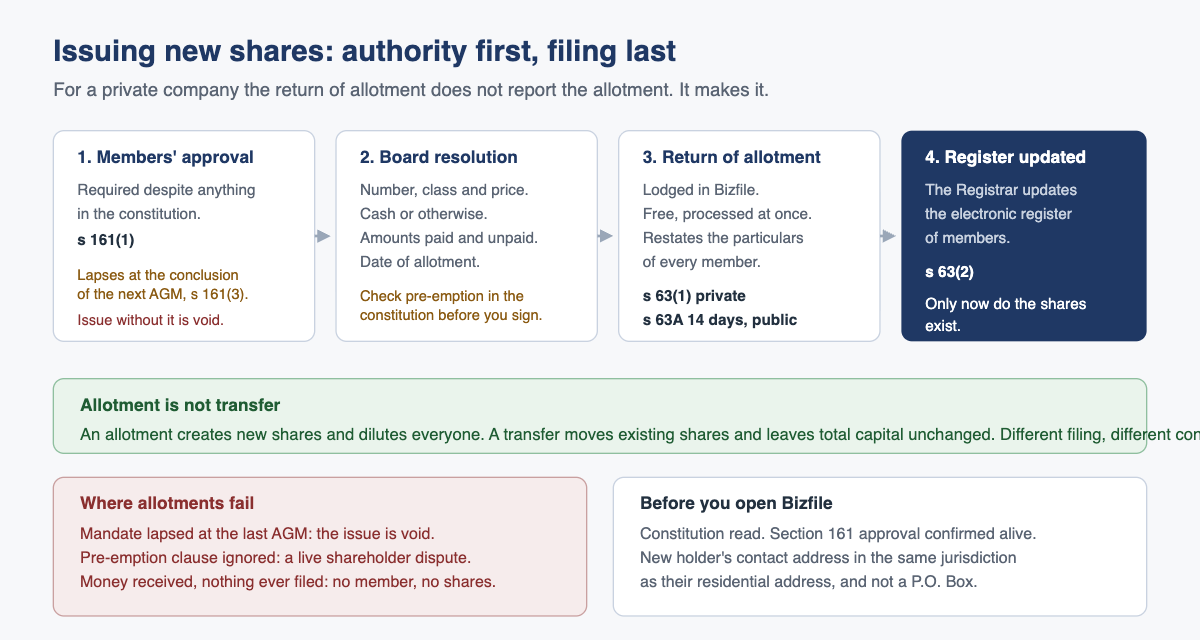
That distinction matters more than anything else here. Under section 63(1) of the Companies Act 1967, a private company allots new shares by lodging the return with the Registrar. Under section 63(2), the allotment does not take effect until the Registrar updates the electronic register of members. The money can be in the bank, the certificate can be printed and the investor can be sitting in board meetings, and still nothing has legally moved.
The filing takes minutes and costs nothing. What goes wrong sits upstream of it, in the approval that allows the directors to issue shares at all.
What is a return of allotment?
A return of allotment is the prescribed notice, lodged through Bizfile, by which a company records with ACRA that new shares have been issued. It updates the company’s share capital and the shareholding of whoever received the shares.
An allotment is different from a transfer. An allotment creates new shares and increases the total share capital, so every existing shareholder’s percentage falls unless they take up their proportion. A transfer moves existing shares from one person to another and leaves total capital unchanged. Our note on filing a share transfer with ACRA deals with the other half.
Shares can be allotted for cash or otherwise than in cash: services rendered, an asset brought into the company, the capitalisation of a loan or a dividend satisfied in shares. Non-cash allotments need the underlying contract or court order available, because ACRA can ask for it.
Who has to approve a share issue before you file?
This is the step companies skip, and the one that creates real legal exposure.
Section 161(1) of the Companies Act 1967 says that despite anything in a company’s constitution, the directors must not exercise any power of the company to issue shares without the prior approval of the company in general meeting. Read the first four words again. It does not matter that your constitution gives the directors a free hand. The members must have approved. That approval can be specific to one issue or a general mandate, and it may be unconditional or subject to conditions.
The expiry nobody diaries
Under section 161(3), the approval continues only until the earlier of two dates: the conclusion of the annual general meeting held next after it was given, or the date by which that meeting was required by law to be held. Members can also revoke or vary it sooner.
So a general mandate passed at the 2025 AGM is dead the moment the 2026 AGM concludes. Directors who allot after that are allotting without authority, and section 161(6) is blunt: any issue of shares made in contravention of the section is void, and the consideration given for the shares is recoverable accordingly. Section 161(7) adds that a director who knowingly contravenes the section, or permits or authorises the contravention, is liable to compensate both the company and the recipient of the shares, with a two-year limitation period running from the date of issue.
Bizfile will not stop you. ACRA does not audit whether your mandate was alive. The defect surfaces years later, usually in due diligence, and curing it requires a ratifying resolution from the very members whose holdings were diluted.
Pre-emption rights, which are a separate question
Many constitutions and most shareholders’ agreements require new shares to be offered to existing members first, in proportion to their holdings, before they can go to an outsider. That is a pre-emption right, and for private companies it is a contractual or constitutional protection rather than a general statutory one.
Nothing in the ACRA filing checks it. If your constitution has a pre-emption clause and you allotted straight to a new investor without offering the existing members their strip, the allotment will file cleanly and you will have a live dispute. Read the constitution before the board meeting, not after the filing. Our guide to the company constitution in Singapore covers where these clauses usually sit.
The board resolution, and what the return contains
Once the members’ approval exists, the directors fix the commercial terms: the number of shares and to whom, the class and sub-class, the issue price and total consideration, whether the shares are payable in cash or otherwise than in cash, the amount paid and unpaid on each share, and the date of allotment. Date the resolution accurately. The date of allotment is a field in the return, and a resolution dated after the money arrived tells its own story to anyone reading the file later.
Section 63(1) then prescribes the particulars the return must carry for a private company. They are worth gathering before you open Bizfile, because collecting them afterwards is what turns a five-minute filing into a fortnight of chasing.
| Particular | Detail required |
|---|---|
| The allotment | Number of shares comprised in the allotment |
| Payment | Amount (if any) paid or deemed paid on each share |
| Unpaid amount | Amount (if any) unpaid on each share |
| Class | Where capital is divided into classes, the class each allotted share belongs to |
| Every member | Full name of each member of the company |
| Every member | Identification and nationality, if the Registrar requires it |
| Every member | Residential address and contact address for individuals, or address for a body corporate |
| Every member | Number and class of shares held |
Note the scope of that last block. The return is not limited to the new shareholder. It restates the particulars of every member, which is why an allotment is a convenient moment to clean up stale addresses. One point people trip over: a member’s contact address must be in the same jurisdiction as their residential address, and a post office box is not acceptable.
Is there really a 14-day deadline?
Not for a private company, and this is where the common advice is loose.
Section 63A(1) imposes the 14-day rule on public companies: where a public company makes an allotment other than a deemed allotment, it must lodge the return within 14 days. Section 63A(3) backs it with an offence carrying a fine not exceeding $4,000 and a default penalty of $250 for every officer in default.
Section 63, the private company provision, contains no period at all. It cannot sensibly contain one, because the filing is the allotment: there is no gap between the event and the report of it to be policed.
| Private company | Public company | |
|---|---|---|
| Governing provision | Section 63 | Section 63A |
| Statutory filing deadline | None stated: the filing effects the allotment | Within 14 days of the allotment |
| When the allotment takes effect | When the Registrar updates the electronic register of members, section 63(2) | On allotment; the return reports it |
| Member particulars required | Every member | The 50 largest members, excluding treasury shares |
| Listed company relief | Not applicable | Member particulars not required if listed on an approved exchange |
| ACRA filing fee | Free | Free |
The practical rule for a private company is therefore simpler and stricter than a deadline: file on the day you allot. Anything else means the company has not issued the shares it believes it has issued.
The steps, in order
- Check the constitution. Does it restrict the classes you may issue? Does it contain pre-emption rights?
- Check the section 161 approval. Does a live members’ approval exist, and has it survived the last AGM? If not, pass one first.
- Pass the board resolution. Number, class, price, consideration, amounts paid and unpaid, date of allotment.
- Collect the new shareholder’s particulars. Full name, identification number, nationality, contact address in the right jurisdiction.
- Lodge the return of allotment in Bizfile through the shares eService, as a company officer or through your corporate service provider. If the section 161 resolution has not been filed separately, you will be asked for the meeting date and a copy of the resolution during the filing.
- Check the electronic register of members afterwards. Officers and members can download it free, so there is no excuse for assuming.
- Issue the share certificate and update the company’s own records, including the register of registrable controllers if the allotment moves anyone across the controller threshold.
What goes wrong, and what it costs
The allotment under a lapsed mandate. Easily the most common. The filing succeeds, the defect is invisible for years, and section 161(6) says the issue is void. It is found by an acquirer’s lawyers at the worst possible moment, and the fix requires the cooperation of shareholders who have just learned they were diluted without authority.
The allotment that was never filed. The investor wires the money, the founders shake hands, and the paperwork is left with whoever seemed most likely to deal with it. Because section 63(2) means no allotment has taken effect, the investor is not a member: they cannot vote, they have no right to a dividend, and on the register they simply do not exist. The money sits in the company as something the accountants must characterise, and our note on share capital, share premium and reserves explains why that is not a neutral position.
The wrong numbers, filed and accepted. Bizfile accepts what you type. Enter the wrong class, quantity or paid-up amount and ACRA’s records are now wrong. Some errors can be corrected by lodging a Notice of Error. Some cannot, and the remaining route is a court application to amend the record. That is why the review screen deserves a second pair of eyes.
Options issued without a plan for the mandate. Section 161(4) allows directors to issue after the approval has lapsed, provided the offer, agreement or option was made while the approval was in force and the approval authorised them to make it. Employee share option schemes need this thought through at grant, not at exercise.
Frequently asked questions
How long do I have to file a return of allotment in Singapore?
A public company must lodge the return within 14 days of the allotment under section 63A of the Companies Act 1967. A private company has no separate deadline, because section 63 makes the lodgement itself the act of allotting, and the allotment does not take effect until the Registrar updates the electronic register of members. File it on the day you allot.
Does ACRA charge a fee for a return of allotment?
No. The return of allotment is a free filing in Bizfile and is processed immediately once submitted. The cost of getting it wrong is a different matter: an error that cannot be fixed by a Notice of Error may require a court order to correct ACRA’s records.
Do shareholders need to approve every share issue?
Yes, in substance. Section 161(1) prohibits directors from exercising any power to issue shares without prior approval of the company in general meeting, and it applies despite anything in the constitution. The approval may be a general mandate rather than a decision on each issue, but it must exist and it must still be in force.
How long does a shareholders’ approval to issue shares last?
Until the conclusion of the next annual general meeting after it was given, or the date by which that meeting had to be held, whichever comes first, under section 161(3). Members can revoke or vary it earlier. Shares issued after it lapses are issued in contravention of section 161 and are void under section 161(6).
Getting the order right
An allotment is a two-minute filing sitting on top of a decision that has to have been made properly. ACRA checks the filing. Nobody checks the decision except the people who later have a reason to.
Raffles Corporate Services handles share issues end to end: reading the constitution before anything is signed, confirming the section 161 mandate is alive, drafting the resolutions, lodging the return, and reconciling the register of members against your own cap table. If you have a funding round closing, or an allotment from an earlier year you are no longer sure was done properly, both are worth a short conversation.
You can reach us through Raffles Corporate Services, or read more on Singapore corporate secretarial practice at Singapore Secretary Services. ACRA’s own page on filing a return of allotment sets out the Bizfile screens, and the provisions are in the Companies Act 1967.
— The Editorial Team, Raffles Corporate Services
Need help with corporate secretarial or compliance matters?
If you would like help with your company's corporate secretarial, governance or compliance requirements, email [email protected] or WhatsApp +65 8501 7133.
Our team can assist with corporate secretarial, accounting and tax matters. Where legal advice is needed, advisers from our associated law firms can assist.