
Every Singapore company, foreign company and LLP must keep a private register naming the people who ultimately own or control it, unless it falls within a narrow list of exemptions. That register is the RORC. It is not public, it is not optional, and failing to keep it properly is an offence carrying a fine of up to $25,000 for the entity and for every officer in default.
If you incorporated recently you already have one, because since 16 June 2025 the information is captured at the point of registration. If your company is older, or if you have never been asked about it, there is a reasonable chance yours is either missing or stale.
This article covers what the RORC is and why it exists. Part two covers who counts as a registrable controller, which is the part that actually requires thought. Part three covers filing with ACRA’s central register and keeping it current.
What is a Register of Registrable Controllers?
The RORC is a private register listing the individuals and legal entities that have significant interest in, or significant control over, your business. Most people know them as beneficial owners. The register records their particulars, when they became a controller, and when they ceased to be one.
Two things make it different from your other registers.
First, it looks through the legal owner to the real one. Your register of members shows who holds the shares. The RORC shows who is actually behind them. If a Singapore company is wholly owned by a BVI company which is in turn owned by two individuals, the register of members shows the BVI company and the RORC shows the individuals.
Second, it is private. The public cannot see it, and you are prohibited from letting them. Access is limited to ACRA and law enforcement agencies. That is a deliberate design choice: the register exists for investigators, not for counterparties.
The obligation sits in Part 11A of the Companies Act 1967. Section 386AF requires the register to be kept, updated and withheld from the public, and sets the $25,000 fine for failing to do any of those things.
Why Singapore introduced it
Singapore’s RORC regime took effect on 31 March 2017. It was not an isolated piece of housekeeping. It came in alongside the nominee director and nominee shareholder registers, as part of Singapore’s response to international standards on beneficial ownership transparency.
The problem the regime solves is simple to state. A jurisdiction where a company’s real owners can be hidden behind two or three layers of foreign holding companies is a jurisdiction that will eventually be used for money laundering, sanctions evasion and tax fraud. Singapore’s answer was to require every entity to identify its own beneficial owners, record them, and hand that record to the regulator.
Note the allocation of work. ACRA does not identify your controllers for you and will not do it on request. The duty to take reasonable steps to find out who your controllers are sits on the company, under section 386AG of the Companies Act 1967. If you cannot identify anyone after genuine effort, there is a fallback, and you are expected to keep the evidence of the effort you made.
The same policy thread runs through the licensing of corporate service providers and the tightening of nominee director rules. Our Corporate Service Providers Act 2024 compliance FAQ covers the provider side of the same architecture.
Who must keep one
The requirement applies to:
- All Singapore-incorporated companies, private and public
- All foreign companies registered in Singapore
- All limited liability partnerships
It applies whether or not the business is trading. A dormant company keeps a RORC. So does a company in winding up, in receivership, under judicial management, or in the middle of a striking off application. People routinely assume that a company on its way out is excused. It is not.
Who is exempt
The exemptions are set out in the Fourteenth Schedule to the Companies Act 1967 for local companies and the Fifteenth Schedule for foreign companies. They are narrow, and they are aimed at entities whose ownership is already transparent through some other regime.
| Entity | Exempt? |
|---|---|
| Public company listed on an approved exchange in Singapore | Yes |
| Singapore financial institution (licensed, approved, registered or regulated by MAS) | Yes |
| Company wholly owned by the Government | Yes |
| Company wholly owned by a statutory body established under a public Act | Yes |
| Wholly owned subsidiary of any of the above | Yes |
| Company listed on a foreign securities exchange with equivalent disclosure and beneficial ownership transparency requirements | Yes |
| Foreign company with a primary listing on an approved exchange in Singapore | Yes |
| LLP where every partner is itself an exempt company or foreign company | Yes |
| An ordinary Singapore private limited company with two local shareholders | No |
| A dormant company | No |
| A company being struck off | No |
Being exempt does not mean doing nothing. You still have to tell ACRA you are exempt through the RORC update eService, and you declare the exemption when you file your annual return or annual declaration.
Exemption can also be lost. A listed company that delists stops being exempt, and it then has 60 days from the date it becomes subject to the requirement to set up its register. Once set up, a previously exempted business files the information with ACRA’s central register within two business days.
When the register has to exist
| Your situation | Deadline to have the RORC in place |
|---|---|
| Incorporated or registered from 16 June 2025 | The same day you incorporate or register. The details are provided at registration |
| Previously exempt, exemption lost | Within 60 days of becoming subject to the requirement |
| Already subject to the requirement | It should already exist. Keep it current |
Where you keep it matters too. The physical or electronic register must sit at your registered office address, or at your corporate service provider’s office. Not in a personal email account, and not on a director’s laptop in another country.
What goes wrong in practice
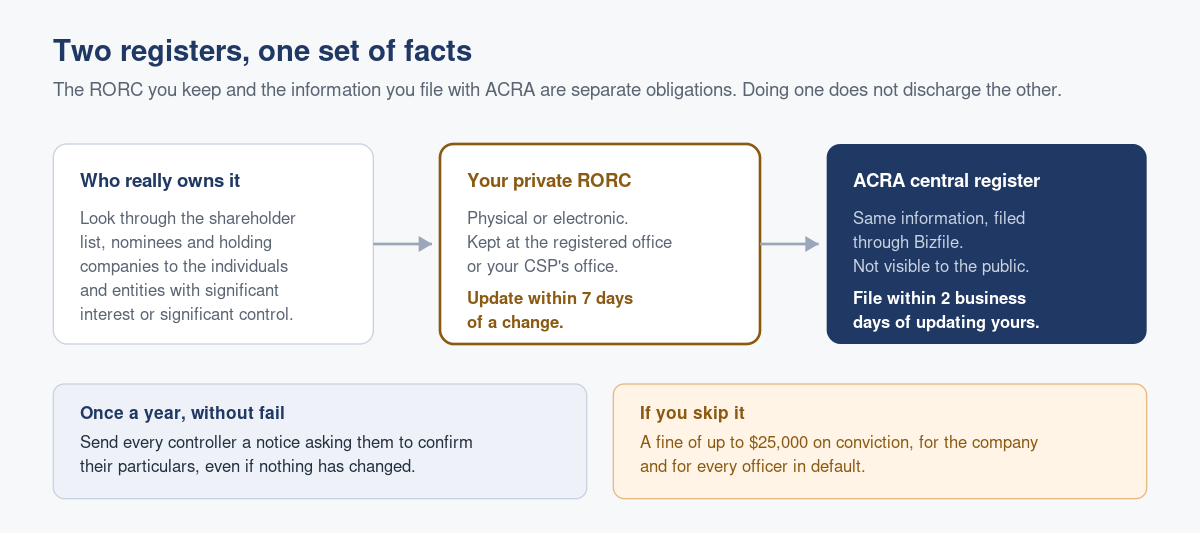
Confusing the private register with the ACRA filing. These are two separate obligations, not one. You keep the private register, and you separately file the same information with ACRA’s central register. Companies that filed at incorporation and assumed that was the whole job frequently have no private register at all, which is its own offence under section 386AF.
Treating the shareholder list as the answer. For a straightforward two-shareholder company the controllers and the shareholders may well be the same people. For anything with a corporate shareholder, a trust, a shareholders’ agreement, or a shareholder holding exactly 25%, they may not be. That is where the analysis in part two earns its keep.
Never sending the annual notice. Even when nothing has changed, the company must send each controller a notice at least once a year asking them to confirm their particulars. Failing to send the annual verification notice exposes the company and its officers in default to a fine of up to $25,000. It is the most commonly skipped step in the whole regime, precisely because nothing has changed and nobody feels the need.
Letting a change sit. When a controller tells you something has changed, you have seven days to update your private register, then two business days from that update to file with ACRA. Both clocks are short and both start without anyone reminding you.
Ignoring nominee arrangements. If shares are held by a nominee, the register looks through the nominee to the person behind. A nominee shareholder who is dutifully recorded in the register of members and nowhere else is a gap. See nominee shareholder arrangements and beneficial ownership disclosure.
Frequently asked questions
Is the Register of Registrable Controllers public?
No. The RORC is private. Your company is prohibited from disclosing it or making it available for inspection by the public. Only ACRA and law enforcement agencies can access the information filed with ACRA’s central register. Counterparties and competitors cannot see who your controllers are.
Does a dormant Singapore company need a RORC?
Yes. The requirement applies regardless of trading activity, and it continues through winding up, receivership, judicial management and striking off. Dormancy suspends no register obligation. The register must be kept, updated when controllers change, and verified annually by notice.
What is the penalty for not keeping a RORC?
Failing to keep, update or properly withhold the register is an offence under section 386AF of the Companies Act 1967, carrying a fine of up to $25,000 on conviction. The fine applies both to the company and to every officer of the company in default, so directors carry personal exposure.
My company is exempt. Do I still have to do anything?
Yes. You must inform ACRA of your exemption status through the RORC update eService, and declare the exemption when you file your annual return or annual declaration. If you later lose the exemption, for example on delisting, you have 60 days to set up the register.
Where must the register be kept?
At your registered office address, or at your corporate service provider’s office. It may be physical or electronic. What matters is that it is held at one of those two addresses and can be produced when ACRA asks for it.
Is the RORC the same thing as the register of members?
No. The register of members records the legal owners of the shares and is maintained electronically by ACRA. The RORC records who ultimately owns or controls the company, looks through nominees and corporate layers, is kept by you, and is not public.
Where most companies want help
The RORC is not hard once the controller analysis is settled. The difficulty is that it is invisible. Nothing prompts you, no email arrives, and the annual notice is a task that exists only if somebody diarises it.
Raffles Corporate Services sets up and maintains RORCs for Singapore companies, issues the annual verification notices, and files updates inside the two business day window. If you are not sure whether your register exists, or whether it names the right people, that is a short review and usually a quick fix.
Read on: who counts as a registrable controller and what ACRA holds versus what you keep. For wider context on the statute, see our Companies Act 1967 deep-dive FAQ, or read more on Singapore corporate secretarial practice at Singapore Secretary Services.
— The Editorial Team, Raffles Corporate Services