

A registrable controller is any individual or legal entity with significant interest in your company, meaning more than 25% of the shares, voting power, capital or profits, or with significant control, meaning the power to appoint or remove the board, more than 25% of member voting rights, or significant influence over the company in fact.
Raffles Corporate Services works with a panel of experienced Singapore law firms who offer cost-effective and efficient legal service and advice. This article is general information only and is not legal advice.
Those two tests are set out in the Sixteenth Schedule to the Companies Act 1967, and they are the whole job. Everything else is application.
For a company owned by two Singaporeans in equal shares, the answer takes ten seconds. For a company with a corporate shareholder, a trust, a nominee, or a shareholders’ agreement giving one party a veto, it takes some thought. This article covers both, and what to do when the answer is nobody.
For what the register is and why Singapore requires it, see part one. For the mechanics of filing, see part three.
Test one: significant interest
Significant interest is the ownership test. The thresholds depend on whether the company has share capital.
| Company type | A person or entity has significant interest if they |
|---|---|
| Has share capital | Have an interest in more than 25% of the shares |
| Has share capital | Hold voting shares carrying more than 25% of the total voting power |
| Has no share capital | Hold a right to share in more than 25% of the capital, or more than 25% of the profits |
Note “more than 25%”, not “25% or more”. A shareholder holding exactly 25% does not meet the interest test on that basis alone, though they may still be caught by the control test.
Note also “an interest in” the shares rather than ownership of them. The Act’s broad concept of an interest in shares applies, which is why options, joint arrangements and nominee holdings matter.
Test two: significant control
Significant control is the power test. It catches people who steer the company without holding the shares. A person or entity has significant control if they:
- Hold the right, directly or indirectly, to appoint or remove the directors who hold a majority of the voting rights at board meetings
- Hold, directly or indirectly, more than 25% of the rights to vote on matters decided by a vote of the members
- Have the right to exercise, or actually exercise, significant influence or control over the company
The third limb is the one people underestimate, and it is deliberately open. A founder who transferred his shares to his children but still decides everything is exercising significant influence in fact. So, potentially, is a lender whose facility agreement lets it veto the budget, senior hires and any change of business. If somebody outside your shareholder list is effectively running the company, consider them.
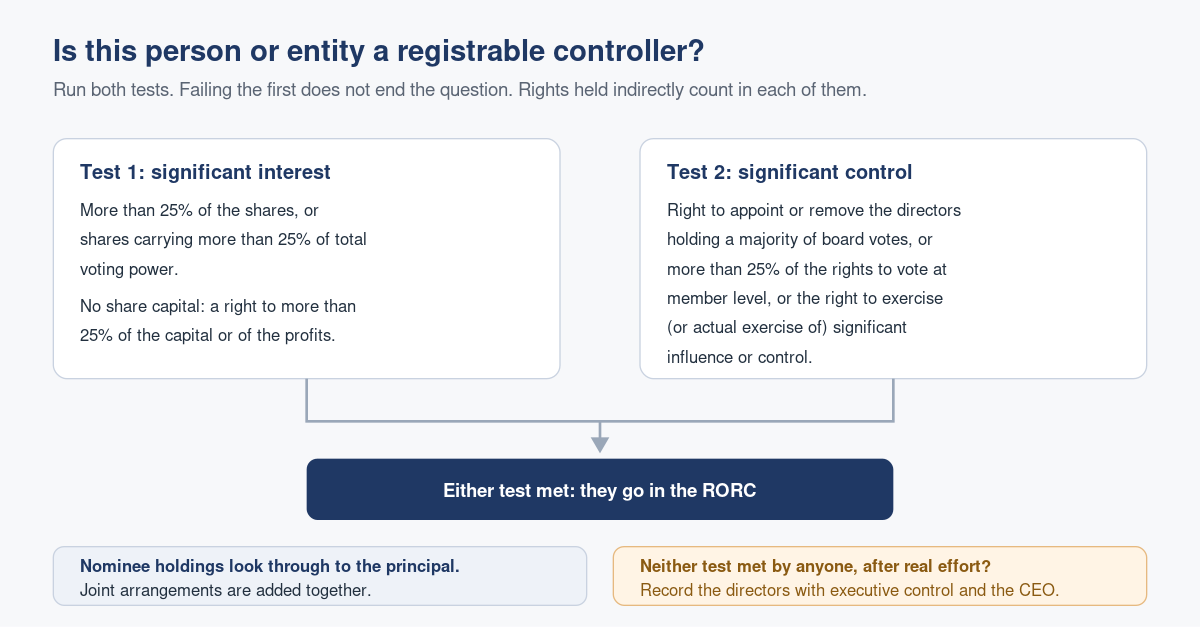
Three rules that change the answer
Rights held indirectly count
Both tests apply to rights held directly or indirectly. If your company is 100% owned by a holding company, and that holding company is 60% owned by an individual, the individual holds more than 25% of your company indirectly. Both are controllers. You are expected to walk up the chain, not stop at the first name on the register of members.
Nominees are looked through
Where a share or a right is held by one person as nominee for another, the Sixteenth Schedule treats it as held by the other person, not by the nominee. The nominee does not become a controller by holding; the person behind them does.
This is why nominee arrangements and the RORC are inseparable in practice. Our note on nominee shareholder arrangements covers the exposure.
Joint arrangements are aggregated
If two shareholders have an arrangement that they will exercise their rights jointly in a predetermined way, each is treated as holding the combined shares or rights. The arrangement need not be legally enforceable: an understanding, a convention or a settled practice counts, provided there is some stability to it.
So two family members with 15% each, who have always voted together under a standing arrangement, may each be treated as holding 30%. Both become controllers. Neither would be, looked at alone.
Worked examples
| Structure | Who goes in the RORC |
|---|---|
| Two Singaporeans hold 50% each | Both individuals |
| One shareholder holds 76%, four others hold 6% each | The 76% holder. The others fail both tests unless they have control rights |
| Four shareholders hold 25% each, no shareholders’ agreement | Nobody on the interest test. Check the control test, then consider the no-controller fallback |
| A BVI company holds 100%, owned 70 / 30 by two individuals | The BVI company as a corporate controller, plus the 70% individual. The 30% individual holds 30% indirectly, so include them too |
| A nominee holds 40% for an undisclosed principal | The principal, not the nominee |
| Two founders hold 15% each and always vote as a bloc under a long-standing arrangement | Both founders, each treated as holding 30% |
| A 10% shareholder can appoint and remove a majority of the board under the constitution | That shareholder, on the control test |
Individual controllers and corporate controllers
Both individuals and legal entities can be controllers, and the particulars you record differ.
| For an individual controller | For a corporate controller |
|---|---|
| Full name and any aliases | Name of the entity |
| Residential address | Registered office address |
| Email address and contact number | Email address and contact number |
| Nationality | Legal form of the entity |
| Identity card or passport number | Jurisdiction of formation and the law it was formed under |
| Date of birth | Name of the corporate registrar it was formed in |
| Date of becoming a controller | Identification or registration number, if one was issued |
| Date of cessation, if applicable | Date of becoming, and ceasing to be, a controller |
Any local or foreign entity can be a corporate controller, including societies and licensed trust companies. Where a foreign corporate controller was never issued a registration number at home, mark that field as not applicable rather than inventing one.
What if you cannot identify anyone?
This is a real outcome, not a failure. It happens where ownership is so widely spread that nobody crosses 25%, and where the chain runs into a jurisdiction that will not tell you anything.
Section 386AG of the Companies Act 1967 requires the company to take reasonable steps to find out and identify its controllers, and to send notices to the people who are likely to know. In practice that means notices to all directors and to each member who directly holds at least 5% of the total voting shares. Recipients have 30 days to respond, and they must respond even if the answer is that they are not a controller. A person who ignores the notice commits an offence carrying a fine of up to $25,000.
If after all that you still have nobody, you fall back to individuals with executive control: the directors with executive control and the chief executive officer. Record their particulars and file on that basis, marking that no controller was identified.
Keep the evidence of the steps you took, because ACRA can ask you to demonstrate it. And if a controller simply failed to respond within the 30 days, enter their most recent known particulars with a note that they are unconfirmed, and mark them as unconfirmed when you file. Silence does not excuse you from updating the register.
What goes wrong in practice
Copying the register of members across. The most common error by a distance. It gives the right answer for simple companies and the wrong answer for any structure with a corporate layer, a nominee or a trust.
Stopping at the first corporate shareholder. A foreign parent is a corporate controller, but not the end of the analysis. The individuals above it are usually controllers too.
Missing the control-only controller. The investor with 20% and a board appointment right, the founder who sold down but still runs the company, the parent whose consent is needed for everything: none show up on a shareholding test.
Ignoring trusts. Where a trust sits in the ownership chain, notices go to the trustee and to the other parties to the trust. Working out who controls trust-held shares is technical, and ACRA’s guidance on the RORC, ROND and RONS is the starting point.
Recording a controller and never revisiting it. Controllers change when shareholdings change, when agreements change, and when people die. The annual notice exists to catch this.
Frequently asked questions
Is a shareholder with exactly 25% a registrable controller?
Not on the interest test, which requires more than 25% of shares, voting power, capital or profits. They may still be a controller under the significant control test, for example if they can appoint or remove a majority of the board, or if they exercise significant influence over the company in fact.
Can a company be a registrable controller, or must it be a person?
Both. Legal entities can be corporate controllers, including foreign companies, societies and licensed trust companies. Where a corporate controller sits in the chain, you record it and continue up the chain to the individuals who control it, since rights held indirectly count under the Sixteenth Schedule.
Does a nominee shareholder go into the RORC?
No, not in that capacity. Where a share is held by one person as nominee for another, the Sixteenth Schedule treats it as held by the person behind the nominee. That person is the controller. The nominee arrangement itself belongs in the Register of Nominee Shareholders.
What happens if a controller does not reply to my notice?
You still have to update your register. Enter their most recent known particulars, add a note that the particulars have not been confirmed, file with ACRA marking them unconfirmed, and do it within seven days of the 30-day response period expiring. The non-responding controller separately commits an offence.
Who do I send controller notices to if I do not know who my controllers are?
To all directors, and to each member who directly holds at least 5% of the total voting shares. For an LLP, to all managers and all partners. The notice asks them to confirm whether they are a controller and whether they know of anyone else who might be.
We genuinely have no controller. What goes in the register?
The directors with executive control and the chief executive officer, recorded as individuals with executive control. File on that basis through the RORC update eService, selecting the no controller identified option, and keep documentation of the steps you took to identify a controller.
When to get a second opinion
If your company is owned by individuals resident in Singapore and nothing sits above them, you can do this yourself in an afternoon. If there is a foreign parent, a trust, a nominee, a shareholders’ agreement with veto rights, or an investor who behaves like an owner without being one, check the analysis with someone who does it weekly.
Raffles Corporate Services works through controller analysis for companies with layered and cross-border ownership, documents the reasoning so it stands up if ACRA asks, and maintains the register afterwards. Getting it right once is cheaper than reconstructing it during a bank’s due diligence.
Continue with what the RORC is, how to file it, or what ACRA holds versus what you keep. More at Singapore Secretary Services.
— The Editorial Team, Raffles Corporate Services
Need help with corporate secretarial or compliance matters?
If you would like help with your company's corporate secretarial, governance or compliance requirements, email [email protected] or WhatsApp +65 8501 7133.
Our team can assist with corporate secretarial, accounting and tax matters. Where legal advice is needed, advisers from our associated law firms can assist.