

Most of your company’s registers are no longer a folder on a shelf. The Registrar keeps them electronically, and they update themselves when you file a change in Bizfile. What you still have to keep yourself is a much shorter list, and it is the list that gets companies fined.
Raffles Corporate Services works with a panel of experienced Singapore law firms who offer cost-effective and efficient legal service and advice. This article is general information only and is not legal advice.
That split is the single most useful thing to understand about Singapore company registers. Get it wrong in one direction and you waste time maintaining paper nobody will ever ask for. Get it wrong in the other and you fail to keep a private register that carries a fine of up to $25,000.
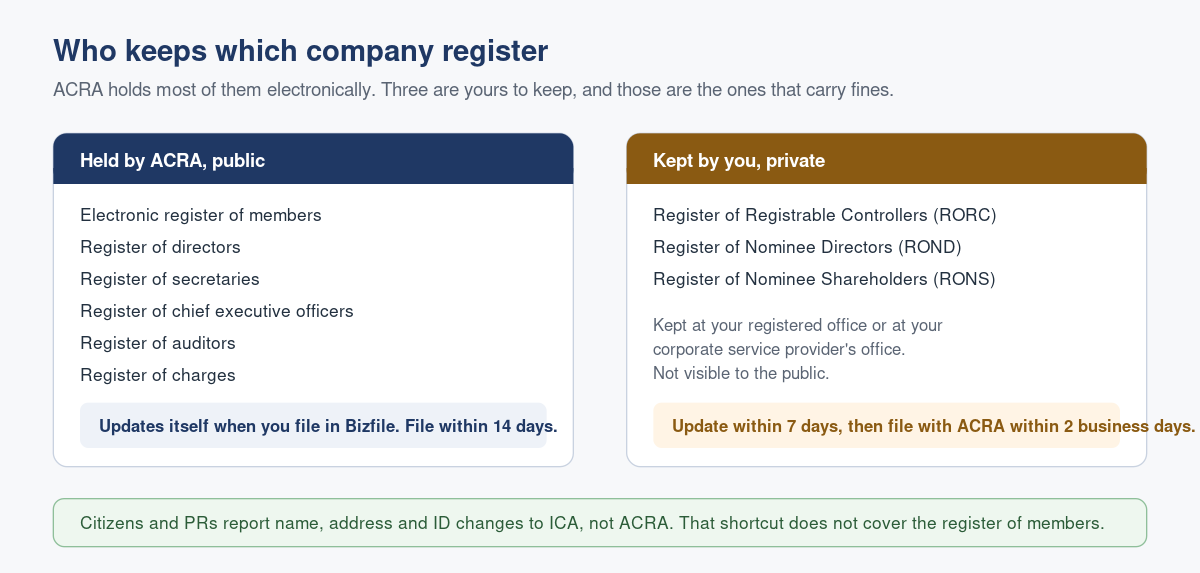
Here is the full map: what ACRA holds, what you hold, what the public can see, and the deadlines attached to each.
What is a company register?
A company register is the official record of a particular class of facts about your company: who owns it, who runs it, who has security over its assets. Under the Companies Act 1967 the Registrar maintains most of these records centrally, which means the authoritative version sits in ACRA’s system rather than in your office.
Section 196A of the Companies Act 1967 requires the Registrar to keep an electronic register of members for every private company. Section 173 requires the Registrar to keep registers of each company’s directors, chief executive officers, secretaries and auditors. Those are not copies of your records. They are the record.
The practical consequence catches people out during share transfers and financing. A share transfer form in your file does not move legal title on its own. The entry in the Registrar’s electronic register of members is what the world, and a court, will look at.
The registers ACRA keeps for you
These update automatically when the corresponding filing goes through Bizfile. You do not maintain a separate book, and you do not send ACRA a copy of anything.
| Register | Maintained by | How it gets updated | Public? |
|---|---|---|---|
| Electronic register of members (local companies) | ACRA | Filing a share transfer, allotment or change of member particulars | Yes |
| Public register of members (foreign companies) | ACRA | Filing the foreign company’s register updates | Yes |
| Register of directors | ACRA | Filing a change of position holder | Yes |
| Register of secretaries | ACRA | Filing a change of position holder | Yes |
| Register of chief executive officers, if one is appointed | ACRA | Filing a change of position holder | Yes |
| Register of auditors, if one is appointed | ACRA | Filing a change of position holder | Yes |
| Register of charges | ACRA | Lodging the instrument of charge | Yes |
The 14-day rule
Changes to the electronic registers must be filed within 14 days of the change. Miss it and you are exposed to late lodgement penalties, which are charged per late transaction rather than per company. A company that lets four changes drift for a year pays four times.
The detail of that deadline is set out in our note on the 14-day rule for filing company changes. The 14 days runs from the date of the change, not from the date somebody remembered. If your directors resolved to appoint a new director on 3 March 2026, the clock started on 3 March 2026 even if the signed resolution only reached your corporate secretary in April.
The exception nobody knows about
Singapore citizens and permanent residents do not need to tell ACRA when their name, residential address or identity card details change. Those flow through from ICA. You report the change to ICA and the electronic registers of directors, secretaries, chief executive officers and auditors follow.
The important carve-out: this does not apply to the register of members. A shareholder’s address change still has to be filed. That is the one people miss, because they assume the ICA link covers everything.
The registers you must keep yourself
Three registers are yours to create, hold and maintain. None of them is public, and all of them carry offences for getting it wrong.
Register of Registrable Controllers (RORC). The record of who ultimately owns or controls the company, commonly called beneficial owners. Required under Part 11A of the Companies Act 1967 unless your company falls within the Fourteenth Schedule exemptions. You keep a physical or electronic copy at your registered office address or at your corporate service provider’s office, and you separately file the same information with ACRA’s central register. We cover the why in what the Register of Registrable Controllers is and the who in who counts as a registrable controller.
Register of Nominee Directors (ROND). A director who acts on the instructions of somebody else is a nominee, and must tell the company so, along with particulars of the nominator. Section 386AL of the Companies Act 1967 gives the director 30 days to disclose.
Register of Nominee Shareholders (RONS). The same logic applied to shares held on behalf of another person. See what the register of nominee directors must record and who counts as a nominee shareholder.
For all three, the pattern is identical: update the private register within seven days of the change, then file the same change with ACRA within two business days of updating your register. Companies registered from 16 June 2025 provide the information at the point of incorporation.
Public versus private, at a glance
| Register | Who can see it |
|---|---|
| Members, directors, secretaries, CEOs, auditors, charges | Anyone, through a purchased Business Profile or register extract |
| RORC | Not the public. ACRA and law enforcement agencies |
| ROND and RONS | Not the public. ACRA and law enforcement agencies |
The public registers exist so that a counterparty can check who they are dealing with before signing. The private ones exist so that the authorities can trace ownership through layers of holding companies. Two different purposes, two different access rules.
What goes wrong in practice
The unfiled transfer. A shareholder sells 30% of the company. Price paid, transfer form signed, share certificate reissued, everyone moves on. Nobody files it. Eighteen months later the company applies for a bank facility, the bank pulls the ACRA register of members, and the shareholding does not match the shareholder agreement the bank was given. The deal stalls while the position is regularised, and late lodgement penalties are payable on top.
Assuming the corporate secretary saw it. Directors often treat a resolution as a filing. It is not. Somebody has to key the change into Bizfile. If your secretary was copied on an email thread three weeks ago and nothing has been lodged, the 14 days has gone.
Treating the RORC as a formality. Because it is private and nobody asks to see it, the RORC is the register most often left stale. It is also the one with a $25,000 offence attached for the company and every officer in default. If your shareholding changed and you updated only the register of members, you are probably in breach.
Nominee arrangements left undeclared. If your company has a nominee director or nominee shareholder, the public registers will not show it and the private registers must. Our note on nominee shareholder arrangements and beneficial ownership disclosure sets out the exposure, and the sentencing framework discussed in Public Prosecutor v Zheng Jia shows how seriously the courts now treat it.
A simple maintenance routine
- Log a date whenever anything changes: a director appointed or resigned, a share moved, a new charge created, a controller changed.
- File the electronic register change in Bizfile within 14 days.
- Update the RORC, ROND or RONS in your own records within seven days of the controller or nominee confirming the change.
- File the private register change with ACRA within two business days of updating your own copy.
- Once a quarter, download your free register copies from Bizfile and compare them against your internal records. If you have not done this before, start with our guide to what Bizfile actually is and to assigning Corppass e-service roles safely.
Step five takes about ten minutes a quarter and catches almost everything.
Frequently asked questions
Do I still need to keep a physical register of members at my registered office?
No, not for a Singapore private company. The Registrar’s electronic register of members is the legal register under section 196A of the Companies Act 1967. You may keep internal records for your own convenience, but they carry no legal weight if they differ from ACRA’s.
How quickly must I file a change of director with ACRA?
Within 14 days of the change taking effect. Late filing attracts a late lodgement penalty, charged per transaction. The deadline runs from the effective date of the appointment or resignation, not from the date the paperwork reaches your corporate secretary.
Can the public see my Register of Registrable Controllers?
No. The RORC is private. Only ACRA and law enforcement agencies can access the information you file with the central register, and you are prohibited from making your own register available to the public. The same applies to the registers of nominee directors and nominee shareholders.
My residential address changed and I am a Singapore citizen. Do I file anything?
Report it to ICA and the electronic registers of directors, secretaries, chief executive officers and auditors will update. If you are also a shareholder, your address in the register of members is not covered by that arrangement and must be filed separately.
What happens if my internal records and ACRA’s registers disagree?
ACRA’s version governs for the registers the Registrar maintains. Close the gap by filing whatever was never lodged, expect a late lodgement penalty, and document the chronology. Our note on restoring statutory registers after a court restoration covers the severe end of this problem.
Does a dormant company still have to maintain registers?
Yes. Dormancy suspends nothing. A dormant company keeps its RORC, files changes to its electronic registers, and complies with the same deadlines as a trading company.
The part that is easy to hand over
Registers are not difficult. They are simply easy to forget, because nothing visibly breaks on day fifteen. The bill arrives later, usually at the least convenient moment: a financing round, a buyer’s due diligence, or an ACRA review.
Raffles Corporate Services maintains statutory registers for several hundred Singapore companies, files inside the 14-day window, and reconciles ACRA’s records against your own before every year end. If you are not certain your registers currently match what ACRA holds, that is usually a short conversation and a quick fix.
You can reach us through Raffles Corporate Services, or read more on Singapore corporate secretarial practice at Singapore Secretary Services.
— The Editorial Team, Raffles Corporate Services
Need help with corporate secretarial or compliance matters?
If you would like help with your company's corporate secretarial, governance or compliance requirements, email [email protected] or WhatsApp +65 8501 7133.
Our team can assist with corporate secretarial, accounting and tax matters. Where legal advice is needed, advisers from our associated law firms can assist.