
Most Singapore companies get their register of registrable controllers wrong not because they misread the definition, but because the ownership sits behind something: a nominee, a trust, a two-tier holding structure, or an informal understanding between shareholders. The definition is short. Applying it is where the work is.
This article is the worked-examples companion to our piece on who is a registrable controller, which sets out the definition itself: significant interest (broadly, more than 25 per cent of shares or voting power) or significant control. Read that one for the rule. Read this one if you have the rule and the structure will not sit still.
Everything below runs off Part 11A of the Companies Act 1967, the Sixteenth Schedule to that Act, and section 7, which supplies the meaning of “interest” in shares.
The two questions, in order
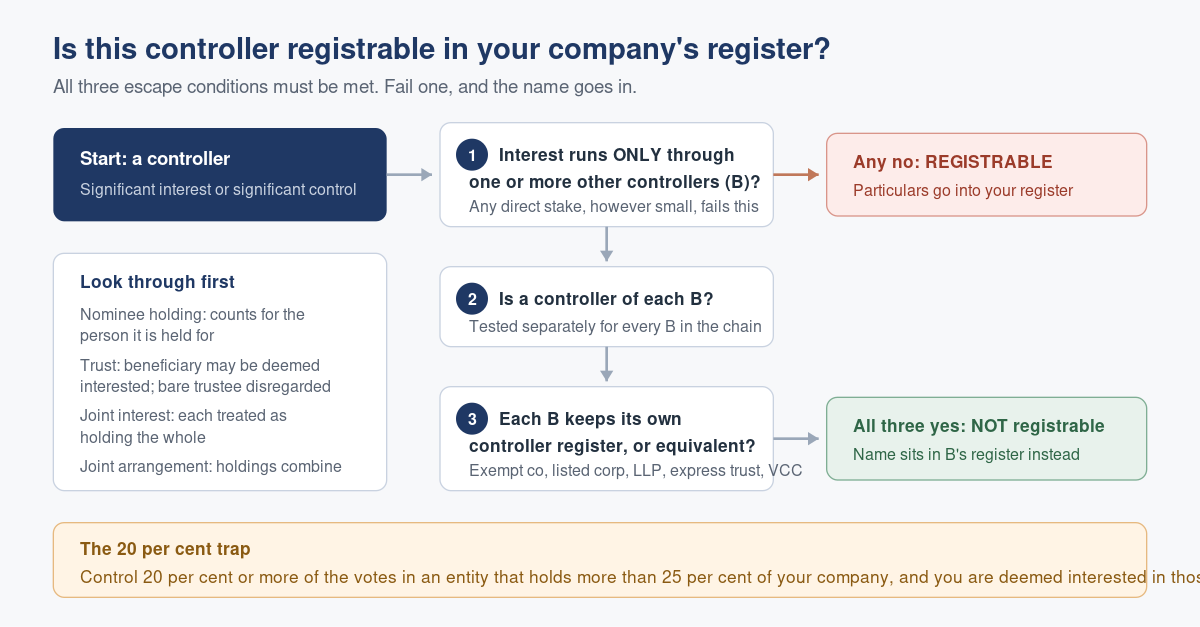
Two separate questions get conflated constantly. Is this person a controller? That is the significant interest or significant control test. Is this controller registrable in your register? A controller is registrable by default, and the only escape is narrow: the person’s interest in or control over your company runs solely through one or more other controllers, they are a controller of each of those, and each of those is itself a body that keeps a controller register (or one of a short list of equivalents, including a company exempted under the Fourteenth Schedule, a corporation listed on an approved exchange, an LLP keeping its own controller register, a trustee of an express trust to which Part 7 of the Trustees Act 1967 applies, or a variable capital company).
All three limbs must be satisfied. Fail any one and the controller goes into your register.
Chains of holding companies
The clean chain
Ms Tan owns 100 per cent of Alpha Pte Ltd. Alpha holds 50 per cent of the shares in Beta Pte Ltd. Beta keeps a register of registrable controllers.
Ms Tan is a controller of Beta, because her interest runs through Alpha. But her interest runs only through Alpha, she is a controller of Alpha, and Alpha keeps its own register. So Ms Tan is not registrable in Beta’s register. She goes into Alpha’s register instead, and Alpha goes into Beta’s. This is the whole point of the registrable filter: it stops the same individual being reported at every rung of the ladder.
The chain that leaks
Same facts, except Ms Tan also holds 5 per cent of Beta in her own name.
Now her interest in Beta does not run only through Alpha. Limb one of the escape fails, so Ms Tan is registrable in Beta’s register and in Alpha’s. That 5 per cent is not itself a significant interest, and that is exactly why people miss it: the small direct stake does not make her a controller, it destroys her exemption from being a registrable one.
Indirect rights and the majority stake test
For rights rather than shares (the right to appoint or remove a majority-voting board, the right to vote on members’ matters, or a right to capital or profits in a company without share capital), the Act asks whether the person holds the right indirectly through a chain of entities in which each holds a majority stake in the one below: a majority of voting rights, or membership plus the right to appoint or remove a majority of the board, or membership plus sole control of a majority of the votes, or significant influence or control over that entity.
The practical consequence: a person three companies up a chain, holding no shares in your company at all, can still be a controller of it.
Nominee arrangements
A share or right held as nominee for another is treated as held by that other person.
Mr Lim holds 30 per cent of Gamma Pte Ltd as nominee for Ms Chua. Ms Chua is the controller of Gamma. Mr Lim is not, at least not on that basis. Ms Chua’s particulars go into Gamma’s register even though her name appears nowhere in the register of members.
Two traps. The register of members will not help you: it shows Mr Lim, and only the nominee arrangement tells you about Ms Chua. That arrangement usually lives in a declaration of trust in someone’s drawer. And nominee status triggers separate registers: a register of nominee shareholders where Mr Lim is one, and a register of nominee directors where a director acts on someone’s instructions. Our note on nominee shareholder arrangements and beneficial ownership disclosure covers the commercial risk side.
Trusts
Trusts are where register work quietly falls apart, because the shares are held by one person and the economic benefit belongs to others.
Where property held in trust includes shares, and a person knows or has reasonable grounds for believing they have an interest under the trust, that person is deemed to have an interest in those shares. In ordinary language: the beneficiaries. So a trust holding 40 per cent of your company can push one or more beneficiaries into your register, depending on the trust’s terms and what they know or ought to know. The trustee’s own position depends on the kind of trustee: an interest held purely as bare trustee is disregarded, while a trustee of an express trust to which Part 7 of the Trustees Act 1967 applies is one of the entities that can break the chain for the registrable test.
If your shareholder register shows a trustee company, a family trust or a foundation, do not guess. Get the deed, identify who has an interest under it, and document the reasoning. That reasoning is itself a supporting document the Registrar can ask to see. For the structuring side, start with our Singapore trust structures FAQ.
Joint holdings and joint arrangements
These two sound alike and are not.
Joint interest. If two or more people jointly have an interest in a share, or jointly hold a right, each is treated as having that whole interest or right. Two individuals jointly interested in 50 per cent of a company are each treated as having 50 per cent. Both are controllers. Both go in the register separately.
Joint arrangement. This is an arrangement between people holding shares or rights that they will exercise all or substantially all of those rights jointly, in a way the arrangement predetermines. An arrangement includes a scheme, agreement or understanding whether or not legally enforceable, and any convention, custom or practice. It needs some stability: a one-off understanding does not count. Where there is one, each party is treated as holding the combined shares or rights of all of them. So a shareholder with 10 per cent of the votes and one with 20 per cent who have agreed to always vote together are each treated as holding 30 per cent. Both are controllers. Neither would have been alone.
This is the most commonly missed limb, because nobody thinks of a long-standing family voting habit as an “arrangement”. The Act does.
The 20 per cent deeming rule
Here is the one that catches sophisticated structures. Where a legal entity has an interest in a share, and a person (together with their associates, if any) is entitled to exercise or control the exercise of not less than 20 per cent of the voting power in that entity, the person is deemed to have an interest in that share.
So: Delta Pte Ltd has an interest in more than 25 per cent of the shares in Epsilon Pte Ltd. Mr Rao controls 20 per cent of the voting power in Delta. Mr Rao is deemed to have an interest in more than 25 per cent of Epsilon’s shares, and is therefore a controller of Epsilon.
Note the thresholds. The controller test uses “more than 25 per cent”. The deeming rule uses “not less than 20 per cent”. A 20 per cent shareholder in an intermediate company is inside the net even though a 20 per cent shareholder in your own company would not be.
When you genuinely cannot identify anyone
If a company knows or has reasonable grounds to believe that it has no registrable controller, or has one but cannot identify them after taking the reasonable steps the Act requires, the law supplies a fallback: each director with executive control and each chief executive officer is taken to be a registrable controller, with a note in the register explaining why. A director with executive control is one who exercises executive control over the daily or regular affairs of the company through a senior management position: someone who can commit it to significant contracts, hire key people, take on significant borrowings or manage key assets.
This is a fallback, not a shortcut. When you later identify a real controller, you must enter a note recording that the directors with executive control and CEOs are no longer taken to be controllers, and the date the real controller’s particulars went in.
Edge cases at a glance
| Situation | Who goes in the register |
|---|---|
| Individual wholly owns a holding company, which owns 50% of your company | The holding company. The individual goes in the holding company’s register |
| Same, plus the individual holds 5% of your company directly | Both the holding company and the individual |
| Shares held by a nominee for someone else | The person for whom they are held, not the nominee |
| Shares held by a bare trustee | The interest as bare trustee is disregarded |
| Shares held on an express trust under Part 7 of the Trustees Act 1967 | The trustee can break the chain for the registrable test; beneficiaries may be deemed interested |
| Two people jointly interested in 50% | Both, each treated as having 50% |
| 10% and 20% holders with a standing agreement to vote together | Both, each treated as having 30% |
| Person controlling 20% of the votes in an entity that holds more than 25% of you | That person, by deeming |
| A lender, supplier, customer, auditor or professional adviser acting as such | Nobody, unless the facts show real influence or control beyond the role |
| No controller identifiable after reasonable steps | Each director with executive control and each CEO, with an explanatory note |
What goes wrong in practice
The chain is assumed rather than traced. “The offshore company owns it” is not an answer. Somebody owns that company. If it does not keep a controller register under Singapore law or fall within one of the listed equivalents, the chain does not break.
The 5 per cent stake nobody mentions. Small direct holdings by people who also sit above a holding company are routinely omitted, and they are precisely what makes the person registrable.
Reliance on the register of members. That register shows legal title. The controller register is about interest and control. Different questions, different answers, whenever a nominee, trust or voting arrangement is in play.
No paper trail. ACRA and public agencies can require the register plus supporting documents: identity documents, the replies controllers gave, and the correspondence behind each entry. Correct names with no evidence behind them is a weak position in an inspection.
Frequently asked questions
Does a beneficiary of a family trust go into the register?
Possibly. Where trust property includes shares and a person knows, or has reasonable grounds for believing, that they have an interest under the trust, they are deemed to have an interest in those shares. Whether that crosses the threshold depends on the size of the trust’s holding and the terms of the trust. Read the deed.
Two shareholders each hold 20 per cent and always vote the same way. Are they controllers?
If there is an arrangement between them, with some degree of stability, that they will exercise their rights jointly in a predetermined way, then yes. Each is treated as holding the combined 40 per cent. An informal but settled understanding is enough. A one-off agreement is not.
Our nominee director is also our only shareholder’s appointee. Which register does he go in?
Potentially more than one. The controller register, the register of nominee directors and the register of nominee shareholders are separate registers with separate definitions. Test each independently. Being in one does not put him in the others, and being in none is also a possible answer.
Can we just put the directors in if the structure is complicated?
No. The fallback to directors with executive control and CEOs is available only where the company knows or reasonably believes it has no registrable controller, or has taken the reasonable steps required by the Act and still cannot identify one. Using it to avoid the analysis is a compliance failure, not a solution.
Who can see this register?
Not the public, and not the company’s auditors. It must be produced on request to the Registrar, ACRA officers and public agencies such as the Police, the Commercial Affairs Department, the Corrupt Practices Investigation Bureau and IRAS.
Getting the analysis right once
The value in a controller register is not the document. It is the reasoning behind it, written down, so that when someone asks in three years’ time why a particular name is or is not there, the answer exists.
Raffles Corporate Services works through these structures for Singapore companies with holding chains, trusts and nominee arrangements, documents the analysis, maintains the register and files to ACRA’s central register inside the deadline. If you are not sure whether your own chain breaks, that is a short conversation.
Related reading: our Companies Act 1967 deep-dive FAQ, our guide to what Bizfile actually is, and the Corporate Service Providers Act 2024 compliance FAQ. ACRA’s landing page for the register of registrable controllers sets out the administrative requirements, and the Companies Act 1967 is on Singapore Statutes Online.
— The Editorial Team, Raffles Corporate Services