
Ceasing a nominator means recording the date a nominee arrangement ended. The filing is free, immediate, and needs one piece of information: the cessation date. What most companies get wrong is not the form. It is assuming that removing the director also removes the nomination, and that ceasing the nomination wipes the record clean. Neither is true.
A nomination can end in several ways. The nominee resigns as a director. The nominee shareholder transfers the shares. Or the nominator and nominee simply agree the arrangement is over while the nominee stays in place in their own right. Each of those is a cessation, and each needs to reach ACRA.
This guide is about the end of a nomination: when it happens, what you file, and what remains visible afterwards.
What ends when a nomination ends
Draw a line between two separate things.
The appointment is the office the person holds. A directorship, or a shareholding. That is recorded in your register of directors or register of members, and it changes through the usual Bizfile transactions.
The nomination is the relationship behind it. The fact that the person acts for someone else. That is recorded in the ROND or RONS, and it changes through the Update Registers of Nominee Directors and Nominee Shareholders eService.
The two can end together or separately. A director can cease to be a nominee while remaining a director, if the arrangement with the nominator ends but the directorship continues. A nominee director can also resign entirely, in which case both records need attention. That distinction drives the whole filing.
Two filings, not one
When a nominee director or nominee shareholder ceases their position altogether, the position change and the nomination change are separate transactions:
- Cease the appointment through the Appoint or withdraw position holder eService. This deals with the directorship.
- File the date the nomination ceased through the Update Registers of Nominee Directors and Nominee Shareholders eService. This deals with the ROND or RONS.
ROND and RONS information is held separately from the rest of your entity’s information at ACRA. Filing one does not trigger the other. A company that resigns a nominee director cleanly through the position holder eService and stops there has left a live nominee arrangement on the central register for a person who is no longer a director.
Our note on editing an existing nominator covers the same parallel-filing problem for changes of particulars, and what Bizfile actually is and what you can and cannot do in it maps which eService does what.
The cessation date rule
You need one piece of data: the date the nomination ended.
It must be today’s date or a date in the past. Future dates are not accepted. If you know the arrangement will end at the close of the month, you cannot file it in advance. You wait, then file.
That is a small design decision with a real consequence. It means a cessation can never be pre-lodged and forgotten, so it has to sit on somebody’s list as a task to do on or after the day. The filings that get missed in practice are almost always the ones that could not be done early.
The timing on the other side is unforgiving in the opposite direction:
| Step | Deadline |
|---|---|
| Nominee informs the company that the arrangement has ended | The nominee’s disclosure duty applies to the arrangement, and you act on being informed |
| Update your private ROND or RONS | Within 7 days of being informed |
| File the cessation with the Central ROND or RONS | Within 2 business days of updating the private register |
| Apply for an extension of time | Not available. There is no extension for ROND and RONS filings |
Late filing exposes the company to prosecution and fines of up to $25,000. There is no fee for filing on time, and processing is immediate, so there is no reason at all for the delay to be a deliberate one.
The filing, in order
You must be a position holder, a registered corporate service provider or a group secretary, logging in to Bizfile as a Business User through Corppass. If you have not set that access up, logging in to Bizfile as a business user is the place to start.
- Log in and confirm you are on the correct entity dashboard. Corporate service providers select the Corporate Service Provider profile first, and the right firm if they act for more than one.
- Open the Update Registers of Nominee Directors and Nominee Shareholders eService and start.
- State whether the entity has any active nominee directors or nominee shareholders. If the answer is now no, the eService offers you the option to cease all the nominators currently listed in one action, which is the efficient route when an entire set of arrangements has ended together.
- Otherwise, under the Nominee Directors or Nominee Shareholders section, click the name of the nominee whose nomination has ended, to expand the entry.
- Enter the date of cessation and save. Today or earlier only.
- Check that the entry carries the “to be ceased” marker before you go further. If it shows anything else, you have not recorded a cessation.
- Review, tick the declaration and submit. Confirmation arrives in your Bizfile Inbox.
What remains on record afterwards
This is the question nominators ask, and the answer is worth being precise about.
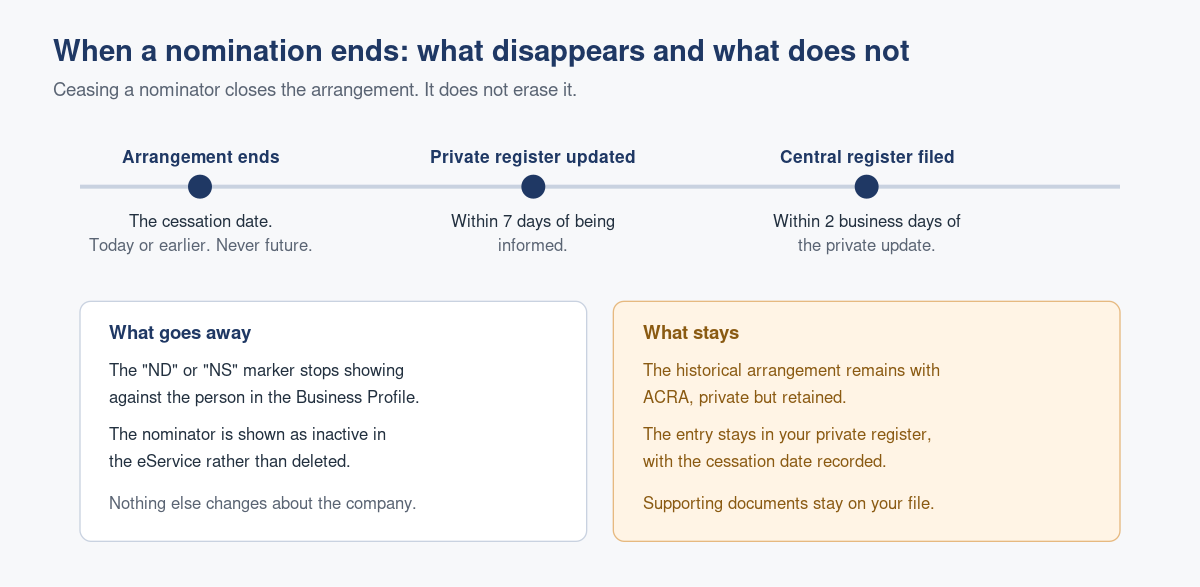
What stops being visible. Nominee status appears publicly as “ND” or “NS” against a person’s name in the company’s Business Profile. Once a nominee arrangement has ceased, that marker no longer appears. The same is true if the director’s appointment has ended, if the shareholder is no longer a member, if the company is exempt, or if the company has no nominee director or shareholder at all.
What does not go away. Inside the eService, a nominator whose nomination has ended shows as inactive rather than vanishing. The record is closed, not deleted. Historical nominee arrangements are expressly among the information ACRA keeps private rather than publishes, which tells you plainly that ACRA retains them. The central registers exist to help law enforcement agencies investigate financial crime, and a register that forgot everything as soon as an arrangement ended would not serve that purpose.
What stays on your own file. The entry remains in your private ROND or RONS with its cessation date recorded. The supporting documents stay with the private register. You never file those with ACRA, but the Registrar, an ACRA officer or a public agency can require the company to produce the register and related documents, and a ceased arrangement is exactly the kind of thing they may ask about.
The practical takeaway: ceasing a nominator is a closing entry, not an eraser. Anyone planning a nominee arrangement on the basis that it can be unwound without trace has misunderstood what the register is for. Our piece on nominee shareholder arrangements in Singapore sets out the wider legal risk, and the sentencing framework discussed in Public Prosecutor v Zheng Jia shows what the courts now do with nominee directors who treat the role as a formality.
What goes wrong in practice
The directorship is ceased and the nomination is not. The most common failure by a wide margin. Two eServices, two filings, and the second one is easy to forget because the first one felt like completing the task.
The company waits for a clean end date. Commercial arrangements often taper off rather than stopping on a specific day. The company holds off filing while it works out when the nomination “really” ended, and the two-business-day window closes. Agree a date, document how you arrived at it, and file. A defensible date recorded on time is better than a perfect date recorded late.
Trying to file a future cessation. The system rejects it. If your process relies on lodging everything the moment the resignation letter arrives, that process will break here.
Ceasing the nominator when the nominee has changed. If the nominee resigns but the same nominator appoints a replacement nominee, that is a cessation of one nomination and the addition of another, not an edit. See our guide to adding a new nominator for the second half of that pair.
Assuming a company being struck off can stop. ROND and RONS requirements continue to apply while a company is dormant, in winding up, being struck off, in receivership or under judicial management. If the nominee arrangements end as part of that exit, they still need to be ceased on the register. The awkward version of this problem, where the nominee director cannot reach the owners at all, is covered in our note on the trapped nominee director’s exit.
Frequently asked questions
Does resigning a nominee director automatically cease the nomination?
No. They are separate filings. Cease the appointment through the Appoint or withdraw position holder eService, then file the date the nomination ended through the Update Registers of Nominee Directors and Nominee Shareholders eService. ROND and RONS data is stored separately from your other entity information, so nothing propagates between them.
Can I file a cessation date in the future?
No. The cessation date must be the current date or a past date. Future dates are not permitted. If the arrangement ends at the end of the month, you file on or after that day. Plan for it as a diarised task rather than something you can lodge in advance.
How long do I have to file a cessation?
Update your private ROND or RONS within seven days of being informed, then file with the Central ROND or RONS within two business days of that private update. No extension of time is available for ROND and RONS filings, and late filing can attract prosecution and fines of up to $25,000.
Is the ceased nominator removed from ACRA’s records?
No. The record is closed rather than deleted, and shows as inactive in the eService. Historical nominee arrangements are retained by ACRA as private information that the public cannot access. What changes publicly is that the “ND” or “NS” marker no longer appears against the person in the company’s Business Profile.
Can I cease several nominators at once?
Yes. If the entity no longer has any active nominee directors or nominee shareholders, the eService lets you cease all the listed nominators in one action. Where only some arrangements have ended, you cease each affected nominator individually within the same transaction.
Does ceasing a nominator cost anything?
No. Ceasing an existing nominator in the Central ROND or RONS is free and processes immediately, as are adding and editing. The only financial exposure comes from filing late, which carries no fee but does carry prosecution risk and a fine of up to $25,000.
Closing an arrangement properly
The end of a nominee arrangement is usually the moment when everyone’s attention has already moved on. That is precisely when it gets missed, and a live nominee arrangement sitting on a central register for a person who has not been involved for two years is a bad thing to explain to a bank, an auditor or a regulator.
Raffles Corporate Services treats a nominee cessation as a two-filing task by default, diarises the ones that cannot be lodged early, and reconciles the ROND and RONS against the register of directors and members before every year end. If you suspect an arrangement ended some time ago and was never closed on the register, tell us and we will work out where you stand.
You can reach us through Raffles Corporate Services, or read more on Singapore corporate secretarial practice at Singapore Secretary Services. ACRA’s compliance page on filing with the Central ROND and RONS sets out the requirement itself, and the Registrar’s RORC, ROND and RONS guidance covers the statutory detail.
— The Editorial Team, Raffles Corporate Services