
You have 14 days. That is the whole rule, and it applies to your business name, your business activity, your place of business, who the owners are, and the personal particulars of every owner and authorised representative on the register.
Sole proprietorships and partnerships get treated as the informal end of Singapore business registration, and in most respects they are. But the notification obligation under the Business Names Registration Act 2014 is not informal at all. It carries a late lodgement penalty and, in the right circumstances, prosecution.
The other half of the problem is knowing which changes go to ACRA at all. Some go to the Immigration and Checkpoints Authority instead, and filing those with ACRA achieves nothing except a wasted afternoon.
Who tells whom
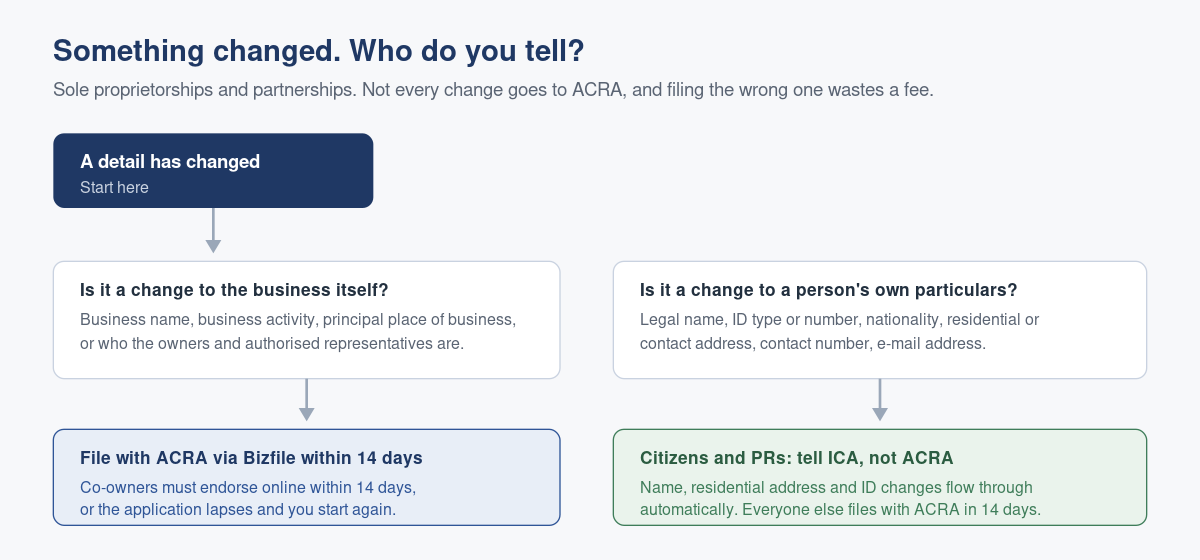
Sort every change into one of two buckets before you touch Bizfile.
Changes to the business always go to ACRA. That means the business name, the business activity, the principal place of business, and the identity of the owners, partners or authorised representatives.
Changes to a person’s own particulars mostly go to ACRA too, with one significant carve-out. If you are a Singapore citizen or permanent resident, changes to your name, residential address and identification are reported to ICA and flow through automatically. Everybody else files those with ACRA within 14 days.
Contact numbers and e-mail addresses are filed with ACRA by everyone, citizen or not. ICA does not pass those on.
What has to be filed, and by when
| What changed | Deadline | Notes |
|---|---|---|
| Business name | 14 days | Clear the new name first, then update the registered information |
| Business activity | 14 days | The registered activity is read by banks and licensing bodies |
| Principal place of business | 14 days | Section 18 of the Business Names Registration Act 2014 |
| Appointment or withdrawal of an owner, partner or authorised representative | 14 days | Needs online endorsement from the others |
| Name of an owner or representative | 14 days | Deed poll must be attached. Citizens and PRs report to ICA instead |
| Identification type or number, nationality | 14 days | Citizens and PRs report to ICA instead |
| Residential address | 14 days | Where ACRA sends official letters. Citizens and PRs report to ICA instead |
| Contact address | 14 days | What appears in public records instead of the residential address |
| Contact number, e-mail address | 14 days | Everyone files this with ACRA |
The general obligation to notify a change in registered particulars sits in section 20(1) of the Business Names Registration Act 2014. ACRA cites that provision directly when it lists failure to notify as a common offence.
Filing a change of owner or authorised representative
This is the one with moving parts, because other people have to act.
- Fix the effective date of the change. Your 14 days run from that date, not from the day you got round to it.
- Gather the incoming person’s particulars and consent to act.
- Tell the existing owners or partners that a filing is coming. They will be asked to endorse it.
- Submit the appointment or withdrawal through Bizfile.
- Follow up on the endorsements. If they are not completed online within 14 days, the transaction lapses and you have to start again.
Step five is where most of the damage is done. People submit the filing, see a confirmation screen, and assume the job is finished. It is not finished until it is endorsed. An application that quietly lapsed is indistinguishable, from the register’s point of view, from never having filed at all, and the penalty is calculated accordingly.
If Bizfile access itself is the obstacle, start with logging in to Bizfile as an individual using Singpass. Sole proprietors usually transact as individuals rather than through Corppass, which trips up people who have been told they need a corporate login. If the platform itself is unfamiliar, what Bizfile actually is and what you can do in it is the place to begin.
The address question people actually care about
A sole proprietor’s residential address is not something most people want available in a purchased business profile. The register provides a contact address for exactly this reason.
The contact address is the one ACRA displays publicly. Your residential address stays on the register but out of public products. Two constraints apply: the contact address must be in the same country as your residential address, and it cannot be a P.O. Box.
Register one. It costs nothing and it solves a genuine privacy problem. Just remember that ACRA still writes to the residential address, so allowing that one to go stale means you stop receiving official correspondence, including anything about enforcement.
What goes wrong, and what it costs
The classic failure is not ignorance of the rule. It is that a sole proprietorship has nobody whose job this is. There is no company secretary, no board, no annual return forcing an annual review. The business moves premises, the owner is busy moving premises, and eleven months later a renewal notice goes to an address nobody occupies.
ACRA’s late lodgement penalties for sole proprietorships and partnerships are:
| Length of default | Penalty |
|---|---|
| Within three months | $50 |
| More than three months | $200 |
Charged per transaction. Two partner changes filed late are two penalties.
Three further offences under the same Act are worth knowing about, because they are more serious than a lodgement penalty:
- Carrying on business without being registered, under a name other than the registered one, or under a name whose registration has been cancelled or has ceased. That is section 35(1)(a).
- Giving ACRA false or misleading information, including leaving out something that makes a submission misleading. That is section 35(1)(c).
- Managing a business as an undischarged bankrupt without written permission from the Official Assignee or leave of the High Court. That is section 34(1).
The first of those catches people who let a registration lapse and keep trading under the same signage. Registration for a sole proprietorship or partnership has to be renewed, and a cancelled registration does not simply mean paperwork is outstanding. It means the name you are trading under is no longer yours to use.
When it is time to stop being a sole proprietorship
Worth saying plainly, because this article will find people at exactly the right moment. A sole proprietorship gives you no separation between business liabilities and personal assets, and it is taxed as your personal income. A private limited company gives you both separation and access to corporate tax rates and exemptions.
If the business has grown to the point where you are filing changes regularly, hiring, or signing contracts of any size, the structure question is worth asking. The Companies Act 1967 deep-dive FAQ sets out what changes once you incorporate, and your first fifteen minutes in Bizfile is a reasonable orientation either way.
Frequently asked questions
How long do I have to tell ACRA I have moved my business?
Fourteen days from the date of the move. The principal place of business is a registered particular and the obligation to notify a change sits in the Business Names Registration Act 2014. File it through Bizfile. Late filing attracts a penalty of $50 within three months of the due date and $200 after that.
I am a Singapore citizen and I have changed my name. Do I file with ACRA?
No. Citizens and permanent residents report changes to their name, residential address and identification to ICA, and ACRA’s records are updated from there. Foreigners on the register do file those changes with ACRA within 14 days, attaching a deed poll for a name change.
My partner will not endorse the filing. What happens?
The transaction lapses if endorsement is not completed online within 14 days, and you have to submit it again. The underlying 14-day deadline is not extended by the failed attempt, so the business is accruing lateness while nothing is happening. Chase the endorsement rather than waiting.
Can I keep my home address out of public records?
Yes. Register a contact address, which ACRA displays publicly instead of your residential address. It must be in the same country as your residential address and cannot be a P.O. Box. ACRA continues to send official letters to your residential address, so that must stay current.
What if I have been trading for years under a name that lapsed?
Deal with it now rather than later. Carrying on business under a business name whose registration has been cancelled or has ceased is an offence under section 35(1)(a) of the Business Names Registration Act 2014, and it is a different order of problem from a late filing penalty. Get the registration position confirmed before you file anything else.
Keeping it boring
Registered details are one of those things that cost nothing when they are right and cost a surprising amount of time when they are wrong: a bank that will not open an account, a grant application bounced on a name mismatch, a renewal notice sent somewhere you no longer are.
Raffles Corporate Services files these changes for sole proprietors and partnerships as a matter of routine, watches the renewal dates, and checks the register against reality before it matters. If you suspect something on your registration is out of date, we can tell you in an afternoon.
Get in touch through Raffles Corporate Services, or read more on Singapore corporate secretarial practice at Singapore Secretary Services.
— The Editorial Team, Raffles Corporate Services